Chargeback.io vs Chargeflow: which one to pick

Chargeback.io vs Chargeflow starts as a tie. Chargeback.io (we) and Chargeflow resell alerts from the same two networks, Ethoca and Verifi. Neither catches disputes the other misses.
I've spent years investigating merchants' processor setups in a support role. That work taught me how differently each one handles disputes.
Five things do separate them. Price, support, dashboard, integrations, and how fast you go live.
Key takeaways
- Both vendors resell Ethoca and Verifi alerts, so coverage is identical.
- Our Visa alerts cost $15, against $29 per deflection on the rival tier.
- Our Shopify listing holds 4.9 stars across 88 reviews.
- Support drew praise in 14 of our 20 most recent reviews.
- One merchant got Ethoca live within a day.
- Alerts cut one merchant's dispute rate from 0.93% to 0.16%.
Want the prevention side priced out? Check our per-alert rates before you compare percentages.
What's the real difference between the two?
Pick us for prevention you can forecast and get help with, and pick Chargeflow to have a filed chargeback fought for you. Alerts are our whole product, so pricing, support, and setup all serve one job. Representment is Chargeflow's whole product, and its alerts tier is one of five things it sells.
Here's the sequence on our side. A customer calls their bank to dispute a charge. The bank sends a pre-dispute alert through Ethoca or Verifi's RDR and CDRN networks. We match that alert to the original sale and refund the order.
The bank never turns the case into a chargeback, so there's nothing left to fight.
Our guide to chargeback alerts covers what each network sends and when.
Chargeflow enters later, with a documented rebuttal to file against a posted chargeback. It works on disputes that chargeback prevention did not reach in time.
A merchant can run alerts for the disputes alerts reach, and keep a representment tool for the ones the bank files anyway.
How does Chargeflow work?
Chargeflow is an automated recovery platform that gathers evidence and files representment once a dispute has been submitted. A merchant connects their store and processor. Chargeflow pulls order data, tracking records, and customer messages into a response packet, then files it against the reason code the bank cited.
Representment means contesting a filed chargeback with documentation, so it can only start once the chargeback exists.
Anyone who has filed a rebuttal by hand knows the work this replaces. A packet pulls together four things:
- The order record, showing what was bought and when.
- The delivery confirmation, showing the customer received it.
- The customer's messages, showing what they asked for.
- Your refund and shipping policy, showing the terms they agreed to.
Then you format all of it to the reason code the bank cited, and you file inside a deadline. Miss the deadline or answer the wrong code, and you lose a dispute you should have won.
You pay Chargeflow's Automation tier only on a win, which cuts both ways. Its pricing page promises "no payment until you recover a chargeback," so a loss costs no fee and returns no money either.
That is worth buying for chargebacks already on your statement. It does nothing for the dispute a refund would have settled last Tuesday.
Do the two catch different disputes?
No. Both companies license Ethoca from Mastercard and Verifi's RDR and CDRN from Visa, so the same disputes alert either way. Neither vendor owns a network. Read our breakdown of Ethoca, RDR, and CDRN for what each one covers.
An alert fires on the customer's dispute, whatever their motive.
Say someone calls their bank about a charge they don't recognize, forgot, or regret. The bank issues the alert either way, the merchant refunds, and the case closes. That covers the friendly fraud disputes merchants worry most about, because an alert reads the dispute itself.
A dispute you refunded at the alert stage is a chargeback that doesn't exist. It never counts against your ratio.
In our Dropship.io case study, disputes clustered around cancellation and fraud. Renewal surprise, believed cancelled, unrecognized charge, stolen card, and first-party misuse all sit inside what friendly fraud claims cover.
They turned on RDR and CDRN, and their dispute rate fell from 0.93% to 0.16% in a quarter. That put their chargeback rate back under Stripe's threshold.
Alerts share the same limits on both sides. Wallet payments (Apple Pay, Google Pay, Stripe Link) are harder to match. Some alerts arrive with no transaction to refund, and a few banks file straight to a chargeback.
So the comparison moves to price, support, and setup.
How do the two alerts products compare?
Same networks, different billing event, and a lower Visa price on our side. We bill per alert received. Chargeflow bills per deflected chargeback, with better rates above 50 a month that it doesn't publish.
Each model has a trade. An alert that fires without stopping a chargeback still costs us a fee. It costs nothing on a deflection model. Our Visa alerts undercut that flat deflection rate, so Visa-heavy accounts pay us less.
Pull last quarter's card-brand split and buy the coverage that matches it.
Chargeback.io vs Chargeflow pricing, compared
We charge a flat rate per alert. Chargeflow runs five tiers, from free analytics up to a 25% cut of each recovery. Both publish their rates, so you can compare without a sales call:
The Visa rows in the table above carry the headline. A prevented Visa chargeback costs roughly half as much with us, while Ethoca matches on both rate cards.
The models also bill on different events. We bill per alert received, Chargeflow bills per deflection, and its recovery tier bills a share of what comes back. That last one tracks your order value:
The alert price holds flat while the recovery cut climbs with the order. High-ticket sellers feel that every month. Per-alert billing is also easier to forecast. Last quarter's alert count is close to next quarter's bill.
See what alerts cost per network, then weigh that against the dispute fees on your statement.
Which one has better support?
Merchants name our support team in review after review. Alert setup lives or dies on one field being exactly right. Our Shopify listing holds 4.9 stars across 88 reviews, with 94% at five stars. The Chargeflow listing holds 4.8 stars across 363 reviews.
Support is the theme reviewers keep returning to for us. Across our 20 most recent reviews, 14 single out the support team. Several name their rep. They credit replies in minutes and hands-on help through enrollment.
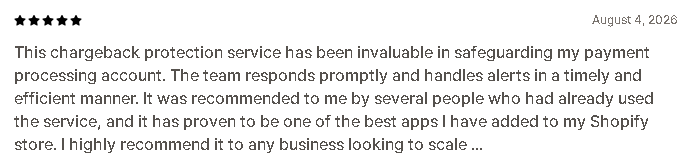
One had a problem fixed within two minutes.
That praise is not a soft benefit. The top reason alerts don't fire is a billing descriptor that doesn't match the enrolled one. Descriptors came up in more than 600 support conversations in my year on the queue.
Nobody solves that by reading documentation. Somebody has to look at your account with you.
Timing is the other frequent cause. RDR activation takes two to seven business days. A dispute filed before activation can never alert. Merchants judge us during the one window we cannot cover, so explaining the lag saves the account.
We answer over live chat and take video calls to move a stalled enrollment. Chargeflow's reviewers praise its reps too, and it reserves a dedicated success manager for Enterprise.
What about the dashboard, integrations, and setup speed?
Our dashboard tracks one job, alerts and the refunds they trigger. Chargeflow's spans analytics, screening, and dispute cases. A narrower tool is faster to read when you only need to know whether an alert arrived.
Three practical differences separate the two beyond price:
Chargeflow lists the longer catalog, which follows from selling more products. For prevention, the integration that counts is the one holding the transaction an alert has to match. The processors above cover most Shopify and subscription stacks.
Enrollment speed is where the gap gets concrete. Alerts only protect you once the network has your descriptor, so every setup day is a day of exposure. One Shopify merchant got Ethoca live within a day, crediting a step-by-step onboarding flow.
Tim's Coffee faced a Stripe shutdown warning and turned on Ethoca and CDRN in under 12 hours. Auto-refund fired under $300, and chargebacks fell 89% in three months.
That threshold closed those disputes before anyone built an evidence packet.
Slack alerts also change the response window. Alerts expire in 24 hours, and an expired one usually becomes the chargeback it warned you about. A notification landing where your team already works beats one waiting in an inbox.
Is Chargeflow free?
Chargeflow's Insights analytics tier is free forever, and every tier that acts on a dispute charges a fee.
The free tier reads the dispute data you already have and reports on it. Acting on a dispute starts at a paid tier. Screening a sale, filing a packet, or deflecting an alert each carries a per-unit charge.
Our own model has no free tier and no monthly minimum either. You pay per alert, and nothing when no disputes come in.
Which one should you use?
Choose us to stop disputes before they file, add Chargeflow to fight the ones already filed, and start with prevention if you can only run one. Your own dispute data settles it. Read that before either vendor's positioning.
Pull last quarter's disputes from your processor and sort each one into a pile:
The bigger pile tells you which tool you need, and if both are big, you need both.
For most merchants the first pile is the bigger one, and the cheaper one to clear. A prevented dispute costs one alert fee and keeps your ratio clean. A recovered chargeback costs a quarter of the money plus the dispute fee you already paid. It also counted against your rate the whole time it was open.
Two accounts should skip prevention. If your dispute volume is near zero, a representment tool on a win-only fee is the cheaper insurance. If your alert coverage is already strong through another provider, Chargeflow's Automation tier is the piece worth adding.
Running both means routing them, not just buying them. Send alerts to us for auto-refund, and send only the chargebacks that file anyway to Chargeflow's Automation tier.
Our roundup of more Chargeflow alternatives covers the other vendors in each category.
The same prevention-versus-remediation split drives our Chargebacks911 comparison.
FAQ
Who is the CEO of Chargeflow?
Ariel Chen is Chargeflow's chief executive officer. He co-founded the company with his brother Avia Chen, who runs marketing.
Can I use both tools at the same time?
Yes, and the two rarely collide, because an alert resolves a dispute before a chargeback exists to file against. Check the order for an existing chargeback before you refund by hand, since your representment tool may already be answering it.
Does Chargeback.io offer representment?
No. Chargeback.io handles pre-dispute alerts and auto-refunds only.
What if Chargeflow loses a dispute?
You pay no recovery fee on a lost dispute under the Automation tier. The chargeback stands, so the disputed amount and your processor's chargeback fee stay with you.