What is Ethoca Alerts & How Does It Work?


Ethoca is a Mastercard-owned company whose chargeback alerts warn merchants in real time when a cardholder disputes a charge with their bank. The merchant can then refund the transaction before it becomes a formal chargeback.
I've disputed chargebacks and fixed billing descriptors on my own stores, and the same pattern holds everywhere I look. An alert only helps if you already know which network covers your cards.
Learn what Ethoca is, what it costs, and where its coverage stops. Then you can size it up in a few minutes.
Key takeaways
- Ethoca alerts warn you of a Mastercard dispute before it becomes a chargeback.
- Pay $29 for each alert through Chargeback.io, billed only when one fires.
- Ethoca is Mastercard-first, so full Visa coverage still needs RDR or CDRN.
- One Shopify retailer cut its chargebacks 89% after enabling Ethoca plus CDRN.
- Fix a generic billing descriptor first, since it blocks most alert matches.
What is Ethoca?
Ethoca is a Mastercard-owned company. It sends merchants a real-time alert when a cardholder disputes a charge with their bank. The alert reaches you before that dispute becomes a formal chargeback.
That gives you a window to refund the charge and resolve it directly, while you still control the outcome.
Ethoca runs two related products.
Ethoca Alerts is the merchant-facing service that flags disputes and fraud in real time.
Ethoca Consumer Clarity works one step earlier. It shows clear purchase details in the cardholder's banking app. A confused customer then recognizes the charge instead of disputing it. Both products aim to clear up confusion before it becomes a dispute.
That network is large. Ethoca's alert service is powered by 5,100+ card issuers, and its Consumer Clarity purchase details reach cardholders in 210+ countries.
Ethoca is strongest on Mastercard, covering about 95% of Mastercard transactions. It also carries some Visa disputes and limited Amex, Discover, and JCB coverage. Those three run through a single reason code only. That partial reach is why Ethoca alone still leaves most Visa disputes uncovered.
How Ethoca alerts work
An Ethoca alert fires when a cardholder contacts their bank about a charge. Ethoca then relays that dispute to the merchant within hours. A formal chargeback takes days or weeks. The alert reaches you while you can still act.
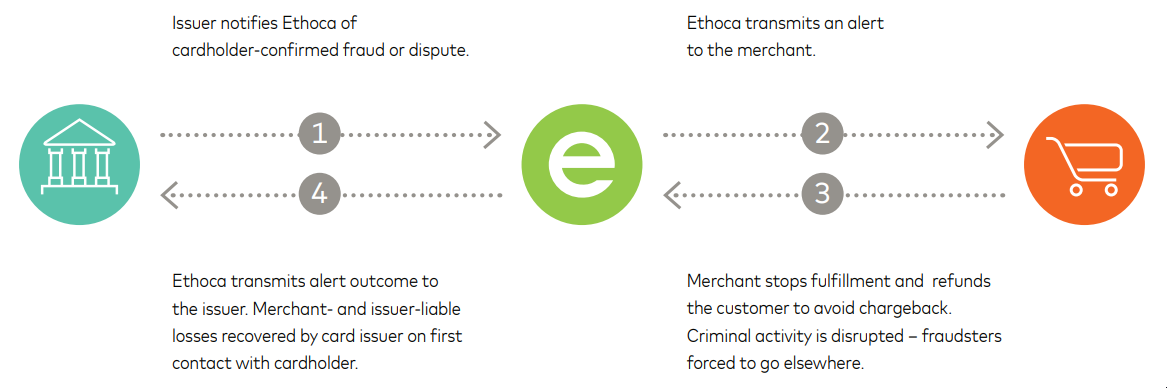
Once the alert lands, you or your alert provider match it against the original sale in your payment processor. You match on the amount, date, and card details. A refund then goes to the cardholder and resolves the dispute before the card network opens a case.
At Chargeback.io, we automate that match and refund, so it runs without manual review on every alert.
Speed is the reason to automate it. Each alert carries a response window. A fast, matched refund turns the warning into a prevented chargeback instead of a missed one.
Tim's Coffee, a Shopify retailer on Stripe, shows the setup in practice. It enrolled in Ethoca plus CDRN and set a threshold rule, per Tim's Coffee's case study. Disputes under $300 auto-refund, and anything over $300 goes to manual review under that same case study.
Most alerts resolved in the setup's first hours.
The match can still fail. A tokenized wallet like Apple Pay or Google Pay hides the original card details. Ethoca may then lack enough to tie the alert back to the sale.
Summary: An Ethoca alert reaches the merchant within hours, and a matched refund closes the dispute before it becomes a chargeback.
How much do Ethoca alerts cost?
Through Chargeback.io, an Ethoca alert costs $29 per alert, billed only when an alert fires, with no monthly minimum or contract. You pay for the alerts you receive.
Because the price is per alert, cost tracks your dispute volume. A quiet month costs less. A merchant with few disputes pays little. Compare that per-alert price against what the chargeback would cost if it slipped through.
That cost is usually the larger one. On Stripe, a dispute carries a chargeback fee of $15 when it arrives, plus another $15 to counter it. The countered fee comes back only if you win. Add staff time and the lost product on top. The alert price above replaces a chargeback that would have cost far more.
Low-volume merchants are the one case where the math can flip. If you rarely see a Mastercard dispute, you may pay for more alerts than the chargebacks they prevent.
Model both sides before you enroll, or run your own numbers with our ROI calculator.
Ethoca vs. Verifi (do you need both?)
Ethoca handles your Mastercard disputes and Verifi handles your Visa disputes, so the two cover different card networks rather than competing. They are two separate companies. Ethoca is owned by Mastercard. Verifi is owned by Visa and works through two products.
Verifi RDR resolves disputes automatically with rules you set. CDRN routes the dispute back to you by hand. Both are on the Visa side.
Your real coverage depends on your card-brand mix. The split works out like this:
- Mastercard-heavy merchants: get most of their protection from Ethoca alone.
- Visa-heavy merchants: need Verifi's RDR and CDRN to cover the bulk of disputes.
- Mixed card mix: most merchants here enroll in both.
Tim's Coffee, above, took the mixed path for this reason. It ran both Mastercard and Visa disputes, so Ethoca plus CDRN covered both sides. The same case study reports an 89% chargeback drop in three months.
Coverage runs thin outside the two big networks. American Express, JCB in the US, and Discover get low coverage from either company, and other payment methods get none. A heavy AmEx or Discover mix sees less protection than the Visa and Mastercard numbers suggest.
For a side-by-side look at the two networks, see our Ethoca vs Verifi guide.
To rank all three products against each other, read RDR vs CDRN vs Ethoca.
Summary: Ethoca covers Mastercard and Verifi covers Visa, so your card-brand mix decides whether you need one network or both.
What Ethoca alerts can't catch
An Ethoca alert fires mainly on Mastercard disputes, and only when the charge matches back to the original sale. Its coverage on Visa and other brands is partial, and enrolling doesn't drop your chargebacks to zero. It helps to know where it falls short.
A few gaps sit outside your control. One is an issuing bank that files straight to the card network without sending a pre-dispute signal first. Those stay a small share, and no alert can catch what it never sees.
The gap you can actually fix is a billing descriptor the cardholder doesn't recognize. A vague statement line pushes the customer to dispute in a way that skips the alert or lands too late. Fixing the descriptor is the first thing to change, before you even look at alerts.
I saw this directly in a support role. A merchant wasn't receiving Ethoca alerts at all, though the setup looked fine. The problem was the descriptor. They changed it to something unique enough to identify them, and the alerts started coming through.
A charge nobody recognizes is a chargeback waiting to happen, and the alert can miss the match.
How to sign up for Ethoca alerts
Ethoca sells through partners, so most merchants enroll through one rather than contract with Ethoca directly. A direct contract means building the matching and refund steps yourself. That suits a large enterprise more than a typical store.
Chargeback.io is an official partner of Ethoca, so enrollment runs through us, and we handle the matching and refunds.
Setup asks for your exact billing descriptor, matched to the statement text character for character. Ethoca covers Mastercard the moment that's in place. American Express runs on a separate Ethoca enrollment you request.
If you're moving from another provider, it has to release your descriptor first.
Do you need Verifi too?
Add Verifi once Visa passes a small share of your transactions, since Ethoca will leave those disputes uncaught. Most merchants end up running both, because few sell to a single card brand.
So the decision comes down to one number, your Visa share. Pull it from your processor, and if it's more than a sliver, enroll in Verifi alongside Ethoca.
Our chargeback prevention guide shows how to weigh that against your dispute volume and cost.
How we sourced our data
The $29 Ethoca alert price and Tim's Coffee's 89% chargeback reduction both come from Chargeback.io's own records. They are our public pricing and a named customer's results, read as our own numbers.
The price is our own platform's listed rate, current as of publication. The case-study figure is a single named merchant's outcome across the alerts our platform processed for that account.
FAQ
Is Ethoca the same company as Mastercard?
Ethoca is owned by Mastercard and brands itself as "Ethoca by Mastercard," but it runs as its own alert service. Mastercard is the card network, and Ethoca is the dispute-alert company it owns.
Can a merchant sign up for Ethoca alerts directly?
Most merchants reach Ethoca alerts through a provider that handles the matching and refunds. Direct contracts with Ethoca are rare, so a provider is the usual route.
Does Ethoca cover American Express or Discover transactions?
Only lightly, since Ethoca is Mastercard-first and its Amex and Discover coverage runs through one reason code. For real AmEx protection, add provider Amex fraud alerts plus Amex's own free ADR program.
What happens if I ignore an Ethoca alert?
Miss the alert's response window and the dispute proceeds, usually becoming the chargeback it warned you about. The alert only prevents a chargeback when you refund or resolve the charge in time.