What Is CDRN? Cardholder Dispute Resolution Network


CDRN, the Cardholder Dispute Resolution Network, is what Verifi calls its pre-chargeback alert service. It's a Visa solution that gives a merchant 72 hours to refund a disputed transaction manually before it becomes a formal chargeback.
I've fought chargebacks and built evidence for my own stores, and later advised merchants on the same thing in a chargeback tooling company's queue. People lump CDRN in with "the alert networks" as if it swaps in for RDR, but the two solve the same problem in opposite ways.
Key takeaways
What is CDRN?
CDRN, the Cardholder Dispute Resolution Network, is Verifi's pre-chargeback alert product that gives a merchant 72 hours to refund a disputed charge by hand. The refund resolves the dispute before it becomes a formal chargeback.
Verifi is a Visa solution, so CDRN sits on Visa's side.
The product runs on what Verifi calls delayed decisioning. The alert routes the dispute to you, and you review it and decide whether to refund. That's the split from Verifi's other product, RDR, which acts automatically instead.
The network covers Visa and non-Visa transaction disputes routed through Verifi, but it isn't a Mastercard product. A merchant taking Mastercard disputes needs Ethoca instead.
Our chargeback alerts explainer maps how these companies and networks fit together.
How do CDRN alerts work?
When a cardholder disputes a Visa or non-Visa charge, Verifi sends you a CDRN alert. You then have 72 hours to refund and resolve the dispute before it converts. The clock starts the moment the alert lands, even if you open it hours later.
For that refund to resolve the right charge, the alert has to match your transaction records. It matches on three fields:
- The billing descriptor.
- The amount.
- The card BIN.
When you enroll, you give Verifi the exact billing descriptor its system compares against. If that descriptor doesn't match what customers saw, the alert can't find your transaction, so you can't act on it.
A resolved CDRN case never becomes a chargeback, so it doesn't count against your Visa chargeback ratio. Miss the 72-hour window, though, and you lose that protection. The dispute then proceeds as if no alert had been sent.
Descriptor mismatches and enrollment delays are the two most common reasons a real alert fails in time. Both come down to what you enroll, so getting the descriptor right at setup fixes most of them.
CDRN vs. RDR: manual or automatic?
CDRN routes each alert to you, while RDR resolves it automatically. That split is the networks' native workflow. RDR auto-refunds at the Visa level with no per-case step. CDRN hands you the alert to clear.
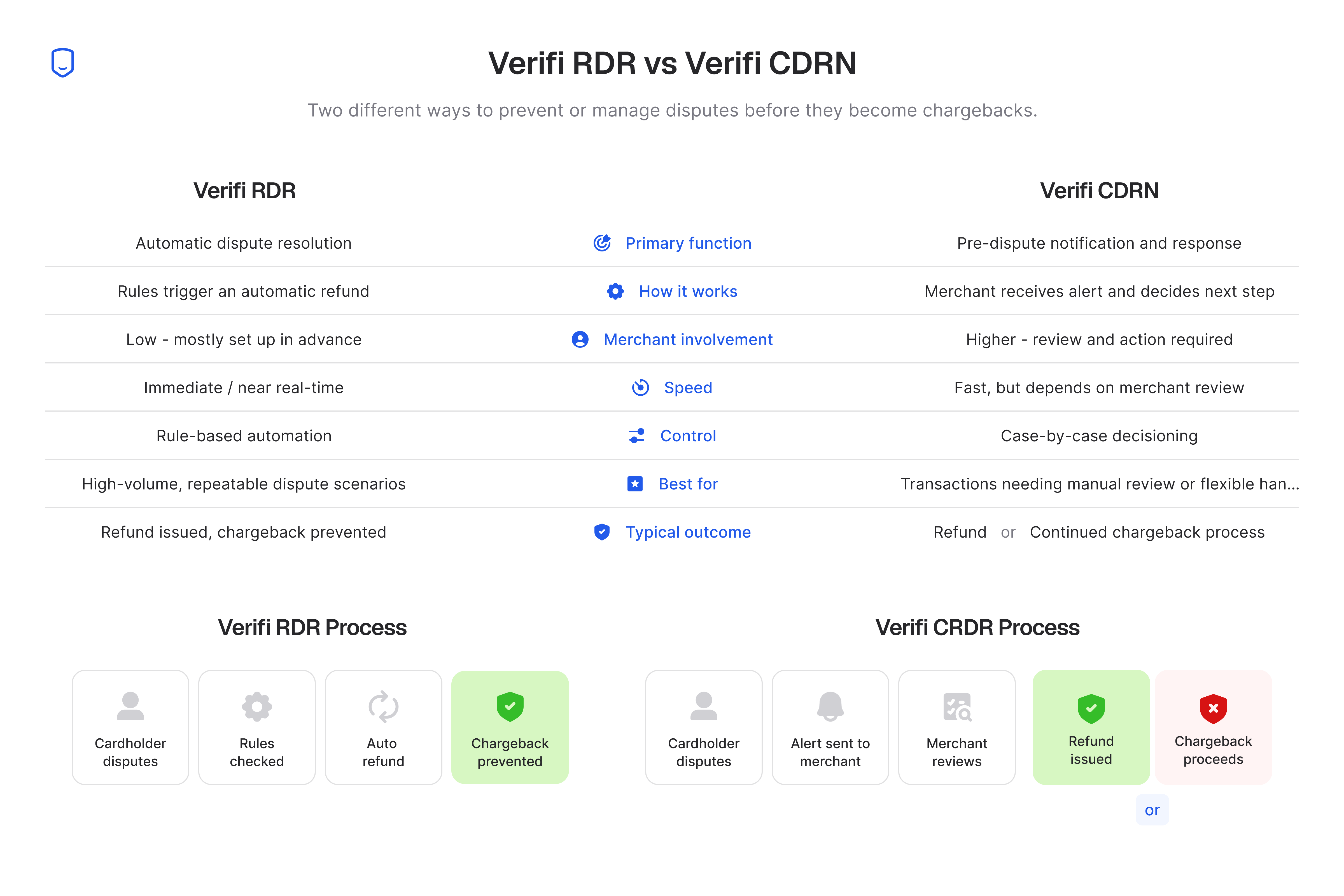
A reseller closes that gap. Connect a payment processor to one like Chargeback.io, and it auto-refunds CDRN alerts on your rules. The manual step becomes a threshold rule, like RDR.
The choice then trades control for speed and labor. Left manual, CDRN lets a person catch a false positive or skip a refund the case doesn't warrant. Automated on a rule, it scales better as your volume climbs.
In Chargeback.io's Dropship.io case study, the merchant ran both RDR and CDRN. Its dispute volume was Visa-heavy. It handled 1,511 RDR alerts and 253 CDRN alerts in the same period. Running both covered the automatic and manual cases inside one network.
So which one fits you?
A merchant with high alert volume and clear rules finds RDR cheaper in staff time, because nobody has to touch each alert. A merchant who wants judgment on borderline cases may prefer CDRN's manual gate. A cancellation dispute and a fraud dispute deserve different handling.
To weigh both against your own dispute mix, try our RDR three-way comparison.
CDRN vs. Ethoca: which cards does it cover?
CDRN is Visa-first, covering about 95% of US Visa transactions, with only limited Mastercard, Amex, and Discover coverage. So a merchant leaning on CDRN alone catches little of their Mastercard volume. For real Mastercard coverage you still want Ethoca, since neither one substitutes for the other.
Ethoca belongs to Mastercard and Verifi belongs to Visa, so they are separate companies, unlike CDRN and RDR, which are two products of one. Each protects its own card brand best. Full coverage means enrolling in both a Verifi product and Ethoca.
Our Ethoca vs Verifi breakdown compares the two networks in more detail.
Coverage has limits even inside CDRN's own scope, because participation varies by issuing bank. The CDRN network includes roughly 1,000 issuing banks, all of them based in the US. Much international Visa traffic sits outside that network.
A merchant with heavy overseas volume will see fewer alerts than their total Visa disputes suggest.
What does CDRN cost?
CDRN alerts through Chargeback.io cost a flat $15 per alert, and cover US transactions only. Verifi charges that fee per alert received, whether or not you refund. Your cost scales with how many alerts you get, even when you resolve only some of them.
Here's how the three networks compare:
The fee only pays off when you act inside the 72-hour window. An alert you paid for but missed still converts to a chargeback. So you're paying for the chance to stop a chargeback, and that only works when you refund in time.
The full cost-versus-fee math belongs with the deeper prevention economics. This section stays on CDRN's price.
Run your own numbers with our free ROI calculator.
How to sign up for CDRN
CDRN runs through Verifi. You enroll either directly with Verifi, or through a partner like Chargeback.io that holds the relationship. A partner handles enrollment and billing. Connect a payment processor and it can also auto-refund your CDRN alerts on rules you set. CDRN covers US transactions only, so it protects your US sales regardless of where your business is based.
Setup registers your exact billing descriptor, matched to the statement text character for character. That descriptor is the field CDRN uses to tie an alert to your charge. A descriptor already enrolled with another provider has to be released first. That release is the step that most often stalls a switch.
How we sourced our data
The case-study figures here, Dropship.io's CDRN and RDR alert counts, come from a named, published Chargeback.io customer case study. We name the customer because the numbers are that one merchant's measured results.
Read them as one real example, and treat any platform average as a separate question.
Dropship.io's counts reflect what happened after it turned on RDR and CDRN. The broader network-split and adoption stats come from anonymized platform data. We report those in full, with their own sourcing note, elsewhere.
FAQ
How long does a CDRN alert give you to respond?
You get 72 hours from when the alert is sent to refund and resolve the dispute. Miss that window and the dispute proceeds to a chargeback, as if no alert had come.
Does a CDRN alert count as a chargeback?
No, a CDRN alert is a pre-dispute notice that sits ahead of any chargeback record. A dispute you resolve through the alert never files, so it doesn't hit your chargeback ratio.
Can a customer file a chargeback after a CDRN alert?
Yes, if you don't refund inside the 72-hour window, the dispute converts to a chargeback. Some issuers can even move forward before you respond.
Do I need CDRN if I already have RDR?
Not necessarily, since both are Visa-side Verifi products and RDR already resolves Visa disputes automatically. Add CDRN only when you want a manual review step on borderline cases.