Chargeback Rebuttal Template: Match Evidence by Reason Code
.png)

Chargeback Rebuttal Template: Match Evidence by Reason Code
A chargeback rebuttal template only works if the evidence inside it matches the reason code you're fighting. A dispute for merchandise the customer says never arrived (code 13.1) needs tracking and delivery proof. A fraud dispute on a card-absent sale (code 10.4) needs the customer's IP address, device ID, and prior transaction history.
I've disputed chargebacks and built the evidence on my own stores, then advised merchants on the same thing. The mistake I see most is treating the rebuttal letter like a form to fill in, when the issuer only weighs the evidence inside it.
Match the evidence to the code, and your rebuttal has a real chance.
Key takeaways
- Match your evidence to the exact reason code before you write anything.
- A card-absent fraud dispute needs prior sales from 119 to 366 days earlier.
- A not-received dispute needs tracking and delivery confirmation.
- Compelling Evidence 3.0 applies to Visa fraud code 10.4 alone.
- The response window runs about 20 to 45 days before a chargeback stands.
- A dispute auto-refunded through Rapid Dispute Resolution can't be rebutted.
What is a chargeback rebuttal letter?
A chargeback rebuttal letter is a merchant's written response disputing a chargeback, submitted through the payment processor before the response deadline. It states the facts of the transaction and attaches evidence matched to the reason code the issuer cited.
The cardholder's bank reviews the rebuttal, and the processor only passes it along. Stripe or Shopify forwards your response, but the issuer decides it under its own card network's rules. So a rebuttal that skips the proof the code requires gets rejected, no matter how well it reads.
The letter also only works inside the response window, which runs about 20 to 45 days. You can find the exact one in our chargeback timeline guide.
Miss it and the chargeback stands, however strong your evidence was.
Why the reason code changes what evidence you need
Generic rebuttal templates lose because they attach the same evidence to every code, and each code demands different proof. A single fixed evidence block treats a fraud claim and a delivery complaint as one problem. They aren't.
Card networks define reason codes as separate dispute categories. Each alleges a different failure and asks for different proof: - Fraud: the cardholder says they never authorized the sale. - Not received: the customer paid but says nothing arrived. - Not as described: the item came but didn't match the listing. - Cancelled recurring: the customer says they already cancelled.
The compelling-evidence rules follow the allegation. So the proof that wins a fraud dispute does nothing for a not-received one. Card-absent fraud (code 10.4) is the most common coded dispute we see. The four codes below cover most of what a merchant faces.
Reason code 10.4 (fraud, card-absent)
In a 10.4 dispute, the cardholder says they never authorized a card-not-present sale, so your evidence has to prove the real account holder bought it. This is sometimes the friendly-fraud code, but mostly for true fraud.
Visa's rules for this code fall under Compelling Evidence 3.0, a program scoped to 10.4 alone. It asks for identifiers that tie the buyer to past orders:
- Customer's IP address: from the disputed order.
- Shipping address: matched to prior orders.
- Login ID or account information: the account used to buy.
- Device ID or fingerprint: the device behind the purchase.
- Two prior transactions: same payment method, undisputed, paid in full, processed 119 to 366 days before the disputed sale.
Reason code 13.1 (merchandise/services not received)
A 13.1 dispute says the customer paid but never got the item, so your evidence has to prove delivery. Here the customer's whole claim is that nothing arrived. Identity data won't answer that, only proof it showed up.
For a physical product, code 13.1 comes down to carrier records. You need the tracking number, the delivery confirmation, and proof of delivery to the cardholder's address. For a service or digital good, use a timestamped access log showing the customer got what they bought.
Reason code 13.3 (not as described or defective)
A 13.3 dispute admits the item arrived but calls it defective or not as described, so your evidence has to show it matched the listing. Delivery proof is beside the point. The customer already has it in hand.
Code 13.3 turns on the listing and the buyer's own words. You need the original product description and photos of the item as sold. Add any messages where the customer confirmed the specs or accepted the condition before buying.
Reason code 13.2 (cancelled recurring)
With a 13.2 dispute, the customer says you charged a subscription they already cancelled, so your evidence has to show the charge came first. This is the subscription-billing code, decided by dates and terms.
You need your cancellation policy as the customer agreed to it. You also need the record of when, or whether, they cancelled. The signed terms then show the billing date was still active when the charge ran.
The Reason-Code Evidence Match: build your rebuttal
The Reason-Code Evidence Match is a four-step process that runs in dependency order. Each step feeds the next:
- Identify the exact reason code.
- Pull that code's evidence.
- Assemble the letter around it.
- Confirm the case is still fightable.
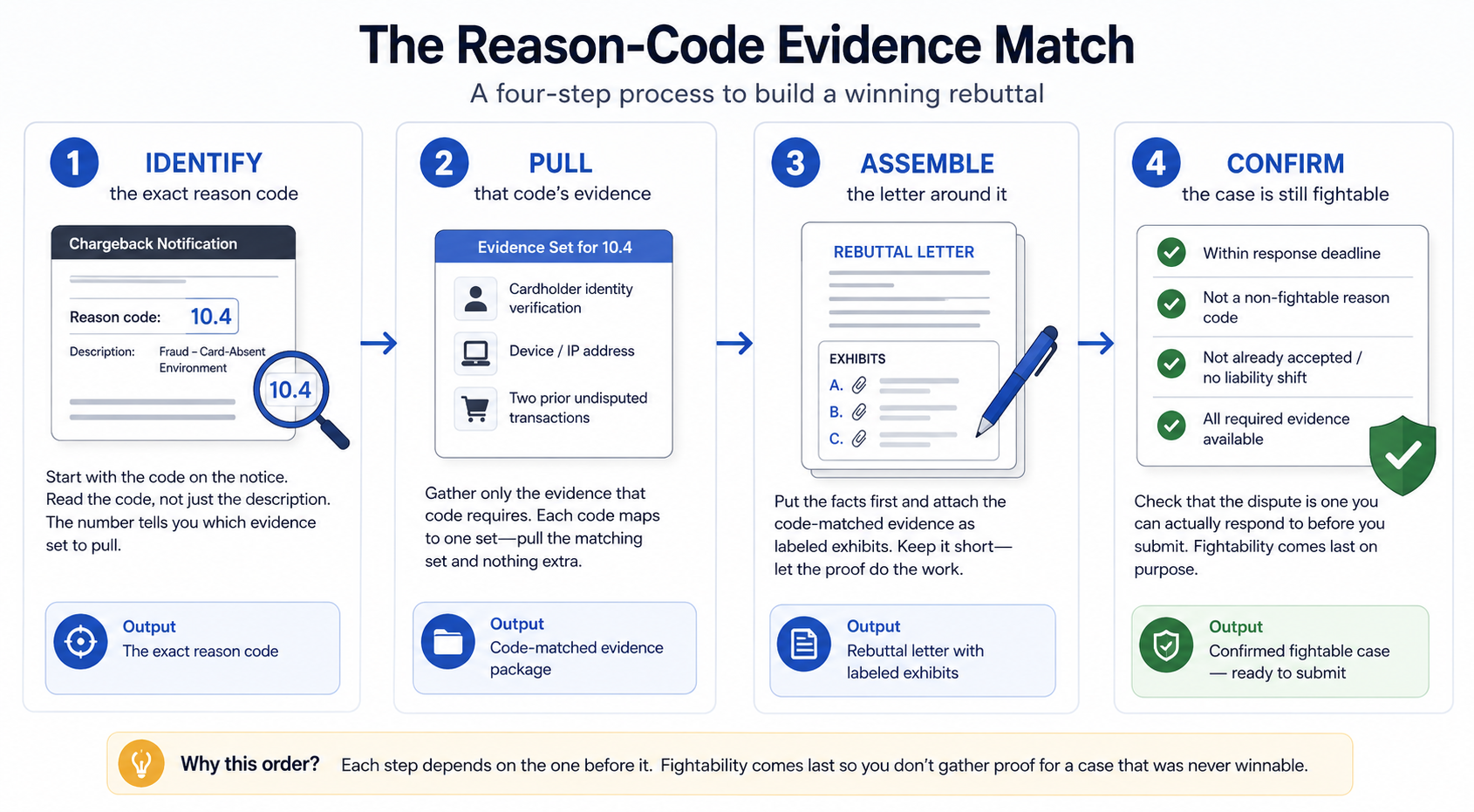
Each step needs the one before it, so the order isn't optional.
Fightability comes last on purpose, so you don't gather proof for a case that was never winnable.
Step 1: Identify the exact reason code
Start with the reason code printed on the chargeback notification, because everything after it depends on getting this right. The notice from your processor names the code and a short description.
Read the code, not just the description. "Cardholder dispute" can map to several codes, each with different proof. The number tells you which evidence set to pull. If the notice is vague, Visa's chargeback reason codes list what each one means.
Our reason code lookup tool looks up the exact code for you, so you don't have to match the description by hand.
Step 2: Pull the code-specific evidence
Gather only the evidence that code requires, using the per-code sets above. Each code maps to one set:
- 10.4: identity and prior-transaction data.
- 13.1: carrier delivery proof.
- 13.3: the listing and photos.
- 13.2: cancellation dates and terms.
Pulling the wrong set is the common miss. Send delivery tracking on a fraud dispute, and you tell the issuer you didn't read the code. Attach IP data to a not-received claim, and you make the same mistake.
Collect the matching set and nothing extra.
Summary: The code decides the evidence, so pull the set that answers the specific allegation.
Step 3: Assemble the rebuttal letter (template)
Put the facts first, then attach the code-matched evidence as labeled exhibits. The letter is short. The proof does the work, so keep the writing plain and let the evidence carry it.
Here is a template you can copy and fill in:
Subject: Rebuttal for Chargeback [case/dispute ID]
Merchant: [business name, merchant ID]
Transaction: [date, amount, order number]
Reason code: [e.g. 10.4, fraud, card-absent]
The facts of this transaction:
[Two or three sentences. What was bought, when, how it was
delivered or accessed, and why the charge is valid.]
Evidence attached, matched to reason code [code]:
1. [Exhibit A, name the first proof for this code]
2. [Exhibit B, name the second proof for this code]
3. [Exhibit C, name the third proof for this code]
Based on the evidence above, this transaction was valid and
authorized. We respectfully request the chargeback be reversed.
[Name, title, contact]
The evidence list changes with the code. A 13.1 case fills those slots with the tracking number, delivery confirmation, and proof of delivery. A 10.4 case fills them with the IP address, device ID, and two prior undisputed sales.
Step 4: Confirm the case is still fightable
Before you submit, confirm the case is one you can actually respond to. Some disputes can't be fought at all, and gathering evidence for them wastes the time you have.
The next section covers the two cases where a rebuttal is already dead on arrival. Check for them before you spend an hour on exhibits.
When a chargeback rebuttal is futile
A rebuttal is futile in two cases, a dispute already auto-refunded through Visa Rapid Dispute Resolution, and one filed after the deadline. A late filing gets rejected on sight. The auto-refunded case is the one merchants miss.
Rapid Dispute Resolution is a Visa tool. It settles the dispute automatically before it becomes a chargeback. It uses refund rules you set in advance. By the time it shows up as resolved, the refund has already gone through on your own terms. There's nothing left to contest.
This only happens on disputes your own rules already caught, though. If you never enrolled in RDR or set auto-refund rules, you won't hit this case at all.
The cheapest chargeback is the one you never have to fight.
Catching a dispute early with chargeback alerts resolves it before it becomes a chargeback you'd need a rebuttal for.
How we sourced our data
The reason-code figures here come from anonymized, aggregated alert data across merchants on the Chargeback.io platform, not industry-wide statistics. The population is our own merchants, and the unit is alerts received.
We counted alerts in each reason-code category and report each as a share of coded alerts:
Reason code
Meaning
Share of coded alerts
10.4
Fraud, card-absent
~11%
13.2
Cancelled recurring
~8.5%
13.7
Cancelled merchandise/services
~8.2%
These are the codes we see most, which isn't the same as the codes hardest to fight. That's why the evidence guidance above maps a slightly different set of codes.
These shares reflect how disputes land on our own platform. They describe our merchant base, and the payments industry as a whole may look different.
FAQ
What happens if I miss the chargeback rebuttal deadline?
The chargeback stands, the funds stay reversed, and you can't submit evidence once the window closes. Your only path then is a separate pre-arbitration or arbitration process, which costs more and rarely favors the merchant.
Can I fight a Stripe chargeback the same way?
Yes, the logic is identical, because Stripe forwards your response to the card network but doesn't decide it. Stripe adds its own dispute fee, yet the proof the issuer wants still comes down to the reason code.
Do I need a lawyer to write a chargeback rebuttal letter?
No, a rebuttal is a business document that merchants submit without lawyers every day. The issuer weighs evidence against reason-code rules, so clear facts and the right proof beat legal language.
Rebuttal vs. retrieval request: what's the difference?
A rebuttal is your full response to a filed chargeback, while a retrieval request is the issuer's earlier, lighter ask for transaction records. It comes before any chargeback exists, and answering it well can stop one from forming.