Stripe High-Risk Classification: What Triggers It


Stripe High-Risk Classification: What Triggers It
Stripe high-risk classification comes down to five factors, your industry, chargeback and fraud history, transaction value, financial stability, and regulatory exposure. The one that moves you in and out of that tier is your chargeback rate.
I've reviewed merchant processor setups for a living, and most Stripe risk decisions I saw traced back to that one number nobody was watching.
Stripe's own page lists the same generic factors every processor lists, but never says which one triggers the decision. This guide names it, what it costs you, and the path back to standard terms.
Key takeaways
- Stripe reviews accounts on a schedule, so an approved account can be reclassified later.
- High-risk means stricter terms, while prohibited means Stripe won't process for you.
- A flagged account typically carries a 5% to 15% reserve, held for months.
- Every disputed charge also carries a $15 fee, on top of the reserve.
- A MATCH or VMSS listing follows you across processors for five years.
- Cutting your chargeback rate, not switching processors, gets you reclassified.
Flagged already? See what alert coverage catches before a dispute files.
What counts as a "high-risk" classification on Stripe?
Stripe weighs your industry, chargeback and fraud history, transaction value, financial stability, and regulatory exposure when it classifies you. Of those five factors, your chargeback rate moves accounts in and out of the tier.
Stripe runs that review on a schedule, so it reads your history again every cycle.
An account approved two years ago can get reclassified this quarter without selling anything new.
A high-risk merchant still processes on Stripe, and Stripe's chargeback policy applies the same way it does to everyone. What changes is your terms, covered in the two sections below.
Stripe rarely announces the classification in plain words. Most merchants learn it from a side effect, like a reserve line in the dashboard, a payout that lands slower than usual, or a request for updated business documents. Those three signals are what to check if you suspect you've been flagged.
Summary: High-risk means Stripe works with you on stricter terms, and prohibited means it won't work with you.
Industries commonly classified high-risk by Stripe
Stripe treats some industries as high-risk by default, because their chargeback and refund rates run high across the whole category. The category sets your starting point, and your own history sets your terms:
Industry
Why Stripe treats it as high-risk
Cryptocurrency and digital assets
Irreversible delivery, heavy fraud targeting
Online gambling and gaming
Rules that vary by jurisdiction
Adult content
High dispute rates, card network rules
Travel and ticketing
Long gaps between payment and delivery
Supplements and nutraceuticals
Recurring billing plus outcome complaints
Tobacco and vaping
Age-restricted sales, shifting state rules
Subscription e-commerce
Charges customers forget authorizing
Debt collection and credit repair
Regulated work, high complaint volume
<style>.wf-table-wrap table{width:100%;border-collapse:collapse}.wf-table-wrap th,.wf-table-wrap td{border:1px solid #ddd;padding:8px 12px;text-align:left}.wf-table-wrap th{background:#f5f5f5;font-weight:600}</style>
<div class="wf-table-wrap" style="overflow-x:auto;">
<table>
<thead><tr><th>Industry</th><th>Why Stripe treats it as high-risk</th></tr></thead>
<tbody>
<tr><td>Cryptocurrency and digital assets</td><td>Irreversible delivery, heavy fraud targeting</td></tr>
<tr><td>Online gambling and gaming</td><td>Rules that vary by jurisdiction</td></tr>
<tr><td>Adult content</td><td>High dispute rates, card network rules</td></tr>
<tr><td>Travel and ticketing</td><td>Long gaps between payment and delivery</td></tr>
<tr><td>Supplements and nutraceuticals</td><td>Recurring billing plus outcome complaints</td></tr>
<tr><td>Tobacco and vaping</td><td>Age-restricted sales, shifting state rules</td></tr>
<tr><td>Subscription e-commerce</td><td>Charges customers forget authorizing</td></tr>
<tr><td>Debt collection and credit repair</td><td>Regulated work, high complaint volume</td></tr>
</tbody>
</table>
</div>
Your own dispute record still decides the outcome. A supplement store with a clean record often runs on standard terms, while an apparel store with a climbing rate gets flagged.
Prohibited vs. high-risk: what's the difference
A high-risk business can use Stripe under stricter terms, and a prohibited business can't use Stripe at all. Stripe keeps two separate lists, and merchants read the wrong one all the time.
The prohibited and restricted list is a policy line. It names business types Stripe declines whatever your chargeback rate looks like. Unregistered money transmission, certain regulated substances, and counterfeit goods are all on it.
That list is about what you sell, so your performance can't move you off it.
High-risk works the other way. Stripe recalculates it from your current numbers, so it can improve or worsen.
Stripe also keeps a middle category. Restricted businesses can process, but only with prior approval or under set conditions. That's why two stores in the same industry sometimes get different answers.
Which list you're on tells you which problem you have. A prohibited business needs a processor built for its category. A high-risk business needs a lower chargeback rate.
Read Stripe's restricted businesses page against your actual product catalog before you assume you're in the clear. Merchants get caught by one line item, like a supplement or a resold electronic, in a category the rest of the store avoids.
How the MATCH/VMSS list relates to Stripe's classification
Heavy chargebacks or fraud can also land you on Mastercard's MATCH file or Visa's VMSS. These are industry-wide lists, separate from Stripe's own classification. Stripe screens against both, and reports to them.
All three systems watch the same number. The MATCH list is Mastercard's and VMSS is Visa's, and each adds a merchant on either of two counts:
List
Chargeback trigger
Fraud trigger
MATCH (Mastercard)
Chargebacks over 1% of monthly sales, totaling $5,000 or more
8% fraud-to-sales ratio, 10 or more transactions, $5,000
VMSS (Visa)
1,000 disputes at a 1.8% dispute-to-sales ratio in one month
$250,000 in fraud at a 1.8% fraud-to-sales ratio
<div class="wf-table-wrap" style="overflow-x:auto;">
<table>
<thead><tr><th>List</th><th>Chargeback trigger</th><th>Fraud trigger</th></tr></thead>
<tbody>
<tr><td>MATCH (Mastercard)</td><td>Chargebacks over <a href="https://docs.stripe.com/disputes/match">1% of monthly sales</a>, totaling $5,000 or more</td><td>8% fraud-to-sales ratio, 10 or more transactions, $5,000</td></tr>
<tr><td>VMSS (Visa)</td><td>1,000 disputes at a 1.8% dispute-to-sales ratio in one month</td><td>$250,000 in fraud at a 1.8% fraud-to-sales ratio</td></tr>
</tbody>
</table>
</div>
Both lists are separate from the programs that watch your rate month to month. Visa's VAMP program flags you while you're still processing.
Mastercard runs a matching program for merchants whose chargebacks stay high.
MATCH and VMSS work later, recording you after the processing relationship ends.
Summary: Stripe's classification is reversible and private, and a MATCH or VMSS listing is neither.
Why a listing outlasts the account
A MATCH or VMSS listing follows you for up to five years, and every acquirer you apply to sees it. A Stripe classification is private, and it reverses.
The listing attaches to the people as well as the business. Acquirers check owner names and tax IDs, so a fresh entity with the same owners rarely clears it.
What changes once Stripe classifies you high-risk
A high-risk classification usually brings a rolling reserve of 5% to 15% of your transaction volume, held for 30 to 180 days, plus closer monitoring. The account keeps processing throughout.
A $15 dispute fee in the US hits every disputed charge on top of that. Stripe sets the reserve to cover the risk it now sees. The money stays yours until the hold ends.
Our Stripe chargeback fee guide has the rate for every other settlement currency.
On thin margins, that's the part that hurts first.
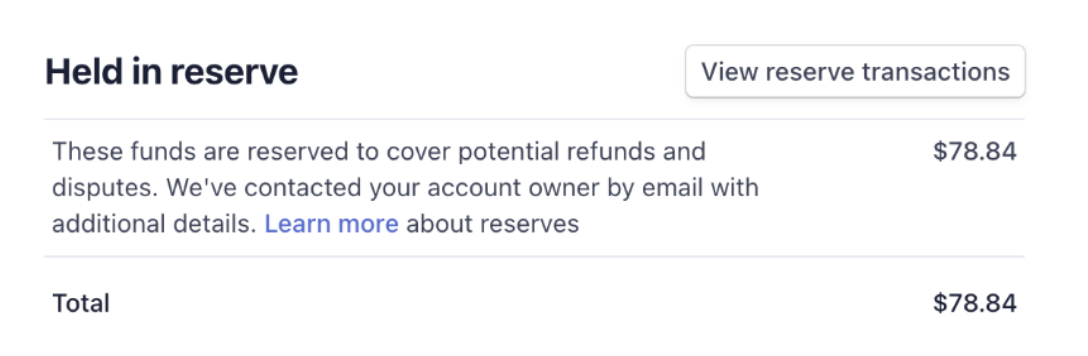
Source: Stripe
A reserve can also loosen or tighten without you changing how the business runs. That's the classification mechanism running in reverse.
One thing is worse than any of this. Cross a MATCH or VMSS threshold and you move past reserves and fees. Stripe closes the account, and the next processor sees the listing.
What a reserve does to your cash flow
The cash-flow hit is the part merchants underestimate. A 10% reserve within Stripe's data, on a 90-day hold, leaves roughly a tenth of three months of revenue out of reach at any moment.
That gap arrives while your supplier and ad bills stay on their old schedule. Stores that fund inventory out of daily payouts feel it within a week.
Stripe can also change how you get paid. Payout timing often stretches from a two-day rolling schedule to seven days or longer, and Stripe can ask for documents before it releases a batch.
Summary: A classification costs you cash flow and payout speed before it costs you the account.
How to get reclassified
The fastest way back to standard terms is a sustained drop in the chargeback rate that triggered the classification. Switching processors leaves you where you started, because a new processor runs the same underwriting review against the same transaction history.
Your target is the monitoring threshold on each network you sell through. Our chargeback rate guide lists the current Visa and Mastercard figures. Three levers move you toward them:
- Fix your billing descriptor. Put the storefront name customers know, plus a support number, in that field.
- Enroll in pre-dispute alerts on both networks. Ethoca and Verifi flag a dispute in time for you to refund it.
- Answer refund requests within one business day. Put a support email and live chat on your order-confirmation page.
Why alert coverage needs both networks
Most merchants enroll on one network and miss the disputes they could have refunded. In our dataset, Ethoca (Mastercard) generates 42.1% of alerts. RDR and CDRN, the two networks Visa runs through Verifi, generate 57.9% between them.
Across the merchants we protect, single-network coverage misses roughly half the alerts.
Each refund does give up the sale. A store with thin margins and high-ticket orders should set a value limit and fight above it, rather than auto-refunding everything.
Set up alert coverage on both networks and the disputes resolve before they count against your rate.
How long reclassification takes
Stripe reads a trailing window and hasn't published its length, so plan on holding the lower rate for a few months. One clean month won't move it.
The three levers pay off on different clocks. The descriptor fix is free and takes an afternoon in your Stripe settings, so start there. Alerts start catching disputes within days of enrollment.
Support response times take longest to show up, because they only affect customers who buy after you make the change.
FAQ
Do I need a new processor if Stripe marks me high-risk?
Only if your business type sits on Stripe's prohibited list, which needs a processor built for that category. A high-risk classification follows your chargeback history, so any new processor's underwriting reaches the same place.
Can Stripe suspend my account without notice?
Yes, Stripe can pause payouts immediately on a serious risk signal, and its terms let it close an account without stating a reason. The email usually arrives after Stripe has already acted.
Does a high-risk classification raise my Stripe fees?
Your published per-transaction rate typically stays the same. The extra cost arrives through the reserve and the $15 dispute fee in Stripe's data.
Will other processors see my Stripe classification?
No, Stripe keeps an account-level classification private, while MATCH and VMSS listings are visible industry-wide. Your dispute history still shows up in any new underwriting review.
How we sourced our data
The alert-network figures here come from anonymized, aggregated data across merchants enrolled on the Chargeback.io platform. We measured total alerts within each network and report them as shares of the alerts we received.
Treat those numbers as a read on Chargeback.io merchants only. Alert coverage also runs low for American Express, Discover, and JCB, so any network split understates disputes outside Visa and Mastercard.