Visa Chargeback Guide for Merchants


This Visa chargeback guide starts with the core fact. A Visa chargeback is a forced reversal of a card payment, started by the cardholder's bank under one of Visa's reason codes. The case then moves through four stages, from pre-dispute to arbitration. Missing any stage's deadline forfeits the dispute automatically, however strong your evidence.
I've disputed Visa chargebacks on my own stores, then advised merchants on the same process from a chargeback tool's support desk. The same thing trips up almost everyone. They treat the reason code as a formality. It's really the one detail that decides what evidence works.
Get the stage, the deadline, and the reason code right, and you know what to send and when.
Key takeaways
- Visa disputes run through four stages, each with a firm response deadline.
- Cardholders get up to 120 days from the transaction to file a dispute.
- Miss any stage deadline and the dispute resolves against you automatically.
- VAMP replaced VDMP and VFMP on April 1, 2025.
- The main VAMP Excessive threshold is 2.2%, dropping to 1.5% in 2026.
- Win a dispute by matching your evidence to the reason code's question.
What is the Visa chargeback process?
A Visa chargeback moves through four stages, and each one has its own deadline and required response. The order runs pre-dispute, dispute submission, pre-arbitration, and arbitration, starting with the alert stage and ending with Visa's final decision.
Each stage hands the case to the other side for a fixed window. Miss that window, and the dispute resolves against you regardless of how strong your evidence is. Knowing which stage you're in, and what it requires, matters more than the strength of your case.
Each stage gives both sides a chance to settle before the dispute escalates. If you miss a stage's deadline, the outcome defaults to whichever side didn't miss it. What decides the process is whether you respond in the right window, more than how strong your case is.
Visa runs on the same broad logic as every other card network, but the specifics are its own. Visa sets the stage names, the deadlines, and the reason codes. A rule you learned for Mastercard or Amex won't map cleanly here, so treat each network on its own.
One case never enters this process at all. A pre-dispute alert from Ethoca or Verifi can catch the transaction early, before the bank files anything.
The Visa dispute process, stage by stage
Each stage has a specific window and a specific action you must take inside it, or the dispute resolves against you. The three stages below run from before a dispute is filed through to arbitration.
Visa builds the deadlines around the acquirer and issuer. Your acquirer is your payment processor, and the issuer is the cardholder's bank. They exchange evidence inside fixed windows, and Visa steps in to decide only after both sides have had their chance.
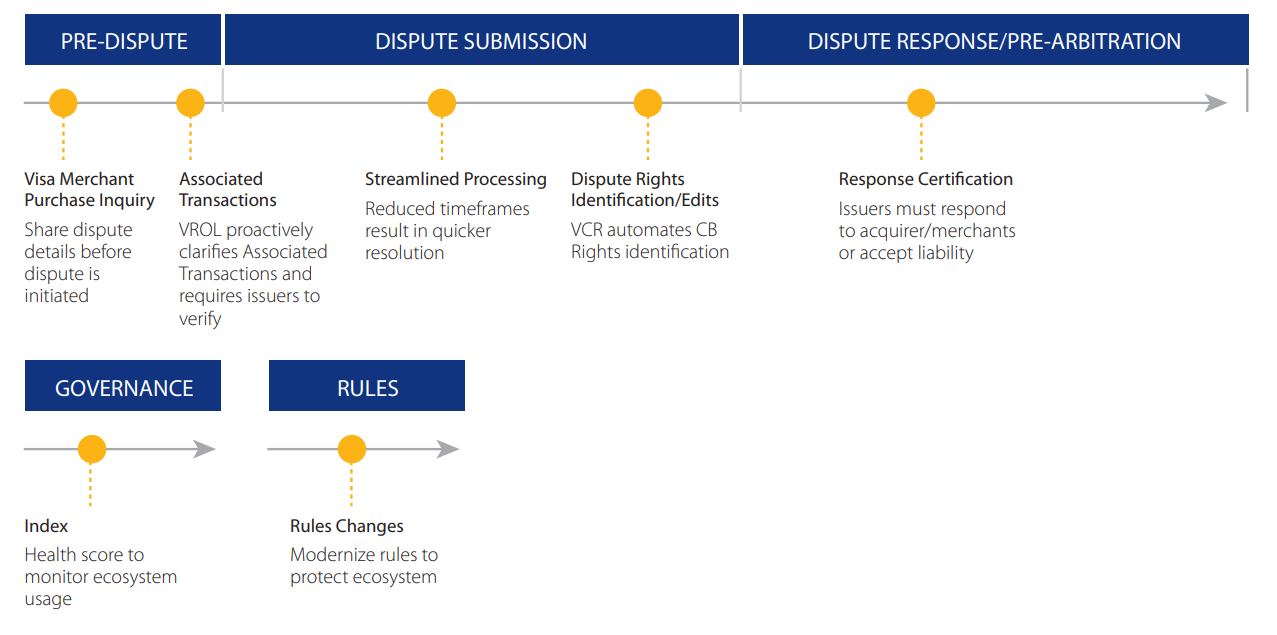
Screenshot from Visa.
1. Pre-dispute
Pre-dispute is the stage before a chargeback becomes a formal dispute, and the only point where you can stop one cheaply. Chargeback alerts from providers like Ethoca and Verifi can resolve it here with a refund.
The alert reaches you because the cardholder contacted their bank, but the bank hasn't filed yet. You get a short window to refund and close the complaint before it becomes a formal dispute. Handle it in time and there's no reason code, no response package, and no fee.
If you'd rather get ahead of disputes than respond to them, this is the stage that matters most. A dispute stopped here never counts toward your chargeback ratio.
2. Dispute submission
Dispute submission is the point of no return for a quick refund, because the funds are already reversed. The issuer files the chargeback under a specific reason code, and that code sets what evidence you'll need.
By now the money has left your account and gone back to the cardholder. Your only way to recover it is a response package that answers the reason code. So the code you get here is the instruction sheet for everything that follows.
You respond through Visa Resolve Online, the platform Visa uses to route disputes between banks. Once the chargeback is filed, refunding the customer no longer undoes it.
3. Pre-arbitration
Pre-arbitration is your second and final chance before Visa itself decides the case. It happens when the issuer rejects your rebuttal or disputes it further.
Between the first response and this stage, the issuer reviews your evidence and pushes back. Now you either add what the issuer said was missing or accept the loss. There's no third try after it.
This is where the cost climbs. If the case reaches arbitration and you lose, you pay Visa's arbitration fee on top of the disputed amount. A weak case often isn't worth carrying this far.
Summary: After a dispute is filed, you respond through Visa Resolve Online, then pre-arbitration is your last step before Visa decides.
Visa chargeback time limits and deadlines
Visa gives cardholders up to 120 days from the transaction or expected-delivery date to file a dispute, and gives merchants a limited response window at each stage. The table below lays out who acts and when:
Stage
Who acts
Deadline
Filing a dispute
Cardholder (via issuer)
Up to 120 days from transaction or expected delivery
Dispute response
Merchant (via acquirer)
Set by Visa per stage, tracked in Visa Resolve Online
Pre-arbitration response
Merchant (via acquirer)
Shorter window, and missing it forfeits the case
Arbitration
Visa decides
After both sides respond
The long filing window keeps cardholders from being time-barred before a problem shows up. That matters most for pre-order or future-delivery purchases. For those, the clock often starts from the delivery date, so a charge from months ago can still be disputed on time.
The shorter merchant window keeps the dispute moving. And the window that actually binds you is usually your processor's. Acquirers set their own deadlines on top of Visa's, often shorter ones. A missed processor cutoff forfeits the case the same way a missed Visa deadline does.
So confirm the deadline with your processor, and don't assume Visa's 120 days is your only clock.
You also pay to defend. A chargeback fee usually applies the moment a dispute is filed, whether or not you respond.
Summary: Cardholders have up to 120 days to file, and your processor's response deadline may be tighter than Visa's.
What is Visa's Acquirer Monitoring Program (VAMP)?
VAMP is Visa's current monitoring program, and it replaced the Dispute Monitoring Program (VDMP) and Fraud Monitoring Program (VFMP) on April 1, 2025. It tracks a single combined fraud-and-dispute ratio against your settled transactions.
The change matters because VAMP folds several programs into one ratio and one set of steps. You no longer track a dispute ratio and a fraud ratio apart. Any VDMP or VFMP language still floating around describes the retired programs, so treat it as history.
Our Visa Acquirer Monitoring Program guide has the current thresholds by region, the ratio formula, and the mechanics behind it.
Summary: VAMP is Visa's current monitoring program, replacing VDMP and VFMP with one combined ratio.
Visa chargeback reason codes you'll encounter
Visa reason codes fall into four categories, and the category decides what evidence can overturn the chargeback. The reason code (also called a chargeback reason code or dispute category) is the single most important detail on a Visa dispute.
Visa splits the categories because each one asks a different question. The table shows the four categories and what each one asks:
Category
Example code
What it asks
Fraud
10.4
Did the cardholder authorize this charge?
Authorization
11.3
Was the transaction properly authorized?
Processing errors
12.5
Did the merchant follow the transaction rules?
Consumer disputes
13.1
Did the merchant deliver what was promised?
One transaction can get re-coded mid-process when the issuer's first code doesn't hold up. Your evidence then needs to answer the final code that stands.
Our reason code lookup covers codes across all four networks if you're checking one from outside Visa.
Can merchants win a Visa chargeback dispute?
You win a Visa dispute by responding inside the deadline with evidence that answers the reason code's question, not just evidence that the sale happened. That distinction decides most cases.
Visa and the issuer weigh whether your evidence closes the specific gap the reason code alleges. Generic proof of a valid sale doesn't address a "not as described" or "no authorization" claim. So a strong rebuttal starts from the code and works backward to the documents that answer it.
What "answering the code" means depends on the category:
- Fraud: proof the cardholder made the purchase, like device, login, or delivery history.
- Consumer dispute: proof you delivered what was described, like tracking or a signed policy.
- Processing error: proof the charge was correct, like the authorization record and receipt.
For fraud reason codes, the standard is Compelling Evidence 3.0. It sets out the transaction history Visa accepts as proof the cardholder made the purchase.
One limit is worth stating flat. A dispute that a pre-dispute alert already auto-resolved can't be rebutted afterward. Representment only applies to disputes still moving through the formal chargeback process.
The cheaper win is the dispute you stop before it files. Our chargeback alerts catch disputes at the pre-dispute stage so you can refund before a chargeback ever lands.
Summary: Winning means matching your evidence to the reason code's question, and only formal chargebacks can be rebutted at all.
FAQ
Is there a minimum dollar amount for a Visa chargeback?
No. Visa sets no minimum transaction amount for a cardholder to file a dispute, so even small charges can be disputed.
Can a merchant refuse a Visa chargeback?
Not outright. You can't reject a chargeback, but you can dispute it by submitting evidence, which is different from refusing to accept it.
Does a refund stop a chargeback that's already filed?
No. Once a chargeback is filed, a refund doesn't undo it, and refunding on top of the reversal can mean paying twice.
What happens if you miss a Visa chargeback deadline?
The dispute resolves against you automatically. Visa treats a missed response window as a forfeit at that stage, whatever evidence you had.