Chargeback Management Companies: The 3 Types

Chargeback Companies: How to Choose the Right One (2026)
Chargeback companies are vendors that help merchants prevent or resolve card disputes. They do that through alerts that stop a dispute before it becomes a chargeback, fraud-scoring at checkout, or managed dispute response.
The right one depends on your transaction volume, your budget, and whether you want prevention, representment, or both.
I've worked with merchants on their chargeback problems, and the first thing I check is what the customer saw on their statement. On my own stores, fixing the descriptor did more than any single dispute I ever won.
Most merchants shopping for a chargeback company haven't decided whether they need one yet. This guide starts there, then narrows to the one or two vendors that fit.
Key takeaways
- Decide whether to buy at all before you compare any vendor.
- Prevention stops disputes before they file, and representment fights them after.
- Score every vendor on pricing, coverage, reliability, fit, and integration.
- A pay-per-use alert vendor can finish setup in under 12 hours.
- Answering a single dispute by hand can take up to 1 hour.
- Fix your billing descriptor first, because it costs nothing.
Want to see what prevention costs per dispute? Check our alert pricing before you book a single sales call.
What is a chargeback company?
A chargeback company either prevents disputes before they turn into chargebacks or fights the ones already filed. Which of those two jobs you need decides the vendor. Buyers shop both categories under the same label, so two vendors with similar marketing can solve completely different problems.
Prevention vendors work inside the window between a customer calling their bank and the bank opening a case. An alert arrives, the merchant refunds, and no chargeback ever lands on the account. A prevention vendor gets paid to keep the dispute off your record.
Representment vendors work after that window closes. The bank has already pulled the money back, so they assemble evidence to win it again, and they get paid on what they claw back. For the mechanics of the underlying dispute, start with what a chargeback is.
This is where merchants overbuy. A store with a clean checkout and a few disputes a month can sign a full-service contract and pay for capacity it never uses.
A merchant near a chargeback monitoring program has the opposite problem. Its rate needs to come down now, and alerts alone may not move it fast enough.
Build in-house or buy a chargeback company?
Handle disputes in-house while you still have the staff hours to investigate each one, and buy a vendor once dispute volume runs past those hours. The decision turns on staff hours.
In-house handling costs more than people budget for. Answering one dispute means gathering four things:
- The transaction record
- The delivery proof
- The customer emails
- The terms the customer agreed to
Then someone writes a response aimed at one reason code. That runs up to an hour per case, and the early months are the worst, because a team wins steadily only once it knows what each code asks for.
A vendor's team writes these responses all day across hundreds of merchants, so it clears that learning curve before you hire anyone.
Tim's Coffee, a Shopify coffee-equipment retailer, went the other way for exactly this reason. It had no in-house fraud team, so it picked a pay-per-use alert vendor and finished setup in under 12 hours.
There's a third answer that costs nothing, and it sits before both options.
Check your billing statement descriptor first. Pull your own statement and read the line your customer sees. Confirm it carries a name they'd recognize plus a working support number.
At low dispute volume, the problem often disappears right there.
We compare the two operating models in full under in-house or outsourced management.
How to evaluate a chargeback company
Score every vendor on pricing model, coverage, reliability, industry fit, and integration. Each one catches a different failure:
Criterion
What to ask for
Why it decides the pick
Pricing model
The billing event in writing, whether per alert, percentage of recovered, percentage of order value, or monthly minimum
Tells you whether you pay per dispute or pay a minimum regardless
Coverage
Which alert networks and card brands the vendor sees, by name
A vendor blind to your dominant card brand can't act on most of your disputes
Reliability
Uptime figures, support response times, and a named customer case study with before-and-after numbers
Decides whether the alerts fire and match your transactions
Industry fit
Which reason codes the vendor declines to fight, and whether it takes your category
Vendors quietly skip harder codes, including recurring-billing disputes
Integration
A live connection to your processor, gateway, and order system
Without it, someone on your team matches alerts to orders by hand
<style>.wf-table-wrap table{width:100%;border-collapse:collapse}.wf-table-wrap th,.wf-table-wrap td{border:1px solid #ddd;padding:8px 12px;text-align:left}.wf-table-wrap th{background:#f5f5f5;font-weight:600}</style>
<div class="wf-table-wrap" style="overflow-x:auto;">
<table>
<thead><tr><th>Criterion</th><th>What to ask for</th><th>Why it decides the pick</th></tr></thead>
<tbody>
<tr><td><strong>Pricing model</strong></td><td>The billing event in writing, whether per alert, percentage of recovered, percentage of order value, or monthly minimum</td><td>Tells you whether you pay per dispute or pay a minimum regardless</td></tr>
<tr><td><strong>Coverage</strong></td><td>Which alert networks and card brands the vendor sees, by name</td><td>A vendor blind to your dominant card brand can't act on most of your disputes</td></tr>
<tr><td><strong>Reliability</strong></td><td>Uptime figures, support response times, and a named customer case study with before-and-after numbers</td><td>Decides whether the alerts fire and match your transactions</td></tr>
<tr><td><strong>Industry fit</strong></td><td>Which reason codes the vendor declines to fight, and whether it takes your category</td><td>Vendors quietly skip harder codes, including recurring-billing disputes</td></tr>
<tr><td><strong>Integration</strong></td><td>A live connection to your processor, gateway, and order system</td><td>Without it, someone on your team matches alerts to orders by hand</td></tr>
</tbody>
</table>
</div>
Reliability is the criterion buyers ask about most and vendor lists cover least. In our own Search Console data for this page, the top question by impressions asks which providers are the most reliable. Our page earns no clicks on it, because it never answers that question head-on.
So ask three things. Get uptime over the last quarter, the median support response time, and one named customer with before-and-after numbers.
Check coverage next, and it's a yes-or-no answer. Chargeback alerts reach a merchant through Ethoca (Mastercard) and Verifi (Visa, which operates RDR and CDRN). A vendor wired to one of those sees nothing from the other.
Check your own mix in three steps. Pull last quarter's disputes, count them by card brand, then match that split against what each vendor covers. Enrollment rules differ by network, and we cover them in how the alert networks differ.
The last three criteria each fail in one way. Usage billing costs a quiet month almost nothing while a minimum bills you anyway. A vendor that skips recurring-billing codes leaves subscription disputes unfought. A missing processor connection puts someone on your team matching alerts to orders by hand.
Ask for uptime figures before you compare prices. If the alerts never match your orders, you're paying for nothing.
Chargeback companies compared
Chargeback.io and Signifyd act before a dispute exists and charge you as it happens, while Chargebacks911 and Chargeflow act after one files and charge for the outcome. Each also offers a different grade of proof that it works:
- Chargeback.io: per-alert prevention, with two published customer case studies.
- Signifyd: checkout screening backed by a fraud guarantee, priced on order value.
- Chargebacks911: managed representment at enterprise scale, quoted privately.
- Chargeflow: recovery first, with prevention scanning sold as separate tiers.
Vendor
Pricing model
When it acts
Reliability proof
Chargeback.io
Per alert, no monthly minimum
Before a dispute files
Two published customer case studies with before-and-after numbers
Signifyd
Percentage of approved order value
At checkout, before the charge
Fraud guarantee on approved orders, uptime unpublished
Chargebacks911
Custom quote, no public pricing
After a chargeback files
Publishes no rates or uptime
Chargeflow
Tiered, from free analytics to a share of recovered disputes
After a dispute files, plus optional scanning before
Publishes a headline win-rate improvement figure
<div class="wf-table-wrap" style="overflow-x:auto;">
<table>
<thead><tr><th>Vendor</th><th>Pricing model</th><th>When it acts</th><th>Reliability proof</th></tr></thead>
<tbody>
<tr><td><strong>Chargeback.io</strong></td><td>Per alert, no monthly minimum</td><td>Before a dispute files</td><td>Two published customer case studies with before-and-after numbers</td></tr>
<tr><td><strong>Signifyd</strong></td><td>Percentage of approved order value</td><td>At checkout, before the charge</td><td>Fraud guarantee on approved orders, uptime unpublished</td></tr>
<tr><td><strong>Chargebacks911</strong></td><td>Custom quote, no public pricing</td><td>After a chargeback files</td><td>Publishes no rates or uptime</td></tr>
<tr><td><strong>Chargeflow</strong></td><td>Tiered, from free analytics to a share of recovered disputes</td><td>After a dispute files, plus optional scanning before</td><td>Publishes a headline win-rate improvement figure</td></tr>
</tbody>
</table>
</div>
Flourish: build a table-with-search from the comparison table above. Columns: vendor name (Chargeback.io, Signifyd, Chargebacks911, Chargeflow), pricing model, when it acts, reliability proof (yes/no + type). Sort by pricing model, usage-based first, then percentage, then custom quote. Source line to display under the chart: "Chargeback.io, verified 2026-08-04."
Each pricing model here costs you something different as you grow, and we rank all four by cost and fit separately.
Here is each one in detail.
1. Chargeback.io
- Best for:
- Sellers watching a dispute rate climb toward a processor threshold
- Teams with no dedicated chargeback staff
- Subscription merchants fighting renewal-surprise disputes
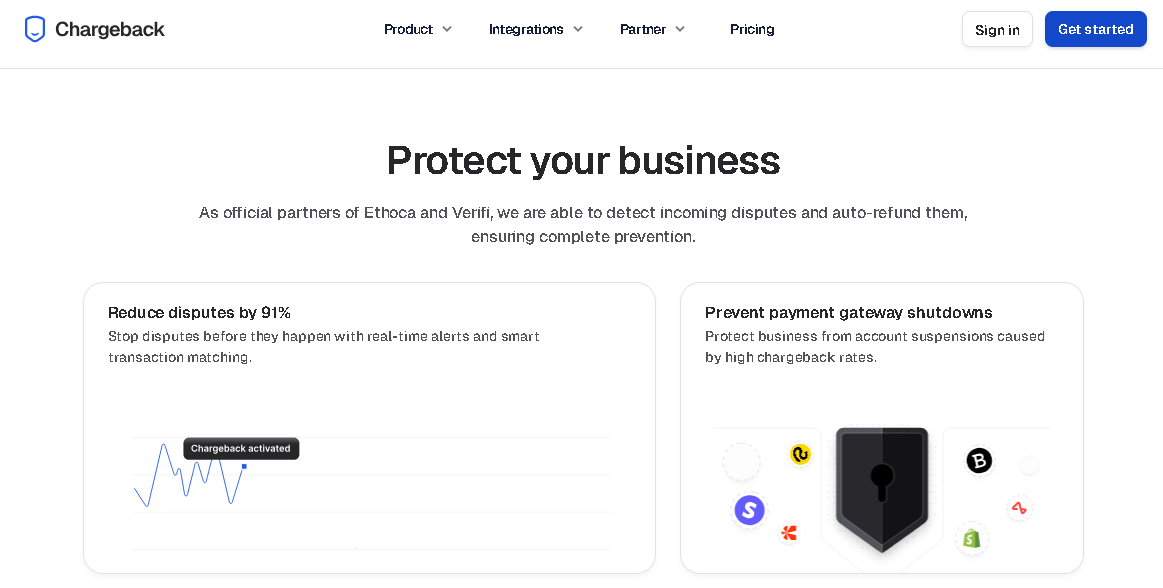
- Pricing: Per alert, with no monthly minimum and no contract
- Coverage: Ethoca and Verifi, covering both card networks
- Features: Dispute alerts, automatic refunds under a threshold you set, automatic subscription cancellation, processor health monitoring, MCP for account help
- Integrations: Stripe, Shopify, Adyen, and NextCommerce
<style>.wf-pc{display:flex;flex-wrap:wrap;gap:16px;margin:24px 0}.wf-pc>div{flex:1 1 240px;border:1px solid #ddd;border-radius:8px;padding:16px}.wf-pc h4{margin:0 0 8px;font-size:1rem;font-weight:600}.wf-pc ul{margin:0;padding-left:20px}.wf-pc li{margin-bottom:6px}.wf-pc .pros{border-top:3px solid #1f9d55}.wf-pc .cons{border-top:3px solid #c53030}</style>
<div class="wf-pc">
<div class="pros"><h4>Pros</h4><ul>
<li>Covers both card networks in one setup</li>
<li>Auto-refunds an alert before it becomes a chargeback</li>
<li>Cost tracks your dispute volume, with no monthly minimum</li>
</ul></div>
<div class="cons"><h4>Cons</h4><ul>
<li>Prevention only, so filed disputes need a second vendor</li>
<li>Fraud scoring at checkout takes a separate tool</li>
</ul></div>
</div>
We sell prevention only, billed per alert, and you can stop any month. An alert arrives from Ethoca or Verifi, and we match it to the order in your processor. If it falls under a threshold you set, we refund it automatically.
The auto-refund threshold is the setting merchants get backwards most often.
Set it too low and no alert qualifies, so someone has to approve every one by hand. Pick the order value you'd rather refund than fight, then check the first week's alerts against it.
Our alert coverage prices against your own dispute volume, so you can size it before you commit.
2. Signifyd
- Best for:
- Larger stores shifting fraud liability off their own books
- Merchants pushing approval rates up without absorbing the risk
- Pricing: A percentage of approved order value, quoted per merchant
- Coverage: Order screening at checkout across major card brands
- Features: Machine-learning order scoring, instant approve-or-decline decisions, a chargeback guarantee on approved orders
- Integrations: Major e-commerce platforms and processors, through its own app listings
<div class="wf-pc">
<div class="pros"><h4>Pros</h4><ul>
<li>The guarantee moves fraud liability off approved orders</li>
<li>Instant decisions keep fulfillment moving</li>
<li>Charges nothing on orders it declines</li>
</ul></div>
<div class="cons"><h4>Cons</h4><ul>
<li>Pricing is quoted per merchant rather than published</li>
<li>Cost scales with how much you sell</li>
<li>A customer who received the goods and disputes still gets through</li>
</ul></div>
</div>
Signifyd scores orders at checkout and guarantees the ones it approves, so it charges a percentage of every order it clears. A clean month still carries a bill.
The guarantee is what larger stores buy. It lets a merchant approve borderline orders it would otherwise decline, because the fraud loss on an approved order moves to Signifyd.
Ask which dispute types the guarantee covers, since it's written around fraud and unauthorized-charge claims.
The category boundary matters more than the price here. Screening acts before the charge, so a customer who really placed the order and disputes it later never reaches Signifyd's screening at all.
3. Chargebacks911
- Best for:
- Enterprises with steady dispute volume and budget for a managed service
- Merchants who want filed chargebacks fought for them
- Pricing: Custom quote, with no public rates
- Coverage: Managed representment across processors, plus alerts
- Features: Managed dispute response, reason-code analytics, compliance review, alert handling
- Integrations: Major processors and gateways, scoped during the sales process
<div class="wf-pc">
<div class="pros"><h4>Pros</h4><ul>
<li>Their team writes and files every response</li>
<li>Detailed reporting across dispute reasons</li>
<li>Built for volume a small team can't work by hand</li>
</ul></div>
<div class="cons"><h4>Cons</h4><ul>
<li>Every quote runs through a sales conversation</li>
<li>Works mostly after a chargeback has already filed</li>
<li>Its 2023 regulatory settlement still shapes the contract terms</li>
</ul></div>
</div>
Chargebacks911 fights chargebacks after they file and quotes privately, so its cost depends on a scoping call rather than a published rate. It handles the volume an in-house team of one or two people can't work through.
A managed model changes what you're buying.
An outside team writes the dispute responses, and that fits a merchant with volume and nobody to assign to it. Their team also decides which disputes are worth fighting, so ask for win rates by code and weigh them against merchant dispute win rates overall.
Treat its regulatory history as part of the evaluation. Ask whether the contract caps which reason codes they'll fight and whether it auto-renews, then get the reliability answers in writing.
4. Chargeflow
- Best for:
- E-commerce stores that want recovery first and prevention as an add-on
- Merchants who want a dispute dashboard across several processors
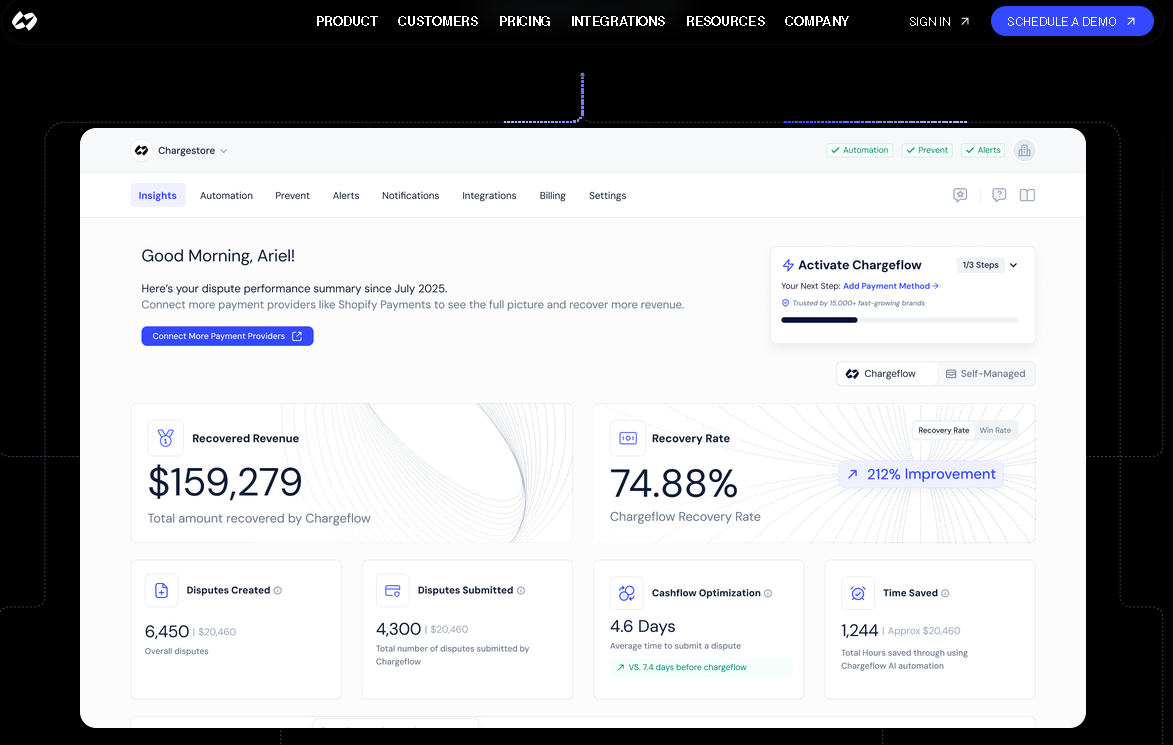
- Pricing: Tiered, from free analytics up to a share of each recovered dispute
- Coverage: Recovery automation plus separately billed alerts and transaction scanning
- Features: Automated dispute responses, a cross-processor dispute dashboard, transaction scanning, alerts
- Integrations: Shopify and Stripe most deeply, plus other processors and platforms
<div class="wf-pc">
<div class="pros"><h4>Pros</h4><ul>
<li>No monthly fee on the recovery product</li>
<li>Free analytics tier covers disputes across processors</li>
<li>Layers prevention scanning on top of recovery</li>
</ul></div>
<div class="cons"><h4>Cons</h4><ul>
<li>Alerts and scanning bill separately from the recovery share</li>
<li>A recovered dispute still counted against your ratio that month</li>
<li>The tier structure makes total cost hard to predict</li>
</ul></div>
</div>
Chargeflow sells prevention and recovery as separate priced tiers, so what you pay depends on which products you switch on. Its core product takes a share of what it recovers, and the alert and scanning products bill on top of that.
The split billing is where merchants misjudge the total.
Ask for the price of the alert product and the scanning product separately, then add both to the recovery share before you compare it against anything else.
How we sourced our data
The ranking and query history behind this article comes from our own Google Search Console data for this page. We pulled monthly position, impressions, and query-level data for this URL, covering April through July 2026.
These numbers are about our page, so they tell you what buyers ask us and nothing about the vendor market.
FAQ
Do companies get in trouble for chargebacks?
Yes, too many chargebacks get a merchant listed in a card network monitoring program, which brings fines and can end in account termination. Processors add their own reserves and payment holds first.
Are most chargebacks successful?
Most disputes end in the cardholder's favor, though merchants who answer the specific reason code win a meaningful share. Win rates vary widely by reason code and by how fast a merchant responds.
Is a chargeback company worth it for a small business?
Yes, once you've fixed your billing descriptor and disputes keep arriving. Pick a per-alert vendor with no monthly minimum, so a low-volume month costs you almost nothing.
Can you switch chargeback companies without losing history?
Your dispute history stays with your payment processor and the card networks, so it survives a vendor switch. Export any reporting or case notes held in the old vendor's dashboard before you close the account.