RDR vs. CDRN vs. Ethoca: Which is Right for You?


RDR and CDRN both come from Verifi, which is Visa's dispute-resolution company. Ethoca comes from Mastercard. The three differ in which card brand they cover, whether resolution is automatic or manual, and what each alert costs.
I've disputed chargebacks and fixed billing descriptors on my own stores, and later advised merchants on the same thing. The mistake I see most often is treating RDR and CDRN as one product because they both come from Verifi.
Pick the right mix for your card-brand split and you stop paying for a network that barely touches your dispute volume.
Key takeaways
- Ethoca comes from Mastercard, and RDR and CDRN both come from Verifi.
- RDR auto-refunds instantly, while CDRN and Ethoca give you 72 hours.
- Our per-alert pricing runs $29 Ethoca, $15 RDR, and $15 CDRN.
- Your Visa-vs-Mastercard dispute split decides which mix fits.
- All three barely cover American Express, JCB, and Discover disputes.
What's the difference between RDR, CDRN, and Ethoca?
RDR and CDRN are both Verifi (Visa) products that split on automation, while Ethoca is Mastercard's separate network, so the three differ on owner, decisioning, and cost. RDR resolves automatically, but CDRN and Ethoca both give you a response window instead.
The names don't tell you who owns each network, and that's the part that matters. Verifi runs two of them, so people flatten all three into one list.
The choice comes down to three things. Each network covers a different card brand, decides a case its own way, and charges its own price per alert. Start with card brand, because it rules most networks out right away. An alert network mostly sees disputes on its parent's card brand.
Your card-brand mix decides which of the three matters most.
A Visa-heavy merchant weighs Verifi's two products first, and a Mastercard-heavy one weighs Ethoca. Only once the card brand fits does decisioning become the next question, and that's where RDR and CDRN part ways despite sharing a parent.
Here is the same split as a table:
One row is an exception. Verifi's own site says CDRN can carry "Visa and non-Visa transaction disputes." So card-brand mix predicts where Ethoca and RDR help, but it under-predicts CDRN. Our Ethoca and Verifi comparison has the two-company breakdown.
Summary: Ethoca is Mastercard's, and RDR and CDRN are both Verifi's (Visa's). They differ on owner, decisioning, and cost.
How RDR works (and why it resolves against you)
RDR automatically refunds the cardholder using rules you set, before a formal chargeback files, so you never get to contest the underlying claim. The refund fires the moment a qualifying alert lands, with no per-case review.
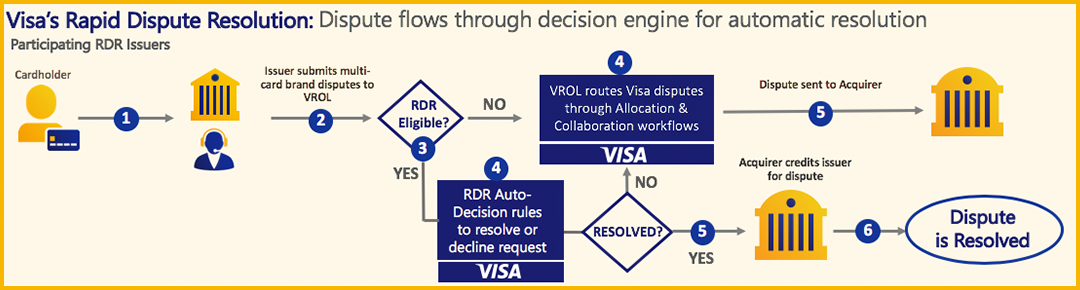
RDR runs on a decision engine you configure once. You set transaction-amount thresholds, reason codes, and a merchant category. Those settings pre-authorize the refund, so the real decision happens at setup and applies to every qualifying alert after.
The speed comes with a tradeoff. RDR resolves at the acquirer level, in seconds, without anyone opening the case. You never see most of these disputes as decisions to make, which is the speed merchants sign up for.
Our RDR auto-refund guide walks through the rule setup.
That automation cuts both ways.
Set overly broad rules and you refund cases you could have won on the merits. That's the "feels like a scam" complaint you'll find in merchant forums. The fix is to narrow the rules. Scope them to the disputes you'd concede anyway, and you keep the speed without losing the winnable ones.
Summary: RDR refunds automatically from your preset rules, so scope those rules carefully or you'll auto-lose cases you could have won.
How CDRN and Ethoca work
CDRN and Ethoca both route the alert to you for a manual decision inside a fixed window, usually 24 to 72 hours, instead of resolving it automatically. You check the alert against the original charge and either refund or let the window lapse.
That manual window is only the network default. Connect a payment processor to a reseller like Chargeback.io, and it auto-refunds these on your rules, like RDR does.
Left manual, your system or Chargeback.io matches each alert to the transaction. The match is the step that can go wrong. If the billing descriptor doesn't line up with the charge in your processor, the alert can't be confirmed, and a real dispute goes unhandled.
Let the window lapse and you lose the chance to catch the dispute early. The upside of the manual step is that it lets you decline a low-confidence match instead of refunding it blind. Where RDR concedes every qualifying case, CDRN and Ethoca leave the call with you.
Our CDRN alerts guide walks through the Visa side of that manual step.
For the Mastercard side, our Ethoca alerts guide has the full walkthrough.
Manual review only helps if someone acts inside the window. New users get burned here during setup. Our own support tickets show a 2-to-7-day activation lag on RDR, which triggers "it's not working" messages in week one. The same timing trap hits any network before its alerts start flowing.
Summary: CDRN and Ethoca hand you the alert by default, though a reseller integration can auto-refund them on rules you set.
What RDR, CDRN, and Ethoca cost
Our per-alert pricing is Ethoca $29, RDR $15, and CDRN $15 for US transactions, so the cheapest network depends on your card-brand mix. The real comparison is price times your expected monthly alert volume for that mix.
Weigh that against what a fought dispute already costs. Stripe charges a $15 dispute fee that you pay whether you win or lose. An alert that prevents the chargeback can pay for itself on that fee alone.
Volume is the multiplier.
A merchant seeing a handful of Visa disputes a month runs different math than one seeing hundreds, even at the same $15 price.
Run the price against your real monthly count for each card brand in our ROI calculator. The mix that fits usually costs more than the cheapest sticker price suggests.
Dropship.io followed that math. It enrolled in RDR and CDRN because Visa was over 50% of its dispute volume. Coverage drove the call, and price rode along with it.
Paying for Ethoca would have meant paying almost double per alert for a network that touched less than half its disputes.
The math flips for low-volume merchants. If your dispute count is small enough, the per-alert cost can exceed what you're losing to chargebacks now. Alerts earn their price once dispute volume clears that threshold.
You can check the same pricing page against your own card-brand mix.
Summary: The comparison that matters is price times your alert volume against the cost of a fought dispute.
Which one should you enroll in?
Your card-brand mix should decide which networks you enroll in. All three cover American Express, JCB, and Discover only lightly or not at all. A Visa-heavy merchant leans Verifi, and a Mastercard-heavy one leans Ethoca.
Pull your processor dashboard and read the card-brand breakdown of your disputes. Then weigh that split against how each network decides a case, automatic for RDR and manual for the other two.
If AmEx is a real slice of that mix, none of these three covers it well. American Express runs its own free program for the gap, Accelerated Dispute Resolution (ADR). It alerts you to non-fraud disputes on US accounts before they file. You enroll for it directly with Amex, separate from these networks.
Your chargeback ratio is what you're protecting.
A chargeback rate above your processor's threshold puts your account at risk, which is the whole reason to catch disputes before they file.
Across our own platform, Visa's two products combined edge out Mastercard's Ethoca on alert volume, as our RDR guide breaks down. That's a useful reference point, but your own dashboard is the number that decides your mix.
Summary: Your card-brand mix decides the enrollment. Check your own dispute split before you weigh either network.
A recommended alert stack
For the widest coverage, most merchants layer the networks in this order. The list runs from the brands behind most disputes down to the narrowest gaps:
- Ethoca and RDR first. This pair covers Mastercard and Visa, the two brands behind most disputes.
- CDRN next, only if RDR won't enroll. A shared BIN or missing BIN, CAID, or ARNs can block RDR, and CDRN is the Visa fallback for US transactions.
- Amex fraud coverage through your provider. Ask your alert provider to add it, since the networks above barely touch Amex.
- ADR for non-fraud Amex. Amex's own free program covers the disputes fraud alerts don't, if you're eligible.
Start at the top and add each layer your volume justifies. A Visa and Mastercard seller rarely needs past step two.
How to enroll in each network
You turn on RDR, CDRN, and Ethoca either by contracting with Verifi and Mastercard's Ethoca directly, or through a partner that holds both relationships. A direct contract means running the matching and refund logic yourself, so most merchants enroll through a partner instead.
Chargeback.io is an official partner of both, which puts all three products behind one enrollment.
Each of the three asks for something slightly different at setup:
- RDR enrolls on your BIN and CAID or ARNs, plus your billing descriptor.
- CDRN and Ethoca enroll on your exact billing descriptor, matched to the statement text character for character.
- Ethoca covers Mastercard by default, while American Express runs on a separate Ethoca enrollment you ask for.
If you're switching from another provider, its descriptors have to be released before yours can enroll, which is the most common thing that stalls a migration. RDR then takes a few business days to activate, so an empty first week just means the setup is still warming up.
How we sourced our data
The per-alert prices here come from Chargeback.io's own public pricing page. We cite the rate listed there for each network at the time of writing. Pricing changes, so check the live page before you budget for your own volume.
FAQ
Can I use all three networks at once?
Yes, you can enroll in all three together, and a balanced card mix is the case where that's worth doing. Each is strongest on its own card brand, so running all three widens coverage rather than duplicating it.
Does a resolved alert count against my chargeback rate?
No, an alert resolved before a chargeback files never reaches your chargeback ratio, which is the point of catching it early. An actual chargeback does count, so preventing it is what protects the ratio.
What if I'm not enrolled in the right network?
The dispute goes straight to a standard chargeback with no pre-dispute chance to resolve it. That's the usual outcome for the card brands that sit outside all three networks.
Do RDR and CDRN work on debit cards?
Yes, both work on Visa debit and credit, since they route on the card network rather than the funding type. What matters is your Visa-vs-Mastercard split, because debit and credit get the same coverage.