Kount Alternatives (2026): Compared by Price and Fit

The best Kount alternatives for fraud screening are Sift, SEON, Signifyd, Riskified, and Forter, and each one fits a different transaction volume and budget. None of them, Kount included, cover chargeback-specific alerts once a dispute has already been filed.
When I worked chargeback support, the merchants who got the most out of alerts were the ones who'd already fixed the basics. An alert on a charge the customer still can't place buys you a refund instead of a save.
Merchants switching fraud-screening tools hit that same gap, because they assume the new vendor covers chargebacks too. By the end you'll have one screening vendor matched to your volume and budget, plus a clear read on what it leaves open.
Key takeaways
Still on Kount? Price our alert coverage against your last quarter of disputes.
What are the best Kount alternatives?
The best Kount alternatives are Sift, SEON, Signifyd, Riskified, and Forter, and your pick comes down to volume, budget, and whether you want a chargeback guarantee behind the score. No single one wins for every merchant.
All six, Kount included, do the same core job in different ways. Each scores an order for fraud risk before or at checkout, reading device fingerprints, identity data, and behavioral signals.
Then it approves the order, declines it, or flags it for review.
A vendor built for enterprise fraud teams is usually the wrong pick for a merchant who wants to sign up this week. Kount and Forter both target enterprise fraud teams, and both quote custom. SEON targets smaller merchants and publishes a starting price.
The guarantee question splits the group again. Signifyd, Riskified, and Forter will absorb fraud chargebacks on orders they told you to approve, which turns fraud loss into a line item you can predict. Sift and SEON score the order and leave the loss with you, which costs less per order and more when one gets through.
Pick against your own transaction volume. The longest feature list rarely decides it.
Kount alternatives compared
Signifyd, Riskified, and Forter include a chargeback guarantee, Sift and SEON don't, and only SEON publishes a price.
All five screen orders, so none of them overlap with the chargeback prevention software category. Here's how the five sort out:
- Sift: the closest like-for-like Kount swap.
- SEON: the only published starting price.
- Signifyd: a liability shift on approved orders.
- Riskified: guaranteed approvals, quoted rate.
- Forter: contractually guaranteed rates at enterprise scale.
Read the table by pricing model first, since that decides what a vendor costs you at your volume:
1. Sift
- Best for:
- Mid-market merchants who want to tune their own risk models
- Teams replacing Kount who want a comparable decisioning engine
- Pricing: Subscription plus usage, quoted per merchant, no published tiers
- Chargeback guarantee: No
- Replaces in Kount: Order scoring and decisioning
Sift is the closest like-for-like swap for Kount, and it markets itself directly against Kount on model tuning. Sift's own comparison page argues that Kount lags in user management and statistical decisioning. It also says Kount exposes no algorithm tuning to the merchant.
Sift wrote that about a competitor, so read it as a sales pitch. It still tells you what Sift wants to be judged on, which is how much control your team gets over the model.
Pricing works the same way Kount's does, so you'll book a call either way. Switching to Sift won't get you a published price.
The fit question is who tunes the model.
A merchant with a risk analyst on staff gets value from exposed tuning, since someone can act on it. A merchant without one pays for tuning they'll never use, and a guarantee-backed vendor covers more ground for that money.
2. SEON
- Best for:
- Merchants who want a real number before talking to sales
- Smaller teams that need setup measured in days
- Pricing: Starter at $699 a month for 2,500 fraud checks, 10 users, and 50 custom rules, with a custom Premium tier
- Chargeback guarantee: No
- Replaces in Kount: Order scoring, device and identity signals
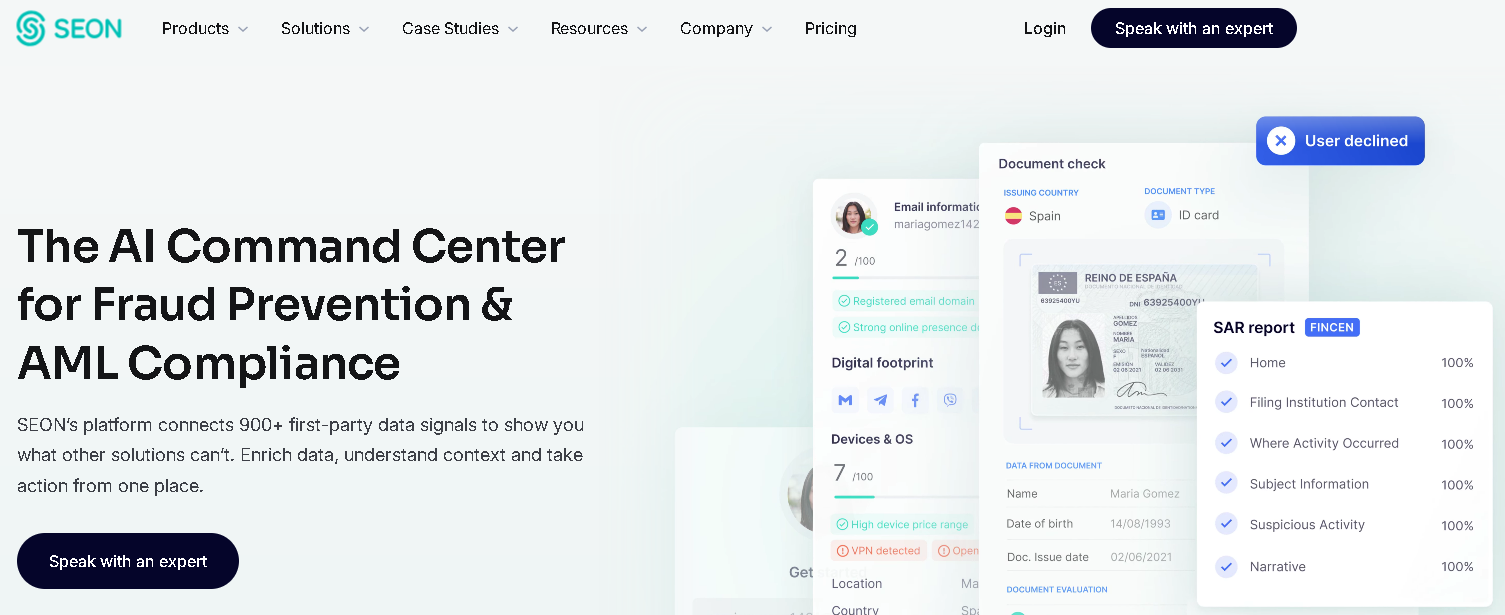
According to SEON's own pricing page, it is the only vendor here that publishes a starting price, at $699 a month on its Starter plan. The Premium tier moves to custom pricing.
Published pricing changes how you evaluate.
You can size the cost against your order volume tonight, while a quote takes a week. That matters when you're comparing five vendors at once.
The tradeoff shows up at scale. A merchant past 2,500 monthly checks lands in Premium and back in a custom quote. The transparency helps smaller merchants most.
Count your real check volume before you read that price as your price. Every order you screen consumes a check, so a store running 4,000 orders a month has already outgrown Starter.
3. Signifyd
- Best for:
- Merchants who want fraud liability off their approved orders
- Stores pushing approval rates up without eating the risk
- Pricing: A percentage of order total on approved orders, with no charge when an order is declined for fraud
- Chargeback guarantee: Yes
- Replaces in Kount: Order scoring, plus a liability shift Kount doesn't offer
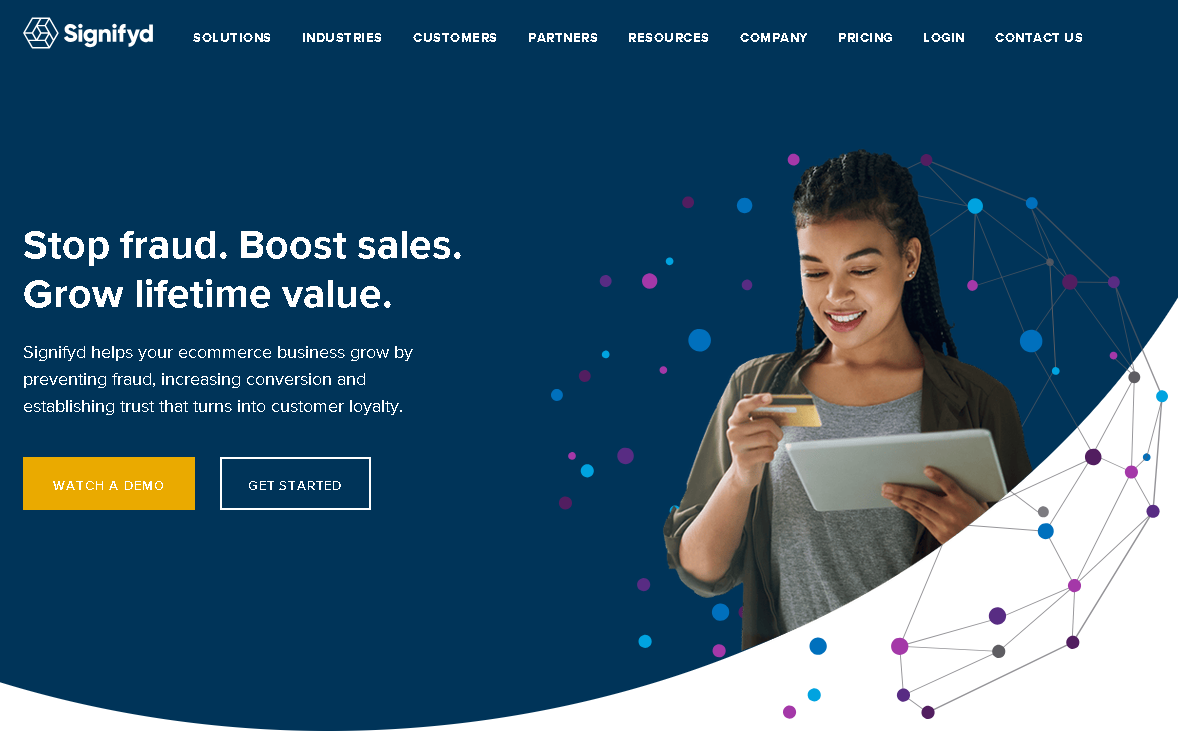
Signifyd charges a percentage of each approved order and takes on the fraud liability for the orders it clears. The rate varies by the products bought, your vertical, order volume, and average ticket price.
You pay on sales instead of on the number of orders screened, so a busy month costs more even when every order was clean.
The guarantee covers fraud, which is narrower than it sounds.
It pays on fraud disputes only. Cancellation, item-not-as-described, and subscription confusion all fall outside it, and those chargebacks still count against your ratio. Read the excluded reason codes before you price the coverage.
4. Riskified
- Best for:
- Higher-volume merchants focused on approval rates
- Teams that want fraud chargebacks covered contractually
- Pricing: Pay only for approved orders that generate revenue, with no published rate
- Chargeback guarantee: Yes
- Replaces in Kount: Order scoring, plus chargeback coverage on approved orders
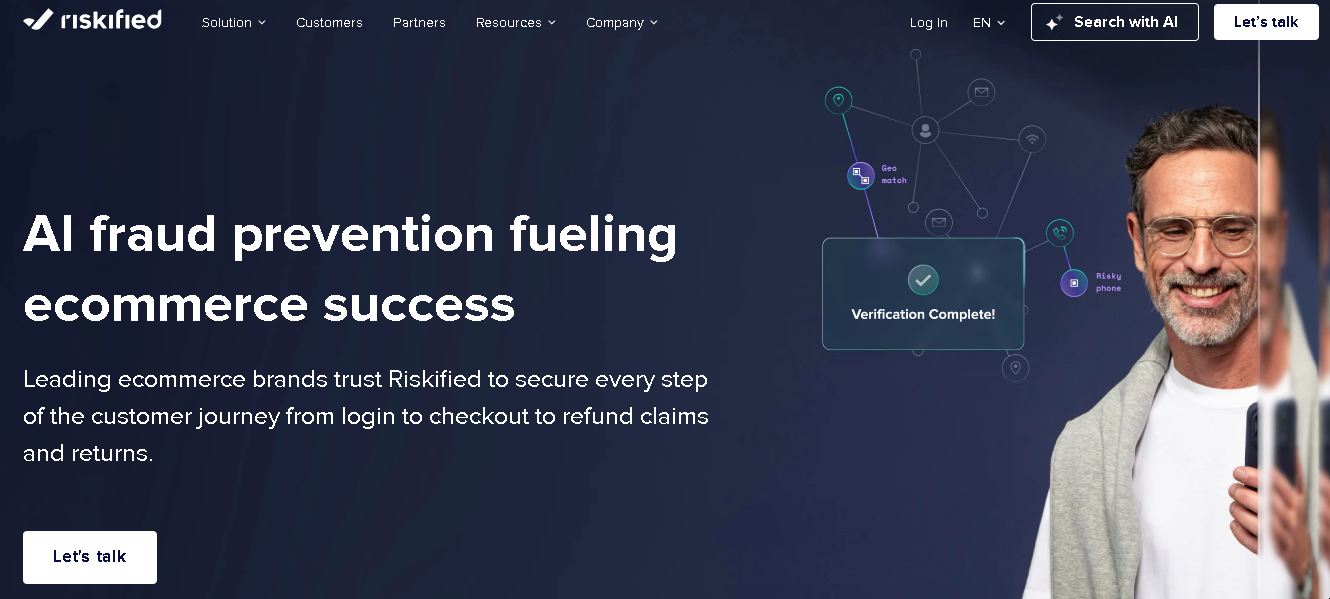
Riskified guarantees its approval decisions and covers the chargebacks that follow, so you pay only for approved orders that generate revenue. Riskified states that model plainly on its own chargeback-guarantee page.
Guarantee pricing moves the risk of a wrong approval onto the vendor. A vendor paying for its own chargebacks also has a reason to decline anything it reads as risky, which can cost you good orders.
No public rate exists, so the percentage arrives in a quote.
Ask what the guarantee excludes while you're in that call. It pays on fraud losses, and disputes filed for other reasons stay yours.
The approval-rate framing tells you who Riskified is built for. The guarantee exists so the vendor can approve orders a stricter tool would reject.
So a merchant losing revenue to false declines gains more here than one losing it to chargebacks. Check your own decline rate first.
5. Forter
- Best for:
- High-volume enterprise merchants
- Teams that want performance guaranteed in the contract
- Pricing: Custom contract with guaranteed approval and chargeback rates, plus a 90-day performance trial
- Chargeback guarantee: Yes
- Replaces in Kount: Enterprise order scoring and decisioning
Forter contractually guarantees both approval and chargeback rates, which is the firmest commitment any vendor here makes. It also offers a 90-day run against your current vendor. Forter states you pay nothing if it can't beat that vendor on both rates.
A contractual rate turns a sales claim into something you can hold a vendor to. The 90-day trial does that job earlier, since it puts the vendor's numbers on your own traffic first.
Forter sits at the enterprise end with Kount, so the scale it's built for is more than most merchants need. Setup effort and contract size both reflect that.
Read the trial terms closely before you treat it as free.
The trial measures its rates against your current vendor's, so you need clean baseline numbers to compare. Pull your last 90 days of approval and chargeback rates first.
How much does Kount cost?
Kount publishes no pricing tiers at all, so every quote is custom and starts with a sales call. Its own pricing page says pricing depends on your business goals and transaction volume, among other factors, and asks you to request a quote.
Custom quoting is normal at the enterprise end of fraud screening. Forter runs the same way, and Signifyd's rate varies per merchant. Integration scope and per-order scoring costs swing too widely to print a flat rate.
Most enterprise chargeback companies price the same way, so a custom quote isn't a red flag on its own.
You can still get a usable number out of a quote process. Every vendor prices off three inputs, so bring all three to the first call:
- Your monthly transaction count.
- Your average order value.
- Your current chargeback rate.
A merchant who arrives with those gets a real figure in one call instead of three.
Ask for the per-order cost at your volume, not the contract total. A monthly figure hides whether you're paying for screening capacity you won't use, and the per-order number is what you can compare across all six vendors.
What is Kount 360, and is "Kount Central" still a thing?
Kount 360 is Equifax's current fraud-screening platform, and it replaced the entire older Kount product line, including Kount Central, on March 2, 2023. Kount 360 is now the only Kount product to shop.
Kount 360 runs on the Equifax Cloud. It combines device fingerprinting, identity data, and payment history into one fraud-risk decision. You manage a single platform instead of separate point products.
The consolidation matters for anyone mid-evaluation. A quote written against the old product names won't map cleanly onto what Kount 360 sells today.
Ask the sales team to restate the scope in current terms before you compare it against Sift or Forter.
The absorption goes further than the product name. kount.com now redirects to Equifax's general identity-fraud page, so a merchant searching for Kount may land on Equifax branding first.
This matters when you're reading comparison content. A page that still lists Kount Central as a live product was written before the 2023 consolidation.
It hasn't been updated since, so treat its pricing and feature claims the same way.
So check the publish date on any Kount comparison you're reading, including this one. Then confirm the current product name on Equifax's own site before you take a quote.
What fraud-screening software doesn't cover
Kount and all five alternatives score orders at checkout, and none of them prevent a chargeback once a dispute is filed against an order they approved. That's a second job, and it takes a second vendor.
Three tool types cover one transaction's life, and each acts at a different moment:
Our breakdown of how the alert networks differ covers which one reaches which card brand.
The recovery vendors get their own treatment in our Chargeflow alternatives comparison.
Take our Dropship.io case study. This SaaS merchant ran high volume through Stripe, and its chargeback rate still climbed to 0.93% before it turned on RDR and CDRN alerts.
Its disputes clustered at trial-to-paid conversion and renewals, where a checkout score has nothing left to decide.
Fix the cheapest thing first. Set your billing descriptor to your store name plus a support number, so the bank reads back a charge the customer recognizes.
Then enable RDR and CDRN for Visa disputes, and Ethoca for Mastercard. Our chargeback prevention coverage handles that enrollment.
Even then, some disputes stay out of reach. Tokenized wallet payments through Apple Pay, Google Pay, and Stripe Link are harder for alert networks to match to the original charge. Budget for a residue of chargebacks no tool catches.
FAQ
Who acquired Kount?
According to Equifax's own investor announcement, it acquired Kount for $640 million under an agreement announced in January 2021. The deal was expected to close in the first quarter of that year.
Who uses Kount?
Kount serves mid-market and enterprise merchants, along with banks and payment providers that need order-level fraud decisioning at volume. Since the Equifax acquisition, it's sold as part of Equifax's broader identity and fraud business.
How many employees does Kount have?
Kount no longer reports headcount separately, because it operates as part of Equifax rather than as a standalone company. Equifax absorbed the team after the 2021 acquisition, so current staffing sits inside Equifax's identity and fraud business.
Is Kount worth it, or should I switch?
Kount is worth keeping if you need enterprise-scale decisioning and already have the integration running. Switch when you want published pricing, faster setup, or a chargeback guarantee Kount doesn't offer.
Do I still need chargeback alerts with a tool like Kount?
Yes. Screening and alerts cover different points in the transaction, so merchants commonly run both together.