Mastercard Chargeback Guide: Time Limits and Thresholds


This Mastercard chargeback guide starts with the core fact that matters most. A cardholder can reverse a charge within 120 days of the transaction, and 540 days in a narrow set of cases.
I lowered my own chargeback rate before I ever touched a dispute, by fixing the descriptor and turning on alerts. The cheapest chargeback is the one you head off first. This guide gives you the exact time limits and thresholds, and a way to stay under them.
Key takeaways
- Cardholders get 120 days to file a Mastercard chargeback, 540 for non-delivery disputes.
- Merchants get 45 days to respond with representment evidence.
- The Excessive Chargeback Merchant Program starts at 100 chargebacks and a 1.5% ratio.
- The higher tier starts at 300 chargebacks and a 3.00% ratio.
- The Excessive Fraud Merchant Program triggers at $50,000 in fraud, 50 basis points.
- Exiting either program takes three straight compliant months.
What is a Mastercard chargeback, and how does it work?
A Mastercard chargeback reverses a card payment when a cardholder disputes it with their bank. The bank moves the disputed amount back to the cardholder while it works out the claim.
The money leaves your account before anyone settles the case.
The dispute runs through the issuing bank first. Mastercard routes the claim to whichever bank issued the card. That bank pulls the funds and tells your acquirer, which is why you often find out only after the money is gone.
People mix up two things with a chargeback. A refund is money you send back on your own. A retrieval request is a bank asking for records, with no money moving. Only a chargeback forces the reversal and counts against your ratio, the number Mastercard watches:
How long do you have to file a Mastercard chargeback?
Cardholders generally have 120 days from the transaction date to file a Mastercard chargeback, and you get 45 days to respond with evidence.
A narrow set of reason codes stretches the cardholder window to 540 days, mostly disputes over services that were never delivered or were stopped partway.
The clock starts on the transaction processing date, and Mastercard counts that day as day one. Visa starts its count the day after. So two disputes that look like they share a deadline can sit a day apart. Near the edge of the window, that one day decides whether the filing is valid.
The 540-day window is the exception. It applies only to codes tied to non-delivery or discontinued service, like a subscription you paid for and then lost. Most Mastercard chargebacks live inside the standard 120 days, so plan your evidence process around that.
The stages of a Mastercard chargeback
A Mastercard chargeback moves through three stages, from the first chargeback to representment to arbitration. Each stage hands the next decision to the other side, so a case only goes the full distance when neither party backs down.
Here's what happens at each stage:
- First chargeback: the issuing bank reverses the funds and sends the dispute to your acquirer.
- Representment: you submit evidence to reverse the reversal and get the money back.
- Arbitration: Mastercard rules on the case, but only if a compliance case is filed after representment.
Each stage exists because the network gives both sides one chance to contest the last outcome. Representment answers the first chargeback. Arbitration answers a disputed representment.
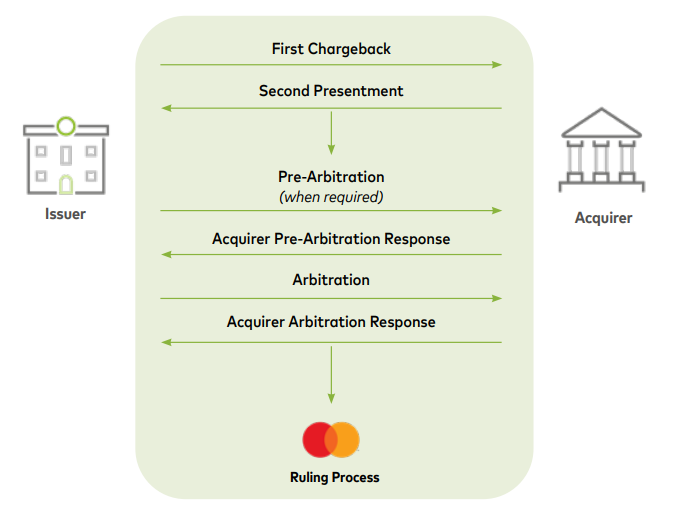
Most chargebacks never get that far. Arbitration only starts when a party formally files a compliance case, which carries its own fee. That extra step is why a contested representment usually ends the matter, so treat arbitration as the rare exception.
Mastercard's chargeback monitoring program thresholds
You enter Mastercard's first monitoring program at 100 chargebacks in a calendar month with a ratio at or above 1.5%. Mastercard runs two of these programs. One tracks your total chargeback volume, the other tracks fraud.
Here are the thresholds for each tier:
Those ECM and HECM cutoffs come from JPMorgan Chase's program guide. The fraud program adds a dollar floor on top of the table's counts, and it only kicks in once fraud chargebacks pass $50,000.
The ratio is what catches merchants off guard. It divides this month's chargebacks by last month's sales. So a drop in sales lifts next month's ratio on the same chargeback count, and seasonal sellers feel it first.
The fines scale with how long you stay enrolled:
On top of that, an issuer recovery assessment adds EUR/USD 5 per chargeback over 300.
Say you have 500 chargebacks and stay in HECM for four to six months. The base fine is EUR/USD 10,000. The issuer recovery adds EUR/USD 1,000, since 200 chargebacks clear the 300 line.
Two rules soften the edges. Breach EFM and ECM in the same month, and Mastercard bills you under EFM only. It pauses the ECM assessment until you exit EFM, and exiting either program takes three straight compliant months.
Our Mastercard monitoring programs guide has the exit rules and full fine schedule.
Mastercard chargeback reason codes
Mastercard sorts its chargeback reason codes into five categories, each covering a different root cause for the reversal. Every category maps to a distinct kind of dispute, and the sections below take them one at a time.
The category decides what evidence wins the dispute. A fraud code needs proof the cardholder authorized the purchase, while a cardholder-dispute code needs proof the goods arrived as described.
Fight every chargeback with one generic evidence packet, and you'll lose ones you could have won.
You can also look up a reason code with our free tool when you need the exact definition.
Cardholder disputes
Cardholder-dispute codes cover claims that the product or service was wrong, missing, or not as promised. This is where non-delivery, "not as described," and cancelled-recurring disputes land. To win them, show proof of what you delivered, like tracking, delivery confirmation, service logs, or a signed terms page.
Fraud-related codes
Fraud codes cover claims that the cardholder never authorized the transaction at all. These include card-not-present fraud and chip liability-shift disputes. Winning one means proving the real cardholder made the purchase. That's why signals like AVS matches, 3D Secure, and purchase history carry the weight here.
Authorization-related codes
Authorization codes cover disputes where the transaction was never properly approved. A missing approval, an expired authorization, or a charge that ran after a decline all fall here. These are usually process errors on your side or the processor's, so the fix is tighter authorization handling upstream.
Point-of-interaction errors
Point-of-interaction codes cover mistakes in how the transaction itself was processed. Duplicate charges, wrong amounts, and currency errors sit here. Your evidence is the transaction record showing what was charged. These disputes often resolve fast, because the record either backs you or it doesn't.
Additional codes
A small set of remaining codes covers disputes that don't fit the four main groups. These are lower-frequency situations, and they follow the same rule as the rest. Match your evidence to the exact code the issuer cites.
Our Mastercard chargeback reason codes guide has the full list with per-code detail.
The 3-Layer Mastercard Chargeback Defense
Three layers keep you under Mastercard's thresholds, and they run in sequence. Each one catches a dispute at a different point, from before the cardholder doubts the charge to after the chargeback is on your record.
The order is the whole point.
Each layer only catches what the one before it missed. Pull the early ones, and every dispute drops onto the slowest, most expensive layer at the end. The three sections below walk through them in order.
Ethoca Consumer Clarity
Ethoca Consumer Clarity shows cardholders clear purchase details in their banking app, so they recognize the charge before they dispute it. Many chargebacks start with a customer who doesn't recognize a line on their statement.
Ethoca is Mastercard's own network, and Ethoca Consumer Clarity puts your business name, logo, and order details in front of that cardholder.
A charge the customer recognizes is a chargeback that never starts.
Ethoca Alerts
Ethoca Alerts notify you the moment a cardholder files a dispute, giving you a window to refund before it becomes a chargeback. This is the layer that protects your ratio directly. Resolve the dispute inside the alert window and it stays a refund you chose. It never becomes a chargeback or counts toward your ECM or EFM ratio.
The mechanics of how Ethoca Alerts work come down to speed. The faster you act, the more disputes you keep off your record.
Our chargeback prevention guide shows how to set up alert-based prevention step by step.
Mastercom collaboration
Mastercom is Mastercard's case-management process for the disputes that still reach the chargeback stage. It's where cases that need manual handling get worked between you, your acquirer, and the issuer.
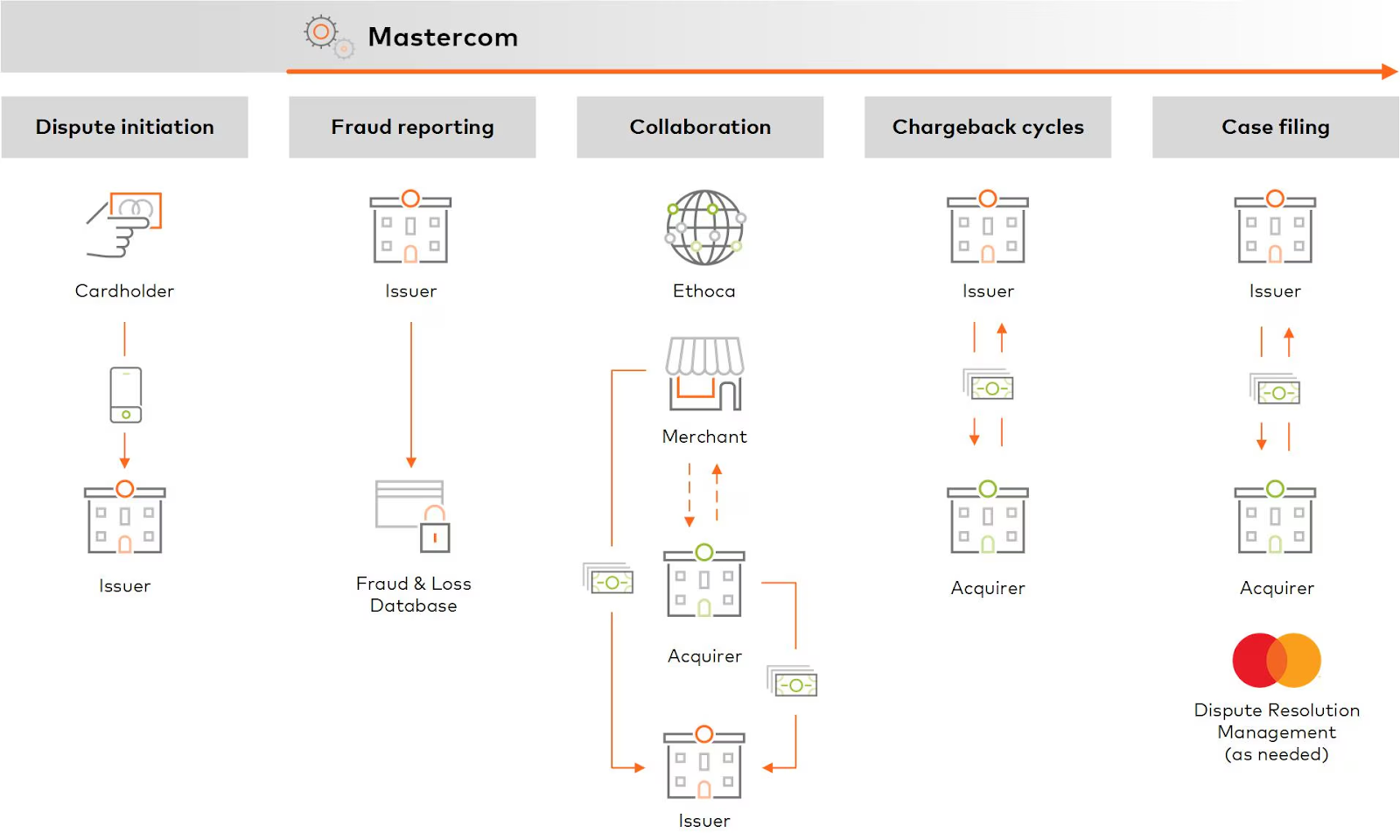
Mastercard runs it inside its own network, so it sits outside Chargeback.io and works disputes that already exist.
It's the costly fallback, so you want the first two layers stopping as much as they can.
FAQ
What are the odds of winning a chargeback dispute?
Win rates vary widely by reason code and by how well your evidence matches the code's specific question. Fraud disputes and friendly-fraud disputes carry different odds, so a single blended win-rate figure tells you little about your own cases.
What are valid reasons for a Mastercard chargeback?
Valid grounds include goods or services not received, products not as described, unauthorized transactions, and billing errors like duplicate charges. Filing a dispute just to skip a merchant's refund process counts as friendly fraud instead.
Can too many chargebacks get a merchant dropped?
Yes. Sustained breaches can lead to account termination and a spot on the MATCH list, which makes getting a new merchant account far harder.
Do chargebacks hurt future Mastercard processing?
Yes. A high chargeback rate can trigger reserve holds, stricter terms, or higher processing costs, even before you hit a formal program.