
How to Fight Product Unacceptable Chargebacks


A product unacceptable chargeback happens when a customer disputes a charge. The item was damaged, defective, or different from the listing. Each card network files it under its own reason code.
Before the dispute process, the first thing I check is the billing statement descriptor.
On my own stores, fixing what customers saw on their statement did more than any alert. A charge nobody recognizes is a chargeback waiting to happen. Get the reason code right and match the evidence. Then you can decide in minutes whether to fight or refund.
Key takeaways
What is a product unacceptable chargeback?
A product unacceptable chargeback is a dispute over an item that was damaged, defective, wrong, or misdescribed. It's a complaint about the product itself. The charge was real and the item arrived, which sets it apart from a fraud claim or a non-delivery claim.
The customer takes this to their card issuer instead of contacting you first. The issuer then assigns the dispute a reason code. That code decides which evidence can overturn the dispute and which the network ignores.
The name is informal. No card network prints "product unacceptable" on a notice. It's the umbrella term merchants use for the codes that all say one thing. The item arrived but was wrong.
Knowing that points you straight at the four real codes and saves you a search for one that isn't there.
Flag one thing early. A customer who never emailed you before disputing may be describing friendly fraud. The product may have been fine. That distinction comes up later in this guide.
Reason codes for product unacceptable chargebacks
Visa files this dispute under 13.3, Mastercard under 4853, and American Express under C31 and C32. Discover uses a single code, NR. Each code gets its own section below with the evidence it needs.
Visa and Mastercard use one catch-all code. It covers both a misdescription complaint and a damaged-item complaint.
Amex is the exception. It splits the two into separate codes. So an Amex notice tells you the complaint before you even read the detail.
Our all-network reason codes guide is the overview this table specializes:
Summary: Four networks, five codes, all covering an item that arrived damaged, defective, or not as described.
Visa reason code 13.3
Visa reason code 13.3 covers a claim that the merchandise was not as described or defective. It's Visa's single code for both complaint types. So the notice alone won't tell you which one you're dealing with.
To win it, you match evidence to what the customer actually claimed. That means the listing photos and written description, the order confirmation, and any messages about the problem. Our reason-code rebuttal template has the full 13.3 checklist and when a rebuttal is worth filing.
Read the dispute text before you build the package. A 13.3 that reads "arrived cracked" is a condition claim. One that reads "not the model I ordered" is a description claim. The same code, two different evidence sets, and the notice won't sort them for you.
Mastercard reason code 4853
Mastercard reason code 4853 is the cardholder-dispute catch-all, and item condition falls under it. It's a broad code that also absorbs several older ones. So a product complaint lands here alongside other cardholder disputes.
Because 4853 is so wide, your evidence has to pin down which complaint the customer made. The code's full scope and the older codes it replaced are in our Mastercard reason codes guide.
The width cuts both ways. It means one code to watch. But the issuer's dispute detail carries more weight than the code number does.
Start from what the cardholder wrote. Treat the 4853 label as the category, and let the detail give you the answer.
American Express reason codes C31 and C32
American Express splits this into two codes, C31 for goods not as described and C32 for goods damaged or defective. Visa and Mastercard hand you one code and leave you guessing. Amex tells you the complaint upfront.
That split changes your evidence before you start. A C31 notice is a description gap, so you build the description package. A C32 notice is a condition claim, so you build the condition package.
Both codes sit in the wider Amex system, covered in our American Express reason codes guide.
The two-code split is a head start. On a Visa or Mastercard notice, you sort the complaint by hand. On Amex, the code number does it for you.
Use it. The code tells you which package to build before you open the dispute.
Discover reason code NR
Discover reason code NR covers an item that shipped not as described or arrived defective. Like Visa and Mastercard, Discover folds both complaints into one code. You treat it the same way. Figure out which claim the customer made, then match the evidence.
Discover volume is smaller for most merchants, so NR shows up less often than 13.3 or 4853. That's a reason to have a plan for it anyway. A rare code you've never handled is the one you fumble under a response deadline.
What causes product unacceptable chargebacks?
Most product unacceptable disputes trace back to one of three gaps between what the customer expected and got. Each cause needs its own evidence, so the split matters when you respond.
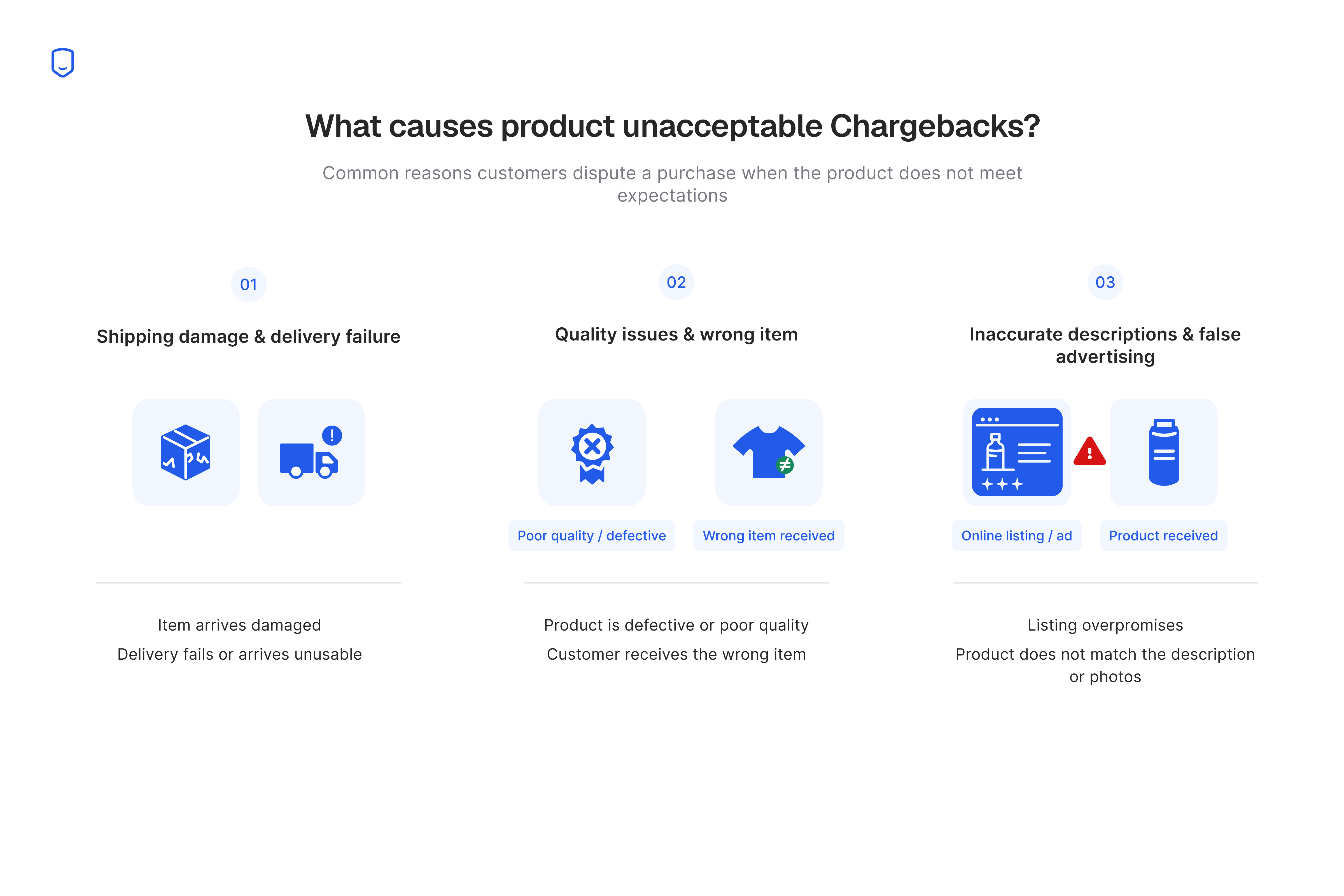
The three below run from a shipping problem to a listing problem.
1. Shipping damage and delivery failure
A product can leave your warehouse in good condition and still arrive broken. The customer disputes because the item is unusable, even though your listing was accurate.
Your defense here is condition at shipment. Packaging photos, a quality-control checklist, and the carrier's handling record show the damage happened in transit, after the item left your shelf in good shape.
2. Quality issues and wrong item
A working product that falls short, or the wrong item entirely, both land as product unacceptable. They're two different problems that share one outcome, and they need two different evidence sets.
A quality claim turns on the product spec and any warranty terms. A wrong-item claim turns on the pick-and-pack record showing what actually left. Get these mixed up and you submit proof that answers a question the customer never asked.
3. Inaccurate descriptions and false advertising
When the listing promised more than the product delivered, the dispute is about your words. A "genuine leather" bag that's synthetic gives the customer a real not-as-described claim. So does a "30-hour battery" that lasts eight.
This is the one cause you fully control, and you fix it before the listing goes live. Use accurate photos, honest specs, and no marketing copy the product can't back up.
How to prevent product unacceptable chargebacks
The cheapest product unacceptable chargeback never files, and three prevention layers stop most of them. Each one closes a different gap before the customer's bank gets involved:
- Accurate listings: match photos, specs, and copy to the real product.
- Clear return policy: make replacement or refund easy and visible at checkout.
- Pre-dispute alerts: get notified before a dispute becomes a chargeback.
The first two work upstream. Accurate photos remove the basis for a "not as described" claim. A visible return policy turns a quality complaint into a return the customer handles with you.
Picture a policy that promises a replacement within 30 days. A damaged-item email then often resolves by refund, before any dispute is filed.
The third layer catches what the first two miss. It runs on chargeback alerts, which forward the dispute to you before the issuer finalizes it. You refund it and keep the chargeback off your record.
On the Mastercard side, those alerts come through Ethoca, Mastercard's own alert partner.
Visa runs the same play through Verifi. We connect every alert source in one place. That turns a dispute you'd otherwise fight after the fact into one you resolve in a click.
Alerts have one catch. They only fire when your enrolled billing descriptor exactly matches the customer's statement. A mismatched descriptor is the most common reason an alert fails to arrive. So I check the descriptor first.
How to respond to and win a product unacceptable chargeback
Winning a product unacceptable dispute means matching evidence to the specific reason code and complaint. The claim is about the item itself. So proof that the transaction happened does nothing on its own.
Every product unacceptable dispute is one of two complaints, and each pulls a different evidence set. Get the match right and a winnable case wins. The table pairs each complaint with what actually overturns it:
The mistake that loses winnable cases is aiming the wrong row at the complaint. Description evidence proves what you promised, and condition evidence proves the state the item shipped in. Each kind answers only its own claim.
Our reason code lookup tool confirms the exact code and network before you build the evidence package.
So strong proof aimed at the wrong claim still loses the case.
Say a customer disputes a couch as "not as described" because the color looked different in a photo. The evidence that wins is the listing's exact product description and any color-disclaimer language. A shipment photo showing the couch arrived intact answers a damage claim the customer never made.
One boundary matters here. A dispute already auto-refunded through Visa's Rapid Dispute Resolution can't be rebutted after the fact. Fighting only applies to disputes that reach the issuer as a formal chargeback.
Are product unacceptable chargebacks friendly fraud?
Some are. The item was fine, and the customer disputed rather than ask for a refund. Disputing is faster, and their bank rarely pushes back.
The dispute system was built to protect customers from real merchant malpractice. It gets used to skip your return process, which shifts the cost onto you. Over time that cost lands on other customers too, through higher prices and more friction at checkout.
This is friendly fraud, and this dispute type is one of its common homes.
The dispute alone hides intent, so the practical response stays the same either way. You still run the same evidence-matching from the section above. Reserve true fraud reporting for a clear pattern, like the same customer filing repeated disputes without ever contacting you.
How we sourced our data
The reason-code descriptions and evidence requirements here come from Chargeback.io's own published reference pages. We cross-checked each one against the network's documented dispute categories.
Each network page cited here states the code's official label and evidence guidance directly. This article summarizes and links to the full page rather than re-deriving it. That way you can go straight to the source for any code on your notice.
FAQ
Can you do a chargeback for a defective product?
Yes, a defective product is a valid reason for a chargeback. It files under codes like Visa 13.3 or Amex C32, though customers often skip contacting you first.
What are valid reasons for a chargeback?
Valid reasons include fraud, an item not received, a defective or misdescribed product, and a charge processed in error. Product unacceptable disputes are one category within that broader set.
Can a bank refuse a chargeback?
Yes, the issuing bank can decline a chargeback when the claim lacks support or misses the network's criteria. The bank reviews it before it ever reaches you.
What if I ignore a chargeback notice?
If you miss the deadline, you lose the dispute by default. You forfeit the funds plus any chargeback fee, and non-response counts as accepting the claim.
