Chargeback Process Flow: The 8 Stages, Explained


The chargeback process is the 8-stage sequence a disputed transaction moves through, from the cardholder filing a dispute with their bank to a final resolution or arbitration. Each stage has its own timeline and decision point, and knowing where a dispute sits tells you exactly what to do next.
I've built evidence packets for disputes on my own stores. The reason code from stage 3 decided everything I could send in stage 5. Most merchants lose cases they could win because they never matched their evidence to the stage that mattered.
Read the sequence once and you can place any bank notice on it by its reason code and its deadline.
Key takeaways
Want fewer of these? See how our chargeback alerts stop a dispute before stage 2 starts.
What is the chargeback process?
The chargeback process runs on handoffs, with one party acting at each of the 8 stages and then passing the case to the next. A chargeback itself is a forced refund the customer's bank pushes through, and what a chargeback is covers that definition in full.
Three parties decide things, each at a different point:
- The issuing bank decides whether to open the dispute
- The acquiring bank decides when you hear about it
- The card network settles what the two banks can't agree on
That split is why one dispute is over in days and another runs past three months. Look at which stage a case is stuck at, and that tells you which party you're waiting on.
In a retrieval request, the issuer is only asking for transaction details and no money moves. That makes it easy to mistake for stage 1.
Our guide to chargebacks and retrieval requests draws the line between them.
Who takes part in the chargeback process?
Five parties can be involved in a chargeback, and each one holds a different piece of the transaction record. The banks run the dispute because they're the only ones who can move the money.
The cardholder knows what they think happened, and you know what actually shipped:
Sell through Shopify or a marketplace app and the platform's payment processor is often your acquirer. It does the same job, so the stages below don't change.
What does change is who you talk to. On a platform, your dispute notices and your response deadline both come through the platform's dashboard, and its support team is your only route to the acquirer.
The 8-stage chargeback process flow
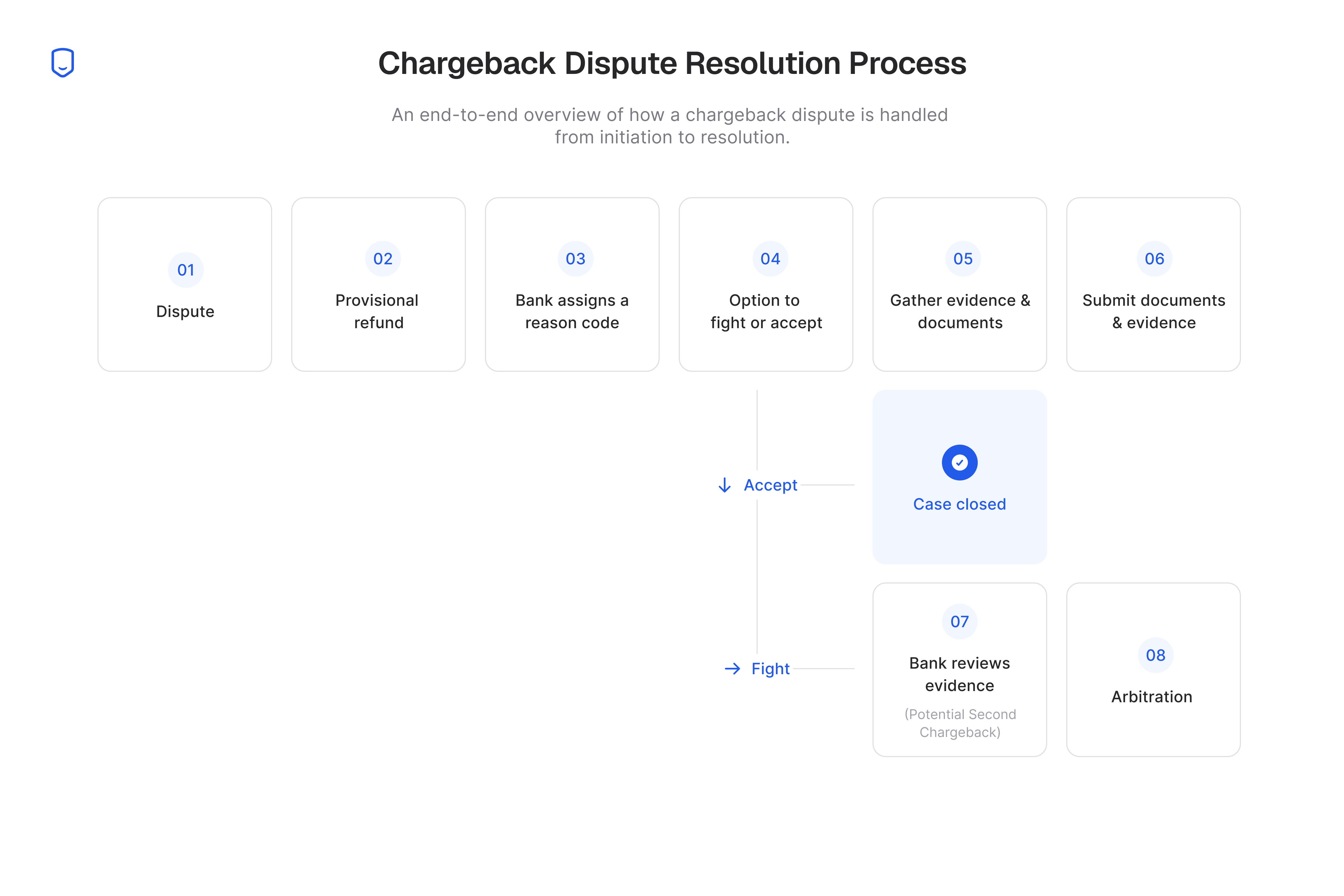
A chargeback goes through 8 stages in fixed order, and each one passes the dispute to the next party. No stage starts until the one before it finishes, so one slow response delays everything after it.
Here's the full sequence:
- Dispute: The cardholder calls their bank
- Provisional refund: The bank takes the money back
- Reason code: The bank classifies the claim
- Fight or accept: Your decision, on a deadline
- Gather evidence: Build the packet the code asks for
- Submit: Send it through your acquirer
- Bank review: The issuer rules, or a second chargeback lands
- Arbitration: The network settles it
Each stage below names who acts, what they decide, and what it means for you.
1. Dispute
The process starts when the cardholder contacts their issuing bank and challenges a transaction. They call the number on the card or file through the bank's app. At this point you have no idea it's happening.
The bank takes the claim at face value to begin with. It asks what the charge was, why the cardholder is questioning it, and whether they tried you first.
Most say no to that last one. A descriptor showing your storefront name is what gets them to call you instead of the bank.
Timing at this stage is out of your hands. The cardholder can file months after the transaction, so a dispute can land on an order you shipped and forgot about last quarter.
Keep your order records longer than you think you need to. A dispute on a six-month-old order still needs that order's tracking number, delivery scan, and checkout terms. Carriers purge tracking detail on their own schedule.
2. Provisional refund (first chargeback)
The issuing bank credits the cardholder the disputed amount and takes the same amount out of your account. This is the first chargeback, and it happens before anyone has looked at your side of the story.
The credit is provisional, so the bank can reverse it later if you win.
Your money has already left your account though, along with the chargeback fee your processor charges. That fee stays charged whatever the outcome.
Watch your balance rather than your dispute queue here. On a thin margin, a cluster of provisional refunds in the same week can leave your payout short before you've even read the first notice.
Your processor decides how it takes the money back. Most deduct the amount and the fee from your next payout, so the line item shows up in your bank feed as a smaller deposit rather than a charge. If your balance is too low to cover it, the processor can debit your linked account directly.
This is also the point where the dispute becomes visible to the card network. From here it counts in the ratio that decides your monitoring-program status, whatever happens in the six stages that follow.
3. Bank assigns a reason code
The issuing bank classifies the claim with a numeric reason code, and that code decides what you have to prove. Visa 13.3 covers merchandise not as described. The evidence that answers it looks nothing like the evidence for an unauthorized-transaction code.
This is the stage merchants skim and then regret.
The code is the question, and the issuer marks your stage 6 packet against that question alone. Send proof of delivery against a "not as described" code and you lose a case you could have won.
Each network keeps its own list, and our breakdown of chargeback reason codes maps them out.
Look up the exact code on your notice with our reason code lookup tool before you decide anything else.
Codes are also wrong sometimes. A bank agent picks the code from what the cardholder said on a call, so a late delivery can arrive tagged as fraud. You still have to answer the code you were given.
4. Merchant's option to fight or accept
Your acquirer tells you about the chargeback and you decide whether to fight it, on a deadline the card network sets. The notice comes as a debit advice letter or a dashboard alert. It gives you the reason code, the amount, and the date you have to reply by.
Weigh three things before you answer:
- The disputed amount against the hours a packet takes to build
- The evidence you hold against what the code actually demands
- The fee you pay either way
Say a $900 dispute with signed delivery confirmation is worth a morning. A $40 dispute on a code you can't answer rarely is.
Accepting is a real option. It closes the case, and your ratio moves the same either way.
One case breaks that rule. Fighting a small dispute from a repeat filer is worth the hours, because accepting teaches them the charge always reverses.
5. Gather evidence and documents
Build a packet that answers the reason code point by point, using records you already have. Most of what you need is already in your order system:
- Delivery confirmation with a carrier scan
- The terms the customer accepted at checkout
- IP address and device data from the order
- Earlier emails or support tickets with the customer
- Your refund policy as it read on the day they bought
Match each document to the specific claim. Tracking with a delivery scan answers a "goods not received" code, while an unauthorized-transaction code needs identity evidence instead.
I matched the wrong documents to the code on my own first dispute. This is the step that decides most cases.
Volume works against you here. Ten documents that circle the claim read worse than three that answer it, because a reviewer working through a queue reads what's on top and stops.
Write a short cover summary and put it first. Name the order, the date, what the record shows, and how that answers the code. The reviewer then has your argument before they open a single attachment.
One gap catches merchants repeatedly. Evidence has to describe the transaction as it existed at purchase, so a refund policy you updated last month proves nothing about an order placed in March.
6. Submit documents and evidence
Send the finished packet to your acquiring bank, which passes it on to the issuer. You upload it in your processor's dispute screen, and the acquirer only moves it along.
Aim to submit at least three business days before the date on your notice. Your processor needs time to package the file and pass it to the network.
Submission is final. Most processors give you one upload per dispute, so a packet sent with a missing attachment is the packet the issuer judges.
Format matters more than it should. Issuers receive your evidence as flattened images or text, so a spreadsheet, a video, or a link to a hosted file can arrive unreadable or get dropped. Export everything to PDF or a screenshot, and put the key detail where a reviewer sees it without scrolling.
Keep your own copy of what you sent. If the case moves to a second chargeback or pre-arbitration, the packet you submitted here is the one the network eventually rules on.
7. Bank reviews evidence (potential second chargeback)
The issuing bank reviews your packet against the reason code and either reverses the chargeback or upholds it. If it reverses, your funds come back. If it upholds, the cardholder keeps the credit.
The cardholder can then file again on the same transaction. That second chargeback starts the review over with your original evidence plus whatever they've added.
A second filing usually means the cardholder argued against your specific evidence. Compare the reason code on the second notice against the first, because a changed code needs a different packet.
From here the case goes to pre-arbitration, where the two banks try to settle it before the network has to rule.
Reviews are rarely line-by-line. The issuer works a queue, so the reviewer is checking whether your packet contains the specific proof the code calls for. That's why a short packet aimed at the code beats a long one that argues the customer is wrong.
You may also get no explanation. Many issuers return an outcome and nothing else, so the reason code and your own copy of the packet are all you have to work out what fell short.
8. Arbitration
Either side can take the case to the card network, which makes a binding ruling and charges the loser. Arbitration is rare. Filing fees run into the hundreds of dollars per case on top of the disputed amount.
You can't add new evidence at this stage, so the network rules on the packet you already sent.
Arbitration only pays when the disputed amount clears the filing fee several times over, which in practice means four figures. Lose, and you pay those fees as well as the transaction.
Your acquirer has a say too. The fees land on its account before they reach yours, so some processors won't file arbitration for a small merchant. Others ask you to accept the charge in writing first. Check that policy before you plan on escalating.
The ruling ends the matter. There's no appeal above the card network, so whatever the network decides is where the money stays.
How long does each stage take?
A chargeback takes roughly 30 days when nobody contests it and several months more once it reaches arbitration, with a different party controlling the deadline at each stage. Knowing which party owes the next response tells you whether to act now or wait.
Treat the windows below as typical ranges. Visa, Mastercard, American Express, and Discover each publish their own deadlines, and your processor's dispute portal has the exact dates for your case.
Our chargeback timeline guide has the per-network day counts:
Stages 4 through 6 are the only part of this you control.
Treat these as ranges rather than promises. A dispute can also sit still for weeks while an issuer works a backlog, and no rule obliges the bank to tell you it's waiting.
Does the process differ by processor and card network?
The card network sets the deadlines, reason codes, and evidence rules at each stage, while your processor only changes which screen you file in. The 8 stages themselves hold everywhere.
Visa, Mastercard, American Express, and Discover each publish their own reason-code list and their own response windows.
Accept all four brands and you're working to four rulebooks at once.
American Express runs a three-party model, because it's usually both the issuer and the acquirer. Visa and Mastercard run a four-party one, so an Amex dispute has one fewer handoff in it.
That cuts both ways. Fewer handoffs means a faster answer, and it also means the party judging your evidence is the same party that took the cardholder's call.
Your processor still shapes the work. On the same Visa deadline, one dashboard drafts the response for you and another emails a PDF, so check what yours does before a dispute lands.
Is this a standard chargeback or a fraud-specific one?
A fraud code means the dispute turns on whether the cardholder authorized the charge, while a standard code turns on what you shipped. Both run the same 8 stages, and the network's fraud rules decide more of a fraud case than your packet does.
A fraud code changes the question to "was this person allowed to use the card."
That needs a different packet. Device fingerprints, AVS results, and the 3D Secure record answer it, while delivery confirmation and your terms of service do almost nothing.
Real fraud is hard to tell apart from a cardholder disputing their own purchase, and our guide to friendly fraud covers the difference.
A cardholder who files false disputes repeatedly can be prosecuted for it, which our guide to chargeback fraud and the law sets out.
A fraud code also leaves you less room at stage 4. Card networks track fraud disputes on separate counters, so a run of them can put you in a monitoring program faster than standard disputes would.
What happens after a chargeback resolves?
When the case closes, the money either comes back to you or stays with the cardholder, and most networks count the dispute toward your chargeback ratio either way. They count disputes filed, not disputes lost.
Win every case you fight and your ratio still goes up.
The ratio counts every dispute filed against you over your transaction count, so the outcome never touches the numerator. Go past the network's threshold and it enrolls you in a monitoring program that charges fees.
Here's where each of the two largest networks draws its line:
Our overview of chargeback monitoring programs covers how to get back out.
Tim's Coffee, a Shopify coffee-equipment retailer in our own case study, had a Stripe warning and payment holds when they dealt with this. They cut chargebacks by 89%, which ended the shutdown risk and gave them back around 9 hours a week of staff time.
Some networks keep a dispute you won in the ratio all the same, so stopping disputes is worth more than winning them.
What happens when you win or lose a chargeback?
Win and the money returns to your account minus the fee, while losing forfeits the transaction, the goods, and the fee. Both outcomes leave something behind.
If the merchant wins
The chargeback is reversed and the money comes back to your account. The bank takes back the provisional credit, and the transaction settles the way it first did.
Two costs stay with you. The chargeback fee is still charged, and the hours you spent building the packet are gone.
If the cardholder wins
The chargeback stands, you lose the transaction amount, and the fees stay on your account. You've also shipped the goods or done the work, so you're out the product as well.
From here you either accept it or go to arbitration, on the terms stage 8 sets out.
How do you prevent chargebacks before stage 1?
The cheapest place to win a dispute is before stage 2, when an alert lets you refund the customer and stop the chargeback happening. Stages 4 to 8 cost you hours per case, and the fee lands either way.
Alert networks tell you a dispute is coming before it becomes a chargeback. Ethoca (Mastercard) and Verifi (Visa, which runs RDR and CDRN) contact you before the bank finalizes it.
Refund inside that window and the case ends there, with no reason code and no ratio movement.
Our comparison of RDR, CDRN, and Ethoca explains which coverage fits which card mix.
Three fixes do most of the work, and a one-person team can run all three:
- Set your billing descriptor to your storefront name, not your legal entity
- Enable Ethoca alerts and auto-refund under a dollar threshold you set
- Put a reachable support contact on the order confirmation and the statement descriptor
Setting that refund threshold is the piece merchants skip. Pick an amount below which refunding always beats fighting, and let the rest come to you by hand.
Some disputes still reach you at stage 4, because alert coverage varies by issuer and network. Ethoca is strongest on Mastercard and Verifi's products on Visa, and some issuers skip the alert and file directly.
Check the reason code on the notice first, then build the packet to match it.
Try our chargeback alerts if you'd rather catch disputes before the bank does.
FAQ
How much do chargebacks cost merchants?
Chargebacks cost merchants $25 to $100 per instance. That's before the lost product, the processing fees, and the staff hours.
Do merchants usually fight chargebacks?
Fighting a small chargeback often costs more in staff hours than the disputed amount, so many merchants accept those and fight the larger ones. The amount and the reason code decide it.
Can you go to jail for chargebacks?
Chargeback fraud can be prosecuted as a crime, and filing a legitimate chargeback cannot. Our guide to chargeback fraud and the law covers where the line falls.
What's the difference between a chargeback and a dispute?
A dispute is the customer's complaint to their bank, and the chargeback is the forced refund that follows if the bank agrees. The bank can turn the claim down first, which ends it before a chargeback exists.
What happens if I miss a stage's deadline?
Miss your response deadline and you lose the dispute automatically, whatever your evidence would have shown. The chargeback stands, the money stays with the cardholder, and there's no appeal on a missed deadline.