How to Streamline Refund Processes to Avoid Chargebacks
.png)

How to Streamline Refund Processes to Avoid Chargebacks
Resolve a customer's complaint before it reaches their bank. That is the only way a refund prevents a chargeback. It works best when the process runs next to your dispute alerts, so each system catches what the other misses.
I've lowered my own chargeback rate before I ever fought a dispute. I fixed the billing descriptor and turned on alerts. Card networks reward merchants who fight disputes after the fact.
But the cheapest chargeback is the one a customer never has to file, and this guide shows how to get there without refunding a charge twice.
Key takeaways
- Refund before the customer disputes, or the chargeback happens anyway.
- Check every refund against open dispute alerts to stop double refunds.
- Run the reconciliation loop and log, check, resolve, then record.
- Act on an alert within 24 hours before it expires into a chargeback.
- A $300 auto-refund rule cut one Shopify store's chargebacks by 89%.
Do refunds prevent chargebacks?
A refund prevents a chargeback only when it happens before the customer disputes the charge with their bank. Once they have disputed, the chargeback stands no matter what you refund afterward.
Timing is the whole game.
Your refund and the bank's dispute run on two separate systems, and neither one checks the other. You issue the refund in your processor, and the customer files the dispute with their bank.
Whichever moves first decides the outcome. So a refund alone can't stop a dispute already in motion, and speed matters more than intent.
A refund issued fast enough still works. Resolve inside the alert-response window and the refund lands before the dispute becomes a chargeback. The system below is built to hit that window every time.
Why streamlining the refund process matters
A messy refund process lets one disputed charge get refunded twice, once by a support agent and once by an alert already working it. That double refund is money you paid out twice and can't recover. It happens because nobody checked one system against the other, so both paid out.
Your support inbox and your alert system can both refund a charge. Without one point that checks a transaction against open alerts first, the two act on their own. Both can pay out on the same dispute in the same week. Neither sees the duplicate until you reconcile your books.
Say a subscription customer emails support about a charge they don't recognize. An agent issues a goodwill refund. Meanwhile an alert on that same charge is already resolving through your processor. Now the customer is refunded twice.
That's an operational failure, and it's separate from how refunds and chargebacks differ as a definition.
Here's the good part. This is a process gap, so you can close it with one habit even at zero automation. Check for an open alert before you refund by hand.
Summary: The double refund happens when support and your alerts pay out on the same charge without checking each other first.
The refund-alert reconciliation loop
The refund-alert reconciliation loop is a four-step system for handling every refund. You log the request, check for an open alert, resolve on the fastest matching channel, then record the outcome. Each step closes one gap the double refund exposed.
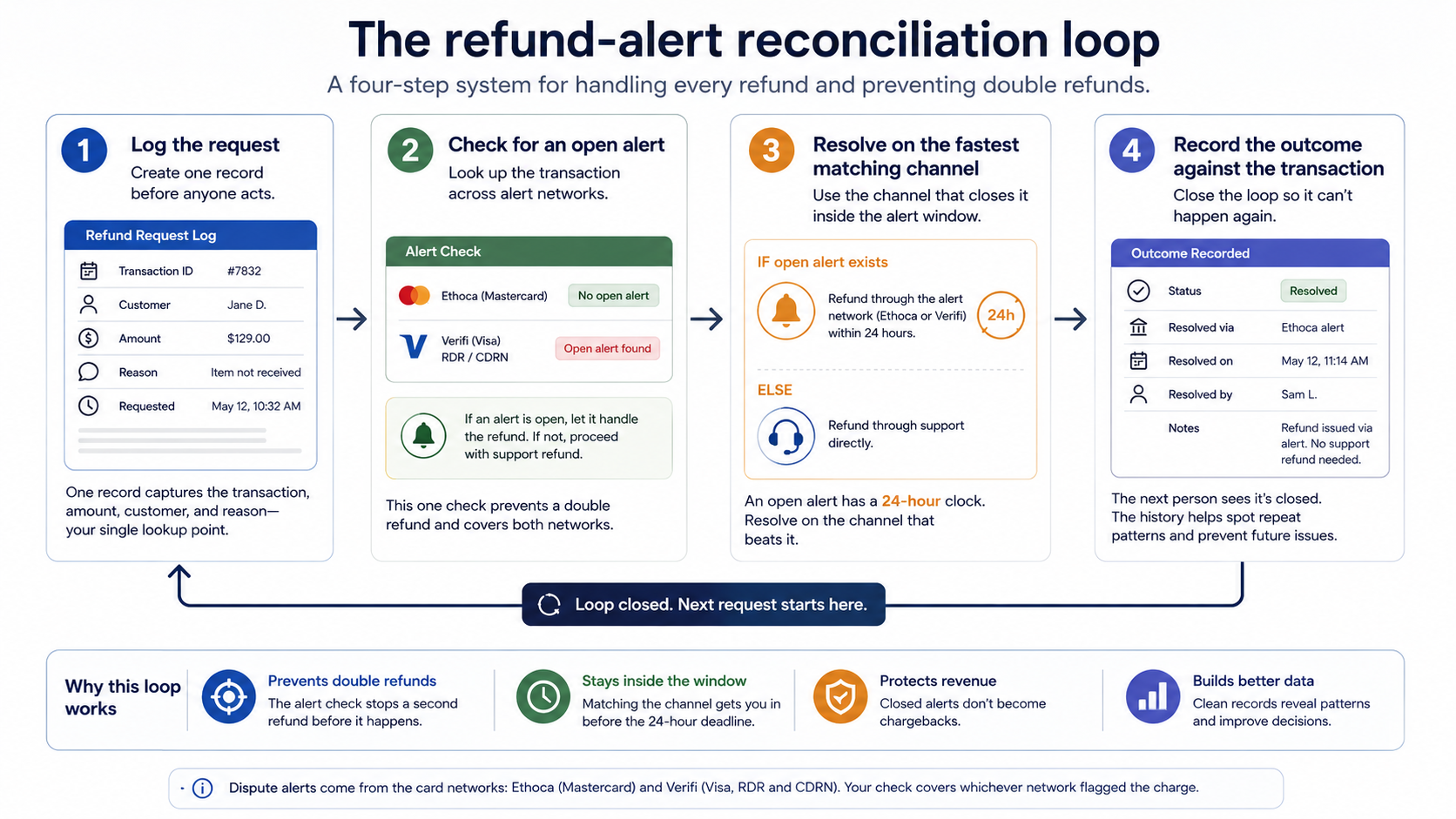
Logging creates the single lookup point. The alert check stops the double refund. Channel-matching gets you inside the alert-response window. Recording closes the loop, so the next request doesn't repeat the miss.
The four steps run in order, and each one needs the output of the one before it.
Log the request
Every refund request goes into one place before anyone acts on it. That gives you a lookup point for the checks that follow. The discipline matters more than the place, so a shared inbox, a help desk, or a spreadsheet all work.
You need one record per request. It names the transaction, the amount, the customer, and the reason. Without it, the next step has nothing to check against, and support ends up refunding from memory. The log turns three people working alone into one process.
Check for an open alert
Before you refund, check whether that transaction already has an open dispute alert working on it. This step prevents the double refund, and most manual processes skip it.
A dispute alert is a signal from a card network that a cardholder has questioned a charge. If an alert is already open, it is handling the refund, so support should not issue a second one. If there is no alert, support proceeds. That one check is the difference between one refund and two.
Two companies run these networks. Ethoca is owned by Mastercard. Verifi is owned by Visa, and it operates both RDR and CDRN. Your alert check covers whichever network flagged the charge.
Resolve on the fastest matching channel
Resolve the request on whichever channel closes it fastest. An alert you don't act on within 24 hours expires, and an expired alert almost always becomes the chargeback it warned about. That 24-hour clock is your deadline.
If the transaction has an open alert, let the alert resolve it inside that window. If it doesn't, refund through support directly. Match the channel to the situation and you stay inside the window instead of racing the bank. A refund that lands on day three is a refund the chargeback already beat.
Summary: An open alert has a 24-hour clock, so resolve on the channel that beats it.
Record the outcome against the transaction
Write the outcome back onto the transaction record, so the same charge can never be refunded again by mistake. This step closes the loop back to the first record.
Once support marks the transaction resolved, the next person who opens that record sees it is closed. The record also builds the history you need to spot repeat patterns, like one customer disputing every third order.
Skip it and the next agent acts blind, which is where the double refund started.
Building the refund policy the loop runs on
A refund policy prevents chargebacks only when support can execute it without escalating, and the customer sees it before they call their bank. Both halves matter. A vague policy slows the refund, and a hidden one gives the customer a reason to dispute instead of ask.
A specific policy removes the judgment calls that push a refund past the alert-response window. When an agent has to ask a manager whether a case qualifies, the clock keeps running. A visible policy removes the "I couldn't find it" excuse that sends customers straight to their bank.
A billing descriptor they don't recognize sends them there too. Match the charge on the statement to your store name.
Two moves make the policy work:
- Self-service threshold: auto-approve refunds under a set dollar amount, no agent review.
- Policy placement: link it from the order-confirmation email, the order-status page, and the receipt.
A policy this permissive does invite abuse on high-value or resold items. Pair the self-service threshold with the tracking in the next section. That catches the patterns a generous policy would miss.
What to track so refunds don't repeat the same mistake
An auto-refund threshold set backward and a partial refund that forfeits alert eligibility break reconciliation more than any policy gap. Both look fine on the surface and cost you chargebacks anyway.
The auto-refund threshold caps what gets refunded automatically. Set it low, thinking you're turning refunds on, and you turn them off for nearly every alert above that amount.
The partial refund is the second trap. Refunding part of a charge can make the whole transaction ineligible for automated resolution. Then the rest comes back as a chargeback you thought you had handled.
In our own dataset, merchants set the auto-refund threshold to $1, $5, or $10 believing they were enabling automatic refunds. The threshold only auto-refunds alerts below that number. Everything above it goes to manual handling, so in our dataset a $1 threshold auto-refunds almost nothing.
Support ran a standing outreach just to catch these before they cost anyone a chargeback.
This matters most if you run any auto-refund rule at all. A fully manual shop only needs the loop's alert-check step and can skip the threshold logic. Partial refunds also cost you RDR eligibility. So a goodwill 10% credit can be why the other 90% comes back as a dispute.
Summary: A low auto-refund threshold turns refunds off, and a partial refund forfeits alert eligibility.
Is a manual refund process enough?
A manual-only refund process costs more per resolved dispute than acting on the alert directly. Count the chargeback fee and the staff time on an unreconciled case and the gap shows up fast. Compare the real cost of each resolved case against the small fixed cost of an alert.
A chargeback that reaches the processor carries a flat dispute fee whether you win or lose. It also costs the staff hours to respond. Stripe's dispute fee is $15 per dispute. An alert resolved through the loop carries only the per-alert cost and no dispute fee.
So the manual path pays the fee, the labor, and often the refund on top. The alert path pays one small fixed cost.
Tim's Coffee, a retailer, shows the gap in practice. They cut chargebacks 89% and cleared their payment holds. In Tim's same case study, they paired Ethoca and CDRN alerts with one rule, auto-refund under $300 and fight manually over $300.
The whole setup took under 12 hours.
If your dispute volume is low, the automation may not pay for itself yet. The alert-check habit still applies at any volume. It costs nothing and works with or without paid alert tooling.
Run the numbers on your own volume with our free refund-versus-chargeback calculator.
When refunds and alerts still miss something
The loop cuts double refunds and speeds resolution, but it can't cover a dispute that never generates an alert. Some transactions slip past the networks no matter how clean your process is.
Alert coverage needs two things. The issuing bank has to take part in the network, and the transaction has to be matchable. Tokenized wallet payments and non-participating banks break that match even when you follow the loop. The charge is real and the dispute is real, but no alert fires.
Digital wallets are where this gap grows fastest. They ran 40% of US e-commerce transactions in 2025, and a wallet-tokenized charge is harder to match back to the original one. That share keeps rising, so more of your traffic runs through the channel where alerts can miss.
How we sourced our data
The patterns in this article come from Chargeback.io's own support conversations, reviewed and de-identified. They describe what we see among merchants on our own platform. Read them as our platform's experience, and check your own numbers against the wider payments industry.
We keyword-matched and clustered support conversation topics by hand over a 12-month window. The window covered merchants enrolled on the Chargeback.io platform, so the patterns reflect that group.
Any figure describes how often these problems show up among our merchants. We report each one as a share of support conversations.
FAQ
What is a double refund chargeback?
A double refund chargeback is when one transaction gets refunded twice, once by the merchant and once through the dispute process. It happens when a manual refund and a dispute alert both act on the same charge.
Can you refund after a chargeback is filed?
You can still issue the refund, but it won't cancel the chargeback, which already exists at the bank. Doing both means you pay the refund and the chargeback on one transaction, so check the dispute status first.
Does subscription billing need a different refund process?
The core loop is the same, but subscription disputes cluster around renewals and cancellations. Add a step that confirms the subscription was cancelled before you refund, and set a proration rule for mid-cycle cancellations.
What happens to the alert fee if I refund first?
If you refund the customer before an alert arrives, the network may still fire one and bill you for it. Check for an open alert before a manual refund, which is what the loop's alert-check step is for.