Best Chargeback Prevention Software (2026), Compared


The best chargeback prevention software depends on your transaction volume, your budget, and whether you want alerts-only prevention or a fully managed service. Chargeback.io, Kount, Signifyd, Chargebacks911, and Chargeflow each target a different mix of those.
I ran alert tooling on my own stores before I ever advised anyone on it, and one lesson stuck.
An alert only helps if the buyer can place the charge once the bank shows them the details. So set your billing descriptor to your store name and a support number first. Tooling never fixes a bad descriptor, it only tells you about one faster.
By the end you'll have two vendors left, matched to your own volume and budget.
Key takeaways
- Pick usage billing under $50,000 a month, managed service above it.
- Prevention stops disputes before they file, and representment fights them after.
- Kount and Signifyd both quote custom pricing, so expect a sales call.
- Chargebacks911 settled a Federal Trade Commission enforcement action in 2023.
- In our two case studies, alerts cut chargebacks 78% and 89%.
Want the disputes caught before they file? See our alert coverage across Ethoca, RDR, and CDRN.
What's the best chargeback prevention software?
The right vendor comes down to your transaction volume, your budget, and how much of the work you want to do yourself. Chargeback.io and Chargeflow suit merchants who want pay-per-use alerts with no monthly minimum.
Kount and Signifyd suit larger merchants who want fraud scoring built into checkout. Chargebacks911 suits merchants who want disputes handled for them after they file.
Three routes cover all five:
- Pay-per-use chargeback alerts, no monthly minimum: Chargeback.io or Chargeflow.
- Fraud scoring inside checkout, custom quote: Kount or Signifyd.
- Someone else files your cases after a dispute lands: Chargebacks911.
Two different products get sold as prevention, and that's what confuses buyers. Prevention software works in the window before the bank turns a dispute into a chargeback. The bank flags it, the vendor matches it to your charge, and you refund the buyer first.
Representment software does the opposite job. It builds your case after the cardholder has already filed. Both get sold as chargeback prevention, so buyers swap one for the other.
The mismatch cuts both ways. A vendor built for a big merchant sells custom fraud scoring and a named account manager.
Say that contract runs $40,000 a month. You're paying for features nobody on your team has time to configure.
The reverse mismatch costs just as much.
Chargeback prevention software compared
Every vendor here either stops disputes before they file or fights them after, and each bills on a different model. Billing runs per alert, per transaction, as a share of orders, as a share recovered, or by quote:
Read the pricing column first, because it rules vendors out faster than anything else. Two of the five publish real numbers you can check today, and three quote only on a call.
The second column matters just as much and gets skipped most often. A vendor that screens for fraud before approval and a vendor that fights chargebacks after they file are solving different problems, and neither one substitutes for the other.
The five sections below add what the table can't hold, including who owns each vendor and what changed in its pricing lately.
1. Chargeback.io
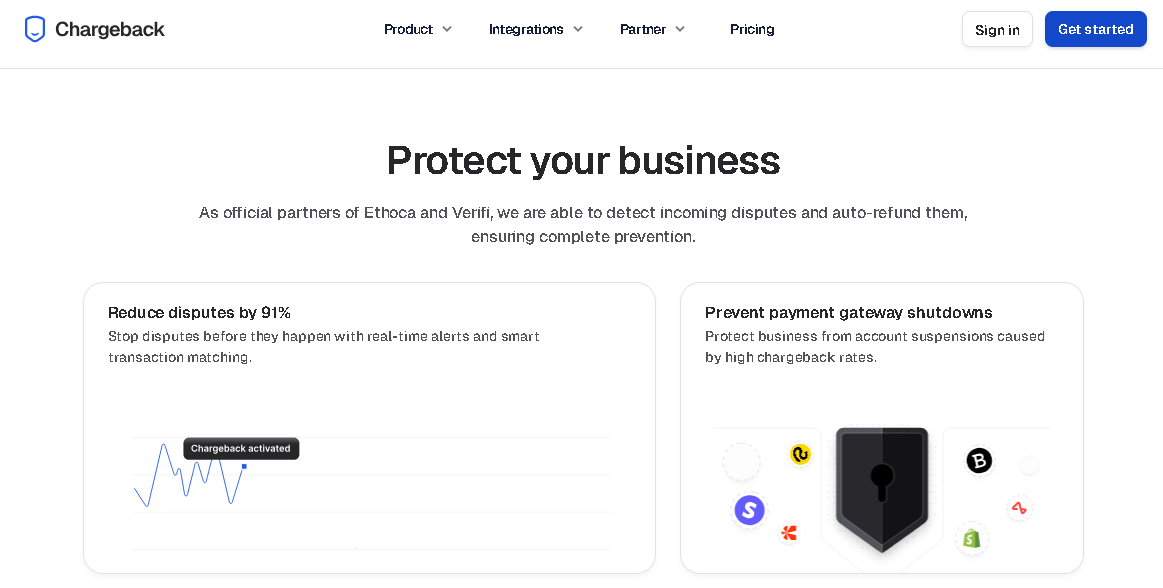
We sell prevention only, billed per alert, and you can leave any month. According to Chargeback.io's own published rates, Ethoca alerts cost $29 each, and RDR and CDRN alerts cost $15 each, with no monthly minimum and no contract.
Ethoca comes from Mastercard, and RDR and CDRN come from Visa's Verifi.
Our guide to how the alert networks differ covers which one catches what.
Which networks you enable should follow your own card mix, because paying for Visa coverage when most of your disputes arrive on Mastercard wastes the spend.
Pay-per-alert billing means a quiet month costs you close to nothing.
That matters for a merchant whose disputes move with the season. A flat contract charges the same in December and February, while alerts bill only when a dispute actually shows up.
We connect to Shopify Payments, Stripe, Braintree, Chargebee, Recurly, and Airwallex, and alerts can route to Slack so nobody has to watch a dashboard.
Setup runs in hours rather than weeks, because there's no rules engine to configure. Tim's Coffee had alerts live in under 12 hours.
Here's who we're wrong for. A chargeback that gets past the alert is yours to fight, because we sell prevention only. If you want a vendor to assemble and file your dispute paperwork, that's a representment vendor's job.
Try it on your own dispute volume: see the alert pricing before you commit to anything.
2. Kount (an Equifax company)
Kount screens payments for fraud before approval and quotes custom pricing only. According to Equifax's own investor announcement, it bought Kount for $640 million in January 2021. Kount is now part of a bigger Equifax product, so you buy it with tools you may not want.
Kount's quote page says the price depends on your goals and your volume, so every number is custom.
No figures appear on its live pages at all now. Some competitor roundups still quote an old monthly minimum and per-transaction rate that no longer appear on Kount's current pricing page.
Kount scores each transaction as it comes in, using device fingerprinting, velocity checks, and rules your team writes. That work needs somebody who owns it. A rules engine nobody tunes drifts toward blocking good orders, which costs more than the fraud it catches.
Fraud screening runs before you approve the order. It does nothing about a dispute filed two months later.
So Kount fits a merchant with enough volume to justify a custom contract and someone in-house to run the rules. Below that, you're buying a fraud team's toolkit without the fraud team.
Ask for the annual minimum on the first call. A custom quote with no published floor is the easiest place in this market to overbuy.
3. Signifyd
Signifyd takes the fraud loss off your books. It charges a share of each approved order and nothing on orders it turns down. Its pricing page says four things move the rate:
- Goods bought: the products in the order.
- Vertical: what the merchant sells.
- Order volume: how much you run through it.
- Ticket size: your average order value.
Because the rate is quoted per merchant, two stores with the same revenue can pay different percentages. Ask what the rate is on your actual product mix and average order value before you compare it to anything else.
The pricing works out well if you have big orders and a real checkout fraud problem.
The reverse is also true. On thin margins, a share of every approved order can cost more than the disputes it prevents. You pay on the many orders nobody was ever going to dispute. Run the number against last quarter's dispute total before signing.
Signifyd doesn't price as three flat tiers anymore. Ignore any flat percentage or flat monthly figure that older competitor roundups still list.
4. Chargebacks911
Chargebacks911 handles representment, so it fights chargebacks that already filed, and it doesn't publish pricing. Expect a custom quote scoped to your dispute volume.
Chargebacks911 also settled a Federal Trade Commission and Florida Attorney General action in November 2023. The deal cut the merchant types it can serve. It also barred the company from filing misleading dispute papers. Our Chargebacks911 alternatives guide has the terms and figures.
Representment is genuinely different work from prevention. Someone reads the reason code, pulls the delivery and authorization evidence, and files a packet inside the network's deadline. Merchants who lose winnable disputes usually answered the wrong code.
Handing that to a specialist earns its cost once your volume outgrows the person doing it by hand.
Confirm your merchant category is one Chargebacks911 can still serve under that order before you take a quote.
It's also the wrong first purchase if you have no prevention in place. Fighting disputes after they file leaves every one of them counted in your chargeback rate, even the ones you win.
That distinction decides whether you keep your processor. A won dispute returns the money and still counts toward the ratio your processor watches.
5. Chargeflow
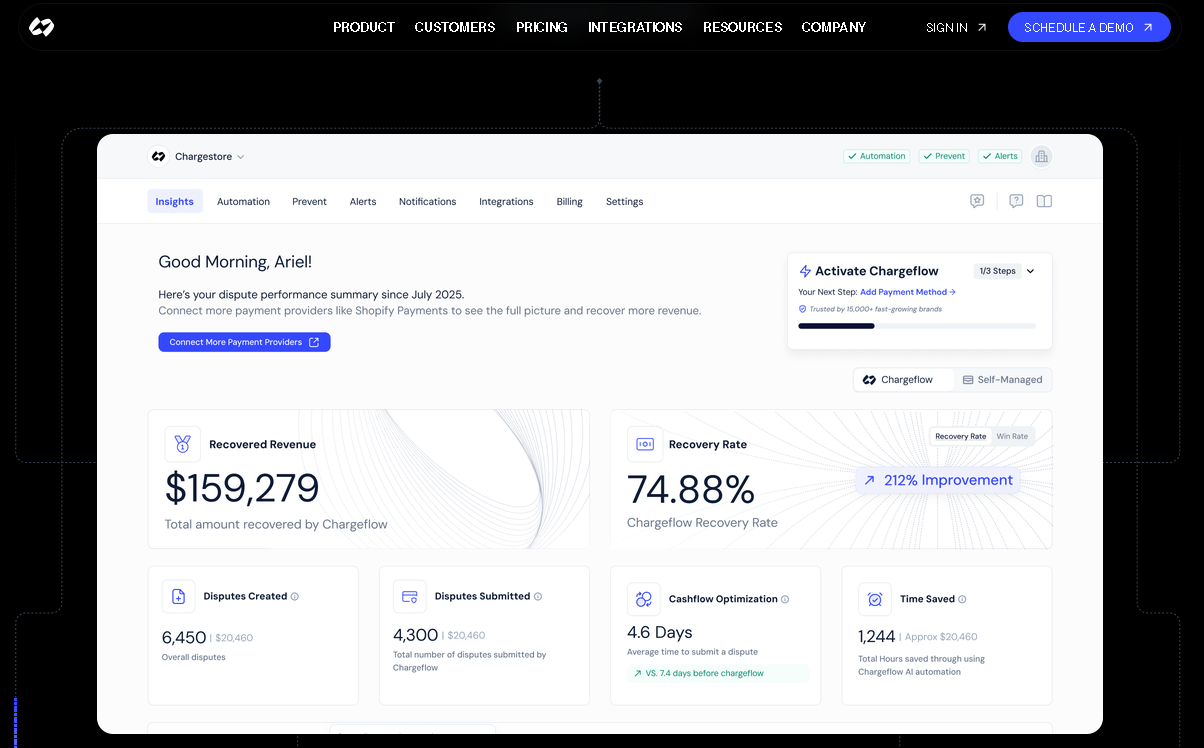
Chargeflow sells prevention and recovery as separate tiers, priced from free analytics up to a share of what it recovers. Five tiers run across that range, according to Chargeflow's own pricing page:
- Insights, per Chargeflow's data: free analytics, no charge at all.
- Prevent, per Chargeflow's data: $0.20 to $0.40 per scanned transaction, first 1,000 free.
- Automation, per Chargeflow's data: 25% of each recovered chargeback.
- Alerts, per Chargeflow's data: $29 per deflected chargeback.
- Enterprise: a custom quote.
The free Insights tier is worth taking on its own terms. It shows you your dispute mix without a commitment, which is useful even if you buy alerts somewhere else.
The paid tiers stack rather than replace each other. A store can run Prevent for screening and Automation for recovery at once, paying on both lines. Price it as a combined bill, not tier by tier.
Chargeflow only bills the recovery tiers when it wins.
Store owners like that, because they don't want to pay monthly for a service that might lose. Its headline claim now is a 300% rise in win rate on average. That replaces the 80% figure older posts still carry.
Our Chargeflow comparison unpacks what that figure covers.
How do you pick the right one for your business?
Run three checks against your own numbers, in this order, and two vendors will be left. Weigh them like this:
- Transaction volume: say your totals run under $50,000 a month, rule out any monthly minimum.
- Who works the alerts: alerts arrive on a deadline, so pick them only if someone checks a queue daily.
- Pricing model: pay-per-use costs nothing in a quiet month, and a flat contract wastes spend under the minimum.
Check one drives the other two, which is why flat-fee vendors put pricing behind a sales call. Each dispute an alert stops is one chargeback fee you keep, and usage billing shows that saving plainly.
Two vendors usually survive all three checks. Break the tie on card mix, and whichever one covers the network your disputes arrive on wins. If that's equal, take the one you can leave without a contract.
What picking wrong costs you
Buy an enterprise fraud stack at low volume and you pay for rules nobody configures. Pick alerts-only at high volume and the disputes outrun whoever works them. Two of our customers reached the same answer from different directions.
In Dropship.io's case study, it chose pay-per-alert RDR and CDRN because Visa was over 50% of its dispute volume. Tim's Coffee, a smaller Shopify store, picked pay-per-alert too, with no fraud staff.
Kount wants staff to run device fingerprinting and custom rules. A small team that buys it early never gets it configured. Signifyd fits poorly lower down, because you pay on every approved order whether or not you had disputes.
On a high-risk merchant account, disputes you fail to stop can get your processor to drop you.
That's the expensive version of picking wrong. Losing a processor means re-applying somewhere worse, usually at a higher rate. Expect a rolling reserve held against your deposits. Per Dropship.io's case study, it was on that path at a 0.93% dispute rate before alerts pulled it back.
The cheaper version is just overpaying. You keep the processor, you keep the tool, and you carry a line item that never earned its cost.
What kinds of chargeback management tools exist?
The three categories are alerts and prevention, representment and recovery, and fully managed. Each gets paid at a different moment in the dispute:
- Alerts and prevention: stops the dispute before it files, billed per alert or per transaction.
- Representment and recovery: fights the chargeback after it files, usually for a cut of what it recovers.
- Fully managed: one vendor runs both on a flat retainer, so it gets paid before either happens.
You can predict how a vendor behaves from when it gets paid. A prevention vendor gets paid win or lose, so it catches disputes early and refunds them. A recovery vendor only gets paid on a dispute it wins, so it picks the winnable ones.
Both incentives are fair, and they lead the two vendor types to chase different disputes.
The category also tells you which disputes a vendor can do anything about:
Fully managed pricing is where the least information is public. All three of the custom-quote vendors here gate their numbers behind a sales call, which makes the category hard to comparison-shop and easy to overbuy. Ask for the annual minimum in the first call, because that single figure rules most vendors in or out faster than a feature list.
Most merchants run both categories. Prevention stops the bulk of disputes early. The few that still land need one named person with the deadline on their calendar.
Does chargeback prevention software actually work?
Alert-based prevention cut chargebacks 78% and 89% inside one to two quarters, in Dropship.io's case study and Tim's Coffee's case study respectively. Neither one switched processors or changed its product.
Here's how that works. An alert reaches you first, you refund the buyer, and the card networks never count the charge in your chargeback rate.
That last part is what saves the processor relationship. Here are both cases:
Dropship.io's drop came between Q2 and Q3 2024. That pulled it back from a Stripe reserve hold and off the path to a VDMP listing. Tim's Coffee got there by auto-refunding every alert under $300 and fighting the rest by hand.
Both are single-customer outcomes, so read them as what these two merchants got.
Alerts miss some disputes, and it's worth knowing which. A wallet payment through Apple Pay, Google Pay, or Stripe Link is hard to match back to the charge. Digital wallets already carried 40% of US e-commerce sales in 2025. Expect more disputes no alert can match.
Some banks also skip the alert networks and file straight to a chargeback, and no vendor reaches those. Coverage also varies by reason code, and RDR doesn't apply to a transaction you already partly refunded.
The honest expectation is a large cut in disputes rather than zero. Any vendor promising zero is selling something the networks can't deliver.
How we sourced our data
The ranking and click history behind this article comes from our own Google Search Console data for this page. We pulled monthly position, impressions, and clicks for this URL, covering April through July 2026.
That data shows the page climbing the rankings for its main search term while earning almost no clicks. A table-first comparison is the fix we drew from it.
The customer results above come from our two published case studies, both named. We report them as single-customer outcomes rather than averages, because two merchants are not a sample.
The vendor pricing and ownership facts come from each company's own live pages, checked on 2026-08-04. Where a figure that circulates widely no longer appears on the vendor's site, we say so instead of repeating it. Vendor pricing moves, so treat any number here as current to that date and check the vendor's page before you sign.
FAQ
Do companies hate chargebacks?
Yes, because a chargeback costs a merchant more than the sale it reverses. One dispute takes the sale, the goods, a fee, and staff time. Enough of them get you flagged by the card networks.
What is the 540 day rule for chargebacks?
Most reason codes give the cardholder 120 days to dispute a sale. A narrow set, covering goods never delivered, stretches that to 540 days. The 540-day figure is an outer limit.
Can you go to jail for chargebacks?
You can go to jail for chargeback fraud, which means lying to your bank about a charge you recognized. Filing an honest dispute carries no criminal risk.
Is prevention software worth it for a small store?
It's worth it when your billing runs on a usage model instead of a monthly minimum. At low volume, a pay-per-alert tool costs less than the fees it saves you.
Can you run two chargeback prevention tools at once?
You can stack fraud screening and alerts, because they act at different moments. Two alert vendors on the same networks mostly duplicate cost, since both pull the same Ethoca and Verifi feeds.