Amex Chargeback Guide: Time Limits, ADR, and How to Win


Amex Chargeback Guide: Time Limits, ADR, and How to Win
An American Express chargeback happens when a cardholder disputes a charge and Amex reverses the payment. Amex handles it differently than Visa or Mastercard. It often tries an inquiry or an ADR alert first. It gives merchants 20 days to respond to a formal chargeback.
I've disputed chargebacks and built representment evidence on my own stores. Amex was always the network that caught me off guard, because its process runs on its own rules. Below you'll find every Amex-specific deadline, so you respond before one gets missed.
Key takeaways
- Amex gives merchants 20 days to respond to a formal chargeback.
- An ADR alert gives you 8 days, a faster, cheaper resolution path.
- Cardholders have 120 days from the transaction to dispute a charge.
- Cross 1% chargebacks for 3 straight months and Amex flags your account.
- Win by matching evidence to the exact reason code, inside 20 days.
What is an Amex chargeback, and how is it different?
An Amex chargeback reverses a disputed payment like a Visa or Mastercard chargeback does, but Amex usually tries to settle with you first. It's both the network and the issuer, so it routes the dispute to you as an inquiry or an ADR alert before it files any formal chargeback.
That early step exists because of how Amex is built. Amex is both the card network and the bank that issues most Amex cards, a closed-loop model. So it can send a dispute straight to you and try to settle it first.
Visa and Mastercard run an open-loop model, with a separate issuing bank in the middle. That's why they don't offer the same early off-ramp.
If you need the base mechanics, here's what a chargeback is.
The refund question comes up a lot too. The chargeback vs refund split matters, because a refund won't always stop a dispute.
You'll manage all of this through the Dispute Center, Amex's merchant portal for disputes.
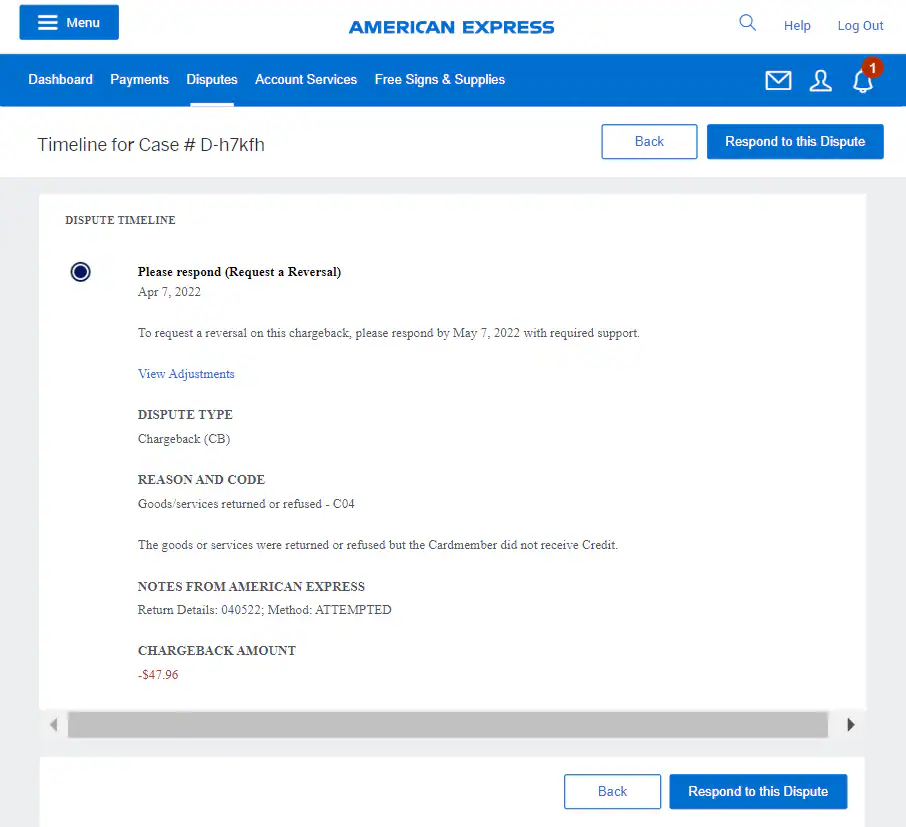
Source: American Express
The early step has one limit. It only applies to non-fraud disputes. A fraud-coded dispute skips the inquiry and ADR stage and goes straight to a chargeback, so you get no chance to resolve it first.
Summary: An Amex chargeback reverses a disputed payment, and Amex often warns you first with an inquiry or alert because it's both the network and the issuer.
The Amex dispute pipeline, stage by stage
A dispute can move through up to four stages, depending on its type. It might start as an inquiry or ADR alert, become a formal chargeback, then a reopened or second chargeback. For merchants with too many chargebacks, an immediate chargeback skips the earlier steps.
Each stage has its own way to resolve it, covered in the sections below.
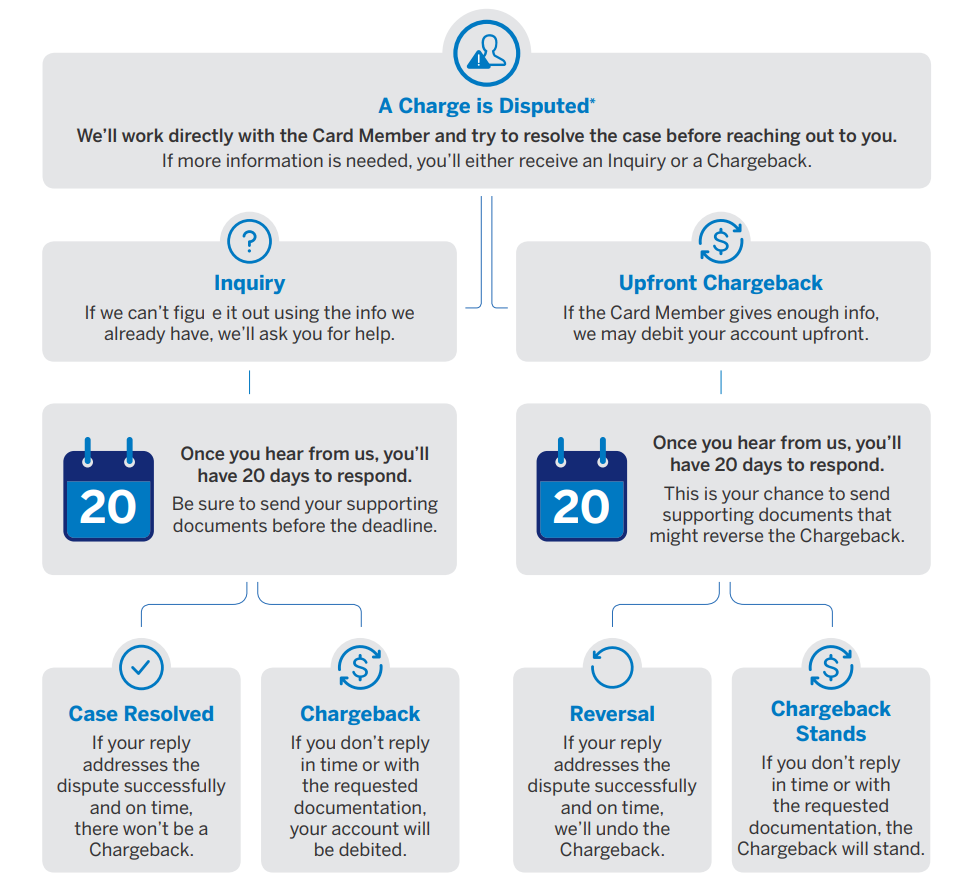
Screenshot from American Express.
1. ADR: the alert most merchants never hear about
ADR (Accelerated Dispute Resolution) is a free, pre-chargeback dispute alert from American Express. It routes certain non-fraud disputes to you before they turn into a formal chargeback. You get a short window to resolve the dispute, usually by refunding it, so no chargeback ever posts.
Most merchants never learn ADR exists, which is why it's worth knowing. It covers non-fraud disputes only and runs on US merchant accounts. When you get an ADR alert, you can accept it and refund the cardholder. Or you let it escalate into a formal chargeback with its own clock.
The catch is the window.
You get far less time to act on an ADR alert than on a formal chargeback, in exchange for the lighter, cheaper resolution. The deadlines section below has the exact day count for each.
2. The inquiry stage
An inquiry is Amex asking you for information about a transaction before it decides whether to file a chargeback. It's a request, not a reversal, so no money moves yet.
The inquiry is your chance to resolve the question with a quick answer. Send Amex what it asks for, a receipt, proof of delivery, or your terms, and the dispute can close before it escalates. Ignore it, and Amex can turn the inquiry into a formal chargeback.
3. Upfront and immediate chargebacks
An upfront chargeback is Amex's standard reversal after an unresolved inquiry or dispute.
The Immediate and Partial Immediate Chargeback Programs remove the inquiry step for merchants with too many chargebacks. Amex charges back the disputed transaction right away, with no inquiry stage to catch it first.
The two programs differ in scope. The Immediate Chargeback Program applies to disputes across the board, while the Partial Immediate Chargeback Program applies only below a set dollar amount. A high chargeback rate lands you in both, covered in the monitoring-program section below.
4. Reopened and second chargebacks
Amex can reopen a closed dispute or file a second chargeback when new information arrives. Two situations trigger it: - Reopened dispute: the cardholder or issuer submits new evidence after a case closed. - Second chargeback: Amex reverses the payment again after rejecting your first response.
How long you have to respond to an Amex dispute
Merchants get 8 calendar days to respond to an ADR alert and 20 days to respond to a formal chargeback. Cardholders get 120 days from the transaction date to dispute a charge in the first place.
Miss a merchant deadline and the decision goes to the cardholder by default, so these dates decide cases on their own.
The ADR window is short on purpose. It's meant to settle a dispute before it ever becomes a chargeback, so Amex trades you less time for a lighter case with no formal chargeback fee. The 20-day chargeback window is longer because a formal chargeback is a full case with evidence on the line.
Here's every Amex dispute deadline and what happens if you miss it:
Deadline
Who it applies to
What triggers it
If you miss it
8 calendar days
Merchant
An ADR alert on a non-fraud dispute
Case escalates to an inquiry or chargeback with a new clock
20 days
Merchant
A formal chargeback
Amex decides for the cardholder, with no review of late evidence
120 days
Cardholder
The original transaction date
The cardholder can no longer file a dispute
Missing the 8-day ADR window doesn't end your case. Amex escalates it to an inquiry or a formal chargeback with its own 20-day clock. So a missed ADR deadline just costs you the faster, cheaper route, and you still get to fight the dispute.
Summary: You get 8 days for an ADR alert and 20 days for a chargeback. Cardholders get 120 days to file.
What triggers Amex's monitoring programs
According to Chargebacks911, Amex can flag your merchant account for a monitoring program once your chargeback ratio passes 1% for 3 consecutive months. Once you're over the line, Amex changes how it handles your disputes, and it can add fees on top.
Which program you land in depends on what's driving your chargebacks. According to Chargebacks911, three programs sit behind that same 1% trigger, each aimed at a different cause:
Program
What triggers it
What changes for you
Fraud Full Recourse Program
Fraud-heavy chargeback volume
Fraud disputes shift to you automatically, with no representment
Immediate Chargeback Program
A high overall chargeback rate
Amex charges back disputes right away, skipping the inquiry step
Partial Immediate Chargeback Program
A high rate on lower-value charges
The inquiry step is skipped below a set dollar amount
You don't pick which program you land in. All three trace back to the same ratio, so lowering the ratio is what keeps you out of every one of them.
Getting out takes work too. Bring the ratio back under the threshold and hold it there. Amex's timeline for releasing you isn't fixed the way the 3-month entry window is.
Summary: Cross 1% chargebacks for 3 straight months and Amex can enroll you in a monitoring program with added fees.
Amex chargeback reason codes you'll encounter
Amex sorts disputes into six reason-code families, from cardholder disputes to fraud to processing errors. This is the category level, and each family holds several specific codes.
The family matters because the code Amex assigns decides what evidence it wants back from you. Spot the family first and you know what to gather before the 20-day clock runs out. Here are the six:
- Cardholder dispute: the customer challenges the product, service, or a recurring charge.
- Fraud: the cardholder says they didn't authorize the transaction.
- Processing error: a duplicate charge, wrong amount, or currency mistake.
- Authorization: the charge ran without proper approval.
- Chargeback program: an automatic reversal tied to a monitoring program.
- Other: disputes that don't fit the five families above.
For the specific codes and the evidence each one needs, see our Amex reason codes guide.
Look up any code fast with our reason code lookup tool.
One boundary is worth watching. Amex can recode a dispute mid-process if it classified the first one wrong. That resets which evidence is relevant, though not your response deadline.
Can you win an Amex chargeback, and how
You win an Amex dispute by responding inside the 20-day window with documentation matched to the specific reason code, not just proof the sale happened. A receipt alone loses cases that a reason-code-matched response would win.
Amex's Dispute Center scores your response against the evidence its system expects for that exact code. A "not received" dispute wants delivery confirmation. A cancellation dispute wants your signed terms and policy.
Generic proof that the charge went through doesn't answer the code's question, so it loses.
Our win an Amex dispute guide walks through the full evidence package by code.
The odds are better than most merchants think. See the data on merchant win rates before you decide a case isn't worth fighting.
The deadline is a hard cutoff. A response filed after 20 days doesn't get reviewed, no matter how strong the evidence. A perfect case submitted late still loses.
Summary: Match your evidence to the reason code and file inside 20 days, or the case defaults to the cardholder.
How to prevent American Express chargebacks
Most Amex chargebacks that reach a formal dispute were preventable earlier. You either fix the billing descriptor so the charge gets recognized, or catch the dispute at the ADR or inquiry stage before it escalates. The cheapest chargeback is the one the customer never files.
A charge nobody recognizes on a statement is the single biggest driver of avoidable disputes.
Clear descriptor text removes the trigger before any alert is even needed, because the customer knows what the charge is. That's friendly fraud, a real customer disputing a real charge they didn't recognize.
Here are the fixes that work upstream:
- Fix your billing statement descriptor so the charge is recognizable at a glance.
- Act on ADR alerts and refund inside the 8-day window before a chargeback posts.
- Answer inquiries fast, before Amex escalates the question.
- Keep delivery and terms records ready to match evidence to the code.
On my own stores, fixing what customers saw on their statement did more for my chargeback rate than any dispute response ever did. I lowered it before I touched a single representment case, by fixing the descriptor and turning on alerts.
Descriptor fixes and alerts have one blind spot. They don't stop fraud-coded disputes, which skip the inquiry and ADR stage and go straight to a chargeback. Preventing those depends on fraud tools like 3D Secure and address verification.
Our chargeback alerts catch disputes at the ADR and inquiry stage, before they ever post as a chargeback.
FAQ
Can American Express reopen a chargeback after it's closed?
Yes, Amex can reopen a dispute you already won if fresh evidence turns up. A closed case isn't always final, so keep your documentation on hand after a win.
Does an ADR alert count as a chargeback on my record?
No, resolving an ADR alert inside the 8-day window keeps a chargeback from posting at all. That's the whole point of the program, and it means the dispute never counts against your ratio.
What happens if I ignore an Amex chargeback?
Amex decides the case for the cardholder and you lose the disputed amount plus any fee. Ignoring it also adds the chargeback to your ratio, which pushes you toward the monitoring-program threshold.
Can too many chargebacks get you dropped by Amex?
Yes, a sustained high chargeback rate can lead to account termination, well past monitoring-program fees. The monitoring programs are the warning stage, and losing the ability to accept Amex is the more severe outcome.