Credit Card Encryption vs. Tokenization: Which Is Safer?


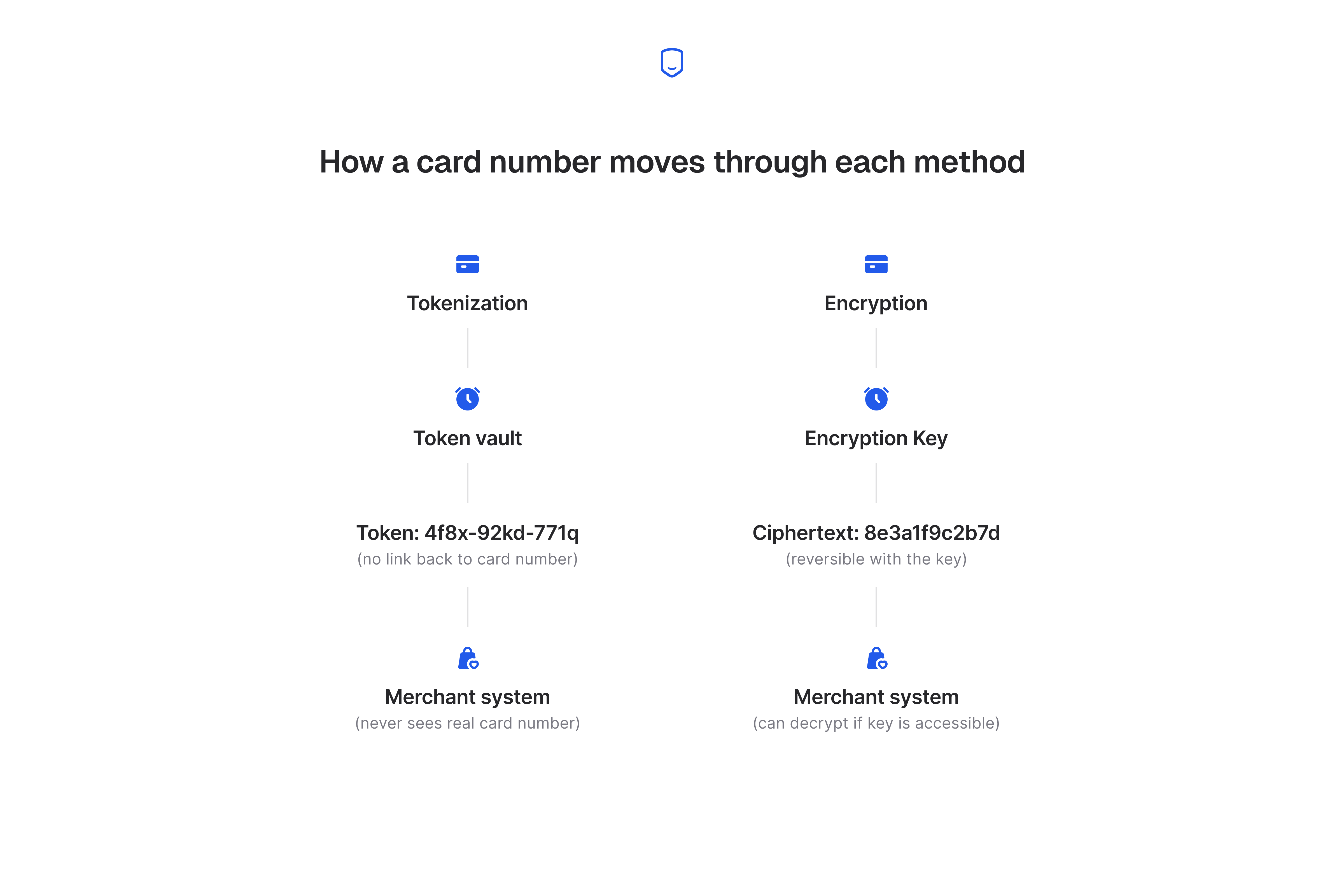
Encryption vs tokenization comes down to reversibility. Encryption scrambles a card number into a format a key can decrypt back to the original. Tokenization swaps it for a random token nobody can reverse. For most merchants, tokenization keeps more systems out of PCI DSS scope. A system that only touches tokens never touches real cardholder data.
I've spent time on the support side of a chargeback tooling company, digging through merchants' processor setups. This question comes up constantly. Someone got asked about it on a PCI questionnaire and has no idea which one their processor uses.
By the end of this, you'll know which method your stack relies on.
Key takeaways
What's the difference between encryption and tokenization?
Encryption scrambles a card number into a format a key can undo. Tokenization swaps it for a random value with no link to the card. Both keep the real number away from attackers.
The difference comes down to whether the value can be turned back into a card number. Anyone holding the key can decrypt an encrypted card number. The real number is still recoverable inside your environment. A properly generated token can't be worked backwards.
Nobody built it from the card number to begin with. The vault stores the only mapping between the two.
Assessors treat the two methods differently for that reason.
Some products still market a "token" they built by running the card number through an encryption algorithm. Under PCI DSS guidance that value counts as an encrypted card number, whatever the vendor calls it.
Where cryptograms fit in
A cryptogram is a one-time security code an EMV chip generates fresh for every transaction, separate from the card number and from any token. EMVCo describes it as a code the chip creates so the issuer and terminal can authenticate the card, and nobody can reuse it.
The chip builds that code at the moment of payment. Steal a cryptogram and you get a value that's already spent. The next transaction demands a new one. An encrypted card number or a stolen token points at the same card every time. Either one holds its value until it expires.
That's why chip payments cut one kind of fraud so sharply. At US merchants who had adopted EMV, counterfeit fraud dropped about 70% in dollar terms between December 2015 and September 2017. That's per PYMNTS reporting Visa's data. At a chip terminal, cloning a card stopped paying off.
Cryptograms only exist where a chip is present. A card-not-present purchase generates none at all. Online payments lean on encryption, tokenization, and tools like 3D Secure to authenticate the buyer instead.
Online, the card number, the expiry date, and the CVVs on the card stay the same for years.
All three work again anywhere they're replayed, which is why fraud moved online as chip terminals spread.
Credit card encryption vs. tokenization by the numbers
Tokenization wins where you want less compliance scope. Encryption wins where you need the real card number back for settlement and refunds. Here's how the two compare, dimension by dimension:
Two of those rows decide most merchant setups.
Compliance
Tokenization can take a system out of PCI DSS scope, while encryption alone can't. An encrypted card number stays cardholder data wherever the key reaches. Irreversible tokens carry no route back to the card number.
The systems handling them hold nothing an attacker can use alone. The vault stays in scope. It holds the real card numbers.
Check the mechanism behind the product name before you trust the label. The PCI Security Standards Council (PCI SSC) is the body that draws this line. It treats a reversible "token" as an encrypted card number, regardless of what the vendor calls it.
Ask your vendor in writing whether tokens come from a random source or from a reversible algorithm. Then ask your assessor whether those tokens let you mark downstream systems out of scope. Check that against the PCI DSS compliance requirements your business falls under.
The scope question decides real work. Each system left in scope brings access reviews and logging requirements. It also brings its own set of questions at assessment time.
Take your order management tool and your analytics stack out of that boundary. The annual exercise shrinks with them.
Tokenization reduces scope, and it never takes you to zero. The vault and the systems calling it stay in.
Security
A stolen token is worthless outside the system that issued it, while a stolen encrypted value is only as safe as the key protecting it. Each method moves your risk somewhere else. Tokenization moves it to the vault. Encryption moves it to the key.
A token is safe as long as the vault's access controls hold and the issued values are truly random. There's no algorithm for an attacker to break. Encrypted data is safe as long as the cipher holds. It's also safe as long as nobody can reach the key.
Ciphers get weaker as computers get faster. Keys leak when staff copy them, share them, or leave them in a config file.
A token vault with weak access controls falls as easily as weak encryption does. The cards inside it are just as exposed once someone is in.
What is credit card tokenization?
Credit card tokenization replaces a real card number with a randomly generated token that has no mathematical relationship to the original.
Visa reports a 30% drop in online fraud on token-based transactions, measured against transactions carrying the raw 16-digit card number.
Only the token vault knows which token maps to which card. Four kinds of system receive the token after that swap:
- Checkout, which charges the token instead of a card number.
- Order management, which stores the token against each order.
- Analytics, which groups repeat buyers by token.
- Support tooling, which looks up a customer by token.
All four hold only the token, so there's nothing to decrypt.
Say you run a subscription product and store a token for each subscriber.
When a renewal charge runs, your processor swaps that token for the real card number inside its own vault. Your database holds only the token throughout.
Read how credit card tokenization works for the full mechanics, including how network tokens differ from processor tokens.
Tokenization protects your systems, and the vault still holds the real card numbers. For most merchants, the payment processor owns that vault, and a breach there exposes the cards inside. You've moved the target to your processor, and you're trusting their security team over your own.
Tokenization pros and cons
Tokenization's advantage is PCI scope reduction. Its limitation is that you're tied to one vault provider's security and format.
Pros:
- Supports repeat billing without storing card numbers anywhere in your stack.
- Can preserve card-number format, so legacy systems keep working.
- Cuts the number of systems your assessor has to review.
Cons:
- Ask your provider for their current PCI DSS Attestation of Compliance before committing.
- Anything that needs the real card number has to call the vault first.
- Tokens rarely transfer between providers.
What makes a token safe also makes switching processors expensive.
Every stored card has to be re-tokenized through the new provider. The two vault providers usually coordinate that migration.
What's credit card encryption?
Credit card encryption turns a card number into unreadable ciphertext using an algorithm and a key.
When a processor says the card "must be encrypted," your system has to capture that ciphertext at the point of entry. Most merchants meet that with point-to-point encryption (P2PE). There, the reader encrypts the card data before your software ever sees it.
Encryption works in both directions. Anyone holding the correct key can recover the original card number. That makes encryption useful for settlement and refunds.
That same reversibility is why those systems stay inside PCI DSS scope.
Picture a P2PE-validated card reader on your counter. The reader encrypts the card number the instant the card is dipped or tapped. Your point-of-sale software and every system behind it handle only ciphertext.
Our guide to how credit card encryption works walks through the algorithms and key exchange behind it.
Encryption doesn't shrink your compliance footprint the way tokenization does. The card data is still recoverable everywhere the key reaches. Every one of those systems stays in your assessment.
Encryption pros and cons
Encryption's advantage is that authorized systems can still recover the real card number. Its limitation is that one stolen key exposes every card it protected.
Pros:
- Authorized systems can recover the real card number for settlement and refunds.
- P2PE hardware encrypts at the reader, before your software touches the data.
- Works without depending on a third-party vault lookup.
Cons:
- Key generation, storage, rotation, and access are a permanent operational load.
- Every system that can reach the key stays in your assessment.
- Anyone holding the key can read the card numbers it protected.
Encryption is a two-way function, so it's only as good as the weakest point in the key's life. Rotate keys on a fixed schedule, store them in dedicated key-management hardware, and keep the access list short. All of that has to hold as staff turn over. It has to hold as teams rebuild systems too.
With tokenization, the vault provider guards the only secret, so it's less day-to-day work for you.
Should your business use tokenization or encryption?
Most merchants end up running both. Encryption protects the card number at capture, and tokenization keeps it out of every system after that.
They solve different problems at different points in the payment flow. Encryption secures the card number while it's moving. That's the span between the customer typing it in and your processor receiving it. Tokenization then secures the number in the systems that never need it back.
Processors run both because the two cover different stages. If you're on a mainstream processor today, your setup probably includes both already.
To find out which one you have, ask your processor whether stored card data is tokenized. Ask whether you hold any decryption keys yourself.
Neither method changes how a chargeback gets evidenced or won. Our tokenization guide finds no primary source showing that tokenization alters what a processor hands back as evidence. Disputes turn on the reason codes the issuer files under, and on what you can produce against them.
So if you came here to cut chargeback exposure, encryption and tokenization won't do it. Catching disputes before they file will.
Chargeback alerts notify you while the cardholder is still questioning the charge. That gives you time to refund it before it becomes a chargeback.
FAQ
Does tokenization replace the need for encryption?
No, because the two protect the card number at different points. Encryption secures it in transit at capture, and tokenization secures it at rest afterward.
Is a payment token the same as a cryptogram?
No. A token stands in for the same card on every transaction, while a cryptogram authenticates one transaction and then expires.
Can a tokenized card number be reversed?
Not if the token was randomly generated, because nothing in it comes from the card number. A value built by reversible encryption can be undone with the key, so it isn't a true token.
Does either method change chargeback evidence?
No. Neither tokenization nor encryption changes what evidence a processor supplies or how an issuer rules on a dispute.