How to Dispute a Chargeback as a Merchant


To dispute a chargeback as a merchant, you match your transaction evidence to the reason code. You send it to your payment processor before that stage's deadline, and the issuing bank decides. Miss the deadline and the case resolves against you, however strong your evidence is.
I've assembled representment packets for disputes on my own stores, and the reason code decided everything that went in them. Merchants who lose winnable disputes are usually answering the wrong code. Get the match right and your response stands a real chance.
Key takeaways
Want fewer of these to fight? See how chargeback alerts let you refund before a dispute becomes a chargeback.
How do you dispute a chargeback as a merchant?
Disputing a chargeback means sending your acquirer evidence that answers the reason code, before that stage's deadline runs out. Your acquirer hands your response to the issuing bank. The bank weighs it against the cardholder's claim. The work starts the moment you answer the notice you already have.
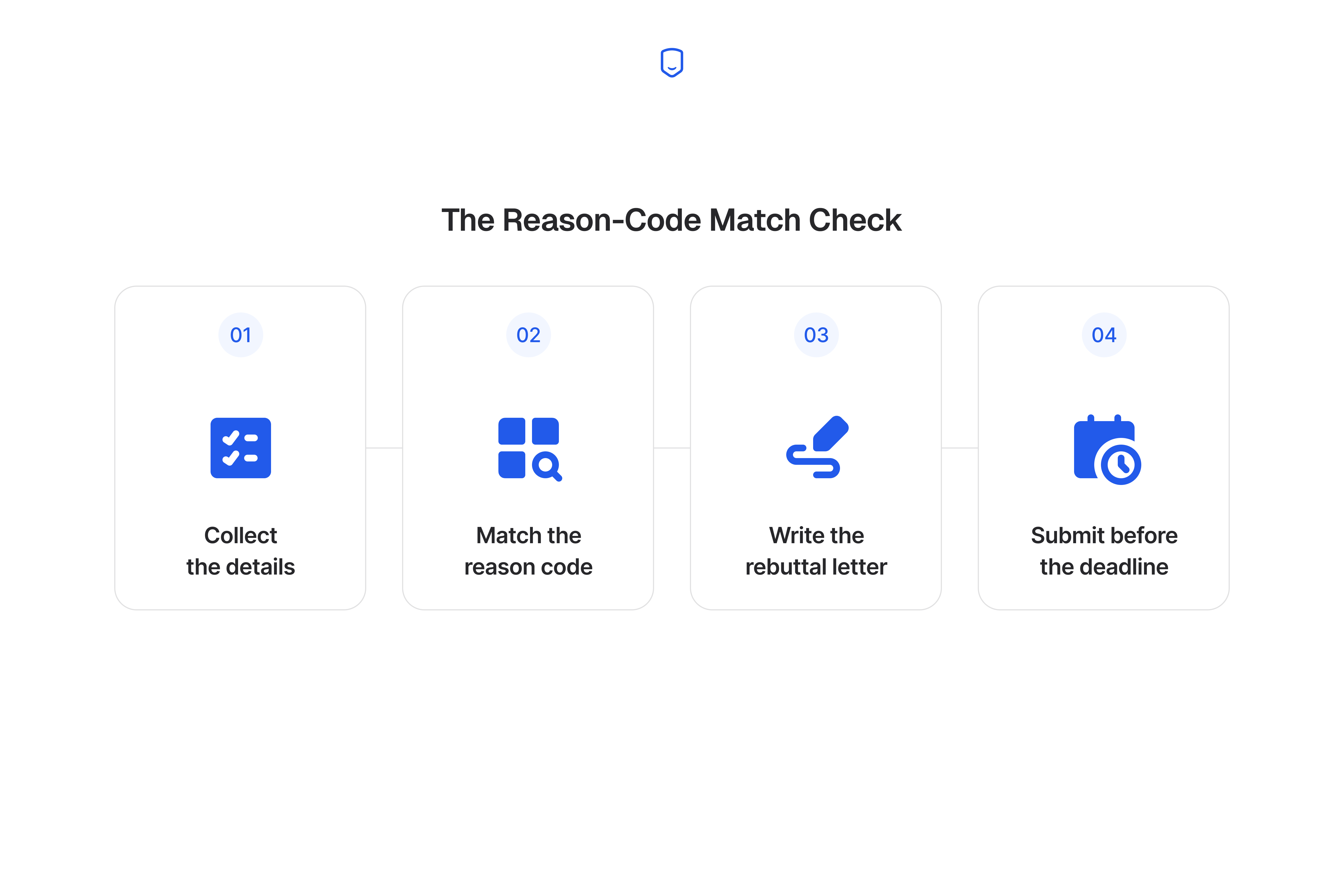
Call it the Reason-Code Match Check. Four steps get you from notice to submission:
- Collect the transaction record and every supporting document.
- Read the reason code and match your evidence to what it asks.
- Write a rebuttal letter that maps each document to each allegation.
- Submit inside the network's window, and your processor's.
The order matters, because each step feeds the next.
1. Collect all the details
Pull the transaction record, your delivery or service confirmation, and every message you exchanged with the customer. These documents are the pool that step 2 filters. Gather them now and you still have the full window for the work that decides the case. You also learn early whether the evidence you need exists at all.
Collect at minimum:
- The transaction record: date, amount, authorization code, AVS and CVV results.
- The order or subscription record showing what the customer bought.
- Proof of delivery or of service access, with timestamps.
- Every email, chat, or ticket exchanged with the customer.
- Your refund and cancellation policy as the customer saw it at checkout.
- The billing descriptor that appeared on their statement.
What matters next is whether each document answers the code.
2. Match your evidence to the reason code
The reason code names what the issuing bank needs answered, and proof that a valid sale happened rarely answers it. Every code sets its own evidence bar, and the bar is about type rather than quantity.
The first chargeback I fought, I sent everything I had and still lost. The packet was complete and it answered the wrong thing, because I'd read the customer's complaint instead of the code. Each network words its codes differently, and our guide to chargeback reason codes sets out what each one needs.
Look yours up in our reason code lookup before you start gathering evidence.
An issuer can also recode a dispute mid-process, and then the evidence you gathered no longer applies.
Re-read the notice at every stage instead of trusting the first code you saw.
3. Write a rebuttal letter
The rebuttal letter is the cover document that tells the acquirer which attached file answers which part of the reason code. Reviewers work a queue under time pressure. Name the allegation, name the document, and give the page where the proof sits.
Then the reviewer never has to guess, and clear packets beat merely complete ones.
Start from our rebuttal letter guide if you don't have a format yet. A letter only organizes the evidence you have, so capture the delivery proof first.
4. Submit before the stage deadline
Every card network sets its own merchant response window, and missing it forfeits the case whatever your evidence shows. The clocks also start on different triggers.
A cardholder's filing window usually runs from the purchase or delivery date. Your response window runs from the day you were notified. Your acquirer then adds a third clock, an internal cutoff that lands before the network's.
Here is how the four major networks compare:
| Card network | Cardholder filing window | Merchant response window | Deadline detail |
|---|---|---|---|
| Visa | 120 days | 30 days | Visa's chargeback deadlines |
| Mastercard | 120 days | 45 days | Mastercard's response deadlines |
| American Express | 120 days | 20 days | Amex's dispute windows |
| Discover | 120 days | 20 days | Discover's response window |
Treat your processor's cutoff as the real deadline.
Confirm that date with them in writing, because your response has to clear your processor first.
What evidence wins each type of dispute?
Every reason code belongs to one of four families, and each family accepts a different type of proof. The exact code decides the detail. The family tells you which records to pull first:
| Code family | What the bank is asking | Evidence that answers it |
|---|---|---|
| Fraud | Did the real cardholder authorize this? | AVS and CVV match results, the authorization record, device and IP data, prior undisputed orders on the same card |
| Product or service | Did the customer get what they paid for? | Delivery or access logs with timestamps, your product description and specs, photos, the terms shown at checkout |
| Processing error | Was the charge itself correct? | The settlement record, the authorization amount, currency and duplicate-charge checks, any correcting credit |
| Cancelled or recurring | Was this charge still authorized when it ran? | The cancellation policy the customer accepted, your cancellation log, the subscription terms and renewal notices |
Cross the families and you lose a winnable case. Delivery confirmation is strong evidence against a product-not-received code and answers nothing on a fraud code. There the bank is asking who tapped the card, not whether a box arrived.
One family is harder than it looks. A cancelled-recurring dispute turns on what the customer agreed to at signup, so a policy you changed since then proves nothing. You need the version they actually accepted.
What happens after you dispute a chargeback?
After you dispute, your case moves to representment, then a bank decision, and rarely to arbitration. Representment is your response's formal name.
You re-present the transaction with evidence attached, and our overview of the full chargeback process covers every stage. Most disputes get there, 73.6% per Datos data. Merchants answer 54.2% of those.
Fewer disputes survive each stage. Some clear because the bank shows the cardholder what they bought and they recognize it. Others clear because you credited the order first.
Here is where US disputes land, as a share of every dispute filed:
| Stage or outcome | Share of US disputes |
|---|---|
| Resolved by purchase-detail prompts or merchant credit | 8.3% |
| Written off by the cardholder's bank | 18.1% |
| Bank wins at the chargeback stage | 33.7% |
| Bank wins after the merchant represents | 29.9% |
| Merchant wins after representing | 8.1% |
| Advances to pre-arbitration or arbitration | 1.9% |
Source: Mastercard/Ethoca, Datos Insights, The Chargeback Window of Opportunity, March 2025 (US data).
Only 4.8% of represented cases reach arbitration, so the bank's decision on your evidence ends nearly every dispute.
These shares are US-only. Datos data show merchant win rates run lower everywhere else it looked:
- United Kingdom: 49.1%
- Australia: 46.7% (same Datos research)
- Brazil: 36.9%
Plan against your own market's number.
Is disputing a chargeback worth it?
US merchants report winning about 54% of the chargebacks they represent, per the same Datos survey. Fighting pays off in over half the cases they take on, but it still depends on how big the charge is. The average US chargeback runs $110, per that survey.
Merchants also write off 16% of what they receive as low-dollar cases not worth pursuing, the same Datos Insights survey found.
Work out your own break-even once. Divide the staff time a response takes by your hourly cost, then compare that to the charge amount. Anything below the line gets written off without a second look.
A case can be worth losing and still worth reading. Three disputes in one month all citing an unrecognized charge point at one of three causes:
- A billing descriptor the customer can't place.
- A delivery confirmation you never captured.
- A cancellation flow that sends people to their bank instead.
Match the disputes to whichever one they point at, then fix that before you fight another case.
The cheapest dispute is the one that never becomes a chargeback.
Our chargeback alerts reach you early enough to refund the customer before a chargeback hits your ratio.
What happens if you win, and what if you lose?
Winning returns the money and losing makes the debit permanent, but neither outcome always closes the case. The issuing bank tells your acquirer how it ruled, and the funds move to match.
A win is not always final. The cardholder's bank can come back with a second chargeback, sometimes called pre-arbitration, if it thinks your evidence missed the point. That path has its own deadlines, covered in our explainer on pre-arbitration chargebacks.
A loss usually ends things. Escalating past the bank's decision means arbitration, where the losing side pays the network's case fee on top of the disputed amount. For a $110 charge, the US average per Datos Insights data, that math almost never works.
Neither outcome erases the chargeback from your record. It counted against your chargeback ratio the moment it was filed. A win generally returns the revenue without clearing that count, so confirm how your processor reports won disputes.
That gap is the real argument for prevention. Ten disputes you win still read as ten disputes on the ratio your processor watches.
Tips to improve your odds of winning
Merchants raise their win rate by sending the right evidence type, submitting on time, making the charge recognizable, and capturing delivery proof. Those four failure modes cause most avoidable losses. Each tactic below names the thing to change:
- Print what the reason code requires, then collect against that list.
- Set a calendar reminder at half your response window, so a 20-day Amex window prompts you on day 10.
- Put your storefront name and a support number in the billing descriptor, using the format rules in our explainer on billing statement descriptors.
- Capture signed delivery confirmation above your average chargeback value, and log timestamped access events for digital goods.
- Store AVS and CVV results with every transaction record, because your gateway may purge them before a fraud-coded dispute arrives.
- Answer refund requests within one business day, because a fast reply usually gets you a refund request instead of a dispute.
I lowered my own chargeback rate before I ever won a dispute. The descriptor fix did more than any case I fought, because a charge nobody recognizes becomes a dispute.
FAQ
How to win a chargeback as a merchant?
You win by sending the exact evidence the reason code asks for, inside your response window. Read the code first, then build the packet to it.
Can you dispute a chargeback after the deadline has passed?
No. Your acquirer cannot reopen a closed response window on your behalf.
Do you need the customer's help to fight a chargeback?
No. The case runs between your acquirer and the cardholder's bank, and the customer plays no part in it once they file.
What happens to the money while the dispute is open?
The issuing bank takes the funds from you when the chargeback is filed, before any evidence is reviewed. Winning makes that debit reverse, so the money comes back only after the bank rules.