Chargeback Prevention: How Alert-Based Prevention Works

Chargeback prevention stops a dispute before it becomes a chargeback. It uses real-time alerts from Mastercard's Ethoca and Visa's Verifi. These alerts flag a transaction the moment a customer contacts their bank. The merchant can then refund it before the bank forces the reversal.
I've lowered my own chargeback rate before I ever touched a dispute, by fixing the descriptor and turning on alerts. The system pays you to fight disputes after the fact. But the cheapest chargeback is the one the customer never files.
This guide covers how alert-based prevention works, what it costs, and whether it's worth paying for. It sits above our types of chargebacks guide and the alert networks that guide organizes.
Key takeaways
What is chargeback prevention?
Chargeback prevention stops a dispute before it becomes a chargeback, most often through real-time alerts. An alert tells the merchant the moment a cardholder disputes a charge. A chargeback is a forced reversal, which the bank runs once a dispute escalates.
Prevention resolves the dispute earlier, while the merchant still controls the outcome.
These chargeback alerts come from two card-network services, Mastercard's Ethoca and Visa's Verifi, and you can enroll in either or both. Verifi runs the RDR and CDRN products.
Chargeback.io matches the alert to the original transaction in your payment processor. It then fires a refund before the bank's formal chargeback process starts.
This is a targeted refund set off by an alert. That's why refunds don't replace alerts, and the two work on different signals.
Alerts only cover disputes the cardholder routes through a participating bank and network. A dispute filed straight with the bank, outside that coverage, can still become a chargeback. So can a tokenized-wallet payment, which is harder to match back to the original sale. More on those gaps below.
How alert-based prevention works (Ethoca and Verifi)
Two companies operate the alert networks that make prevention possible, Mastercard's Ethoca and Visa's Verifi. They connect to different card networks, and each one works a little differently. The next two sections break down how.
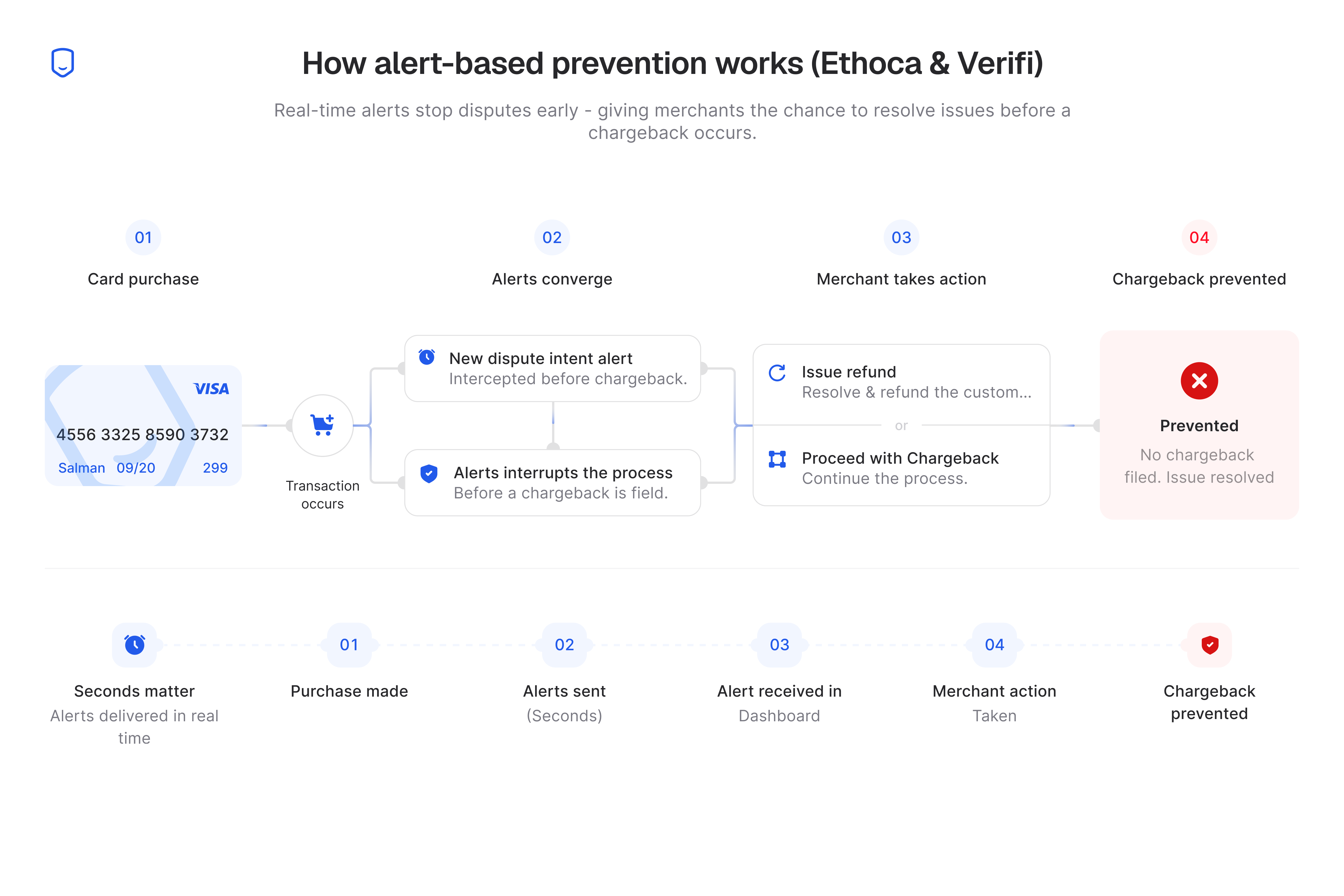
Whichever network sends it, the alert runs the same four-stage loop: 1. A dispute is triggered when the cardholder calls their bank. 2. The alert is received by your provider. 3. The transaction is matched to the original sale in your processor. 4. An auto-refund is issued.
Ethoca (Mastercard)
Ethoca is Mastercard's alert network, and it generates the single largest share of alerts we see. When a Mastercard cardholder disputes a charge with their bank, Ethoca passes that signal to the merchant. You can then resolve the transaction before it becomes a formal chargeback.
The value is in the timing. The alert reaches you in the short window between the cardholder's call and the bank's filing. You act while a refund still counts. Read how Ethoca works in full for the mechanics.
Ethoca also runs a second product, Ethoca Consumer Clarity, which sends clear purchase details to the cardholder's banking app. That helps a customer recognize a charge they might otherwise dispute. It stops the dispute one step earlier than an alert.
Verifi and its two products, RDR and CDRN (Visa)
Verifi is Visa's alert company, and it runs two products, RDR and CDRN, under one roof. How Verifi works comes down to those two products handling a Visa dispute in two different ways.
RDR resolves Visa disputes on its own, using rules you set in advance. It refunds at the acquirer level, so it fires without a case review.
CDRN routes the pre-dispute back to you to resolve. You clear it by hand, or on a rule once you connect a processor to Chargeback.io. It can carry non-Visa disputes too, and RDR only ever runs on rules.
Verifi also runs Order Insight, which shares transaction data with the bank. That heads off the dispute before an alert is ever needed.
Our Ethoca vs Verifi guide weighs the two companies side by side.
Which alert network covers the most disputes?
In our dataset, Verifi (Visa) covers the most disputes, with 57.9% of alerts against Ethoca's 42.1%. That 57.9% splits into RDR at 30.6% and CDRN at 27.3%.
Verifi’s RDR and CDRN together account for 57.9% of alerts in our dataset; no single product accounts for more than half.
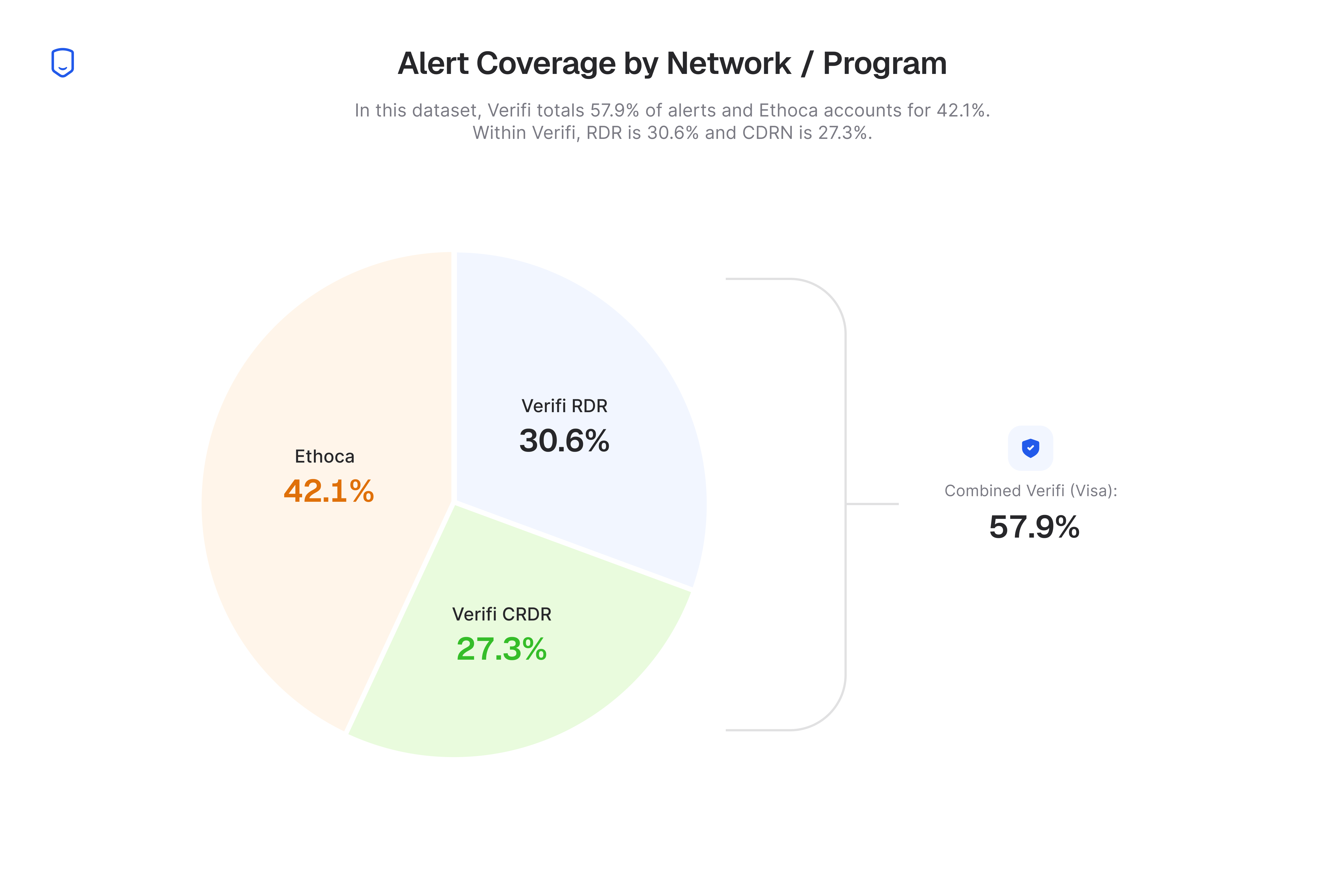
The split follows each merchant's card-brand mix. A Visa-heavy merchant sees more value from Verifi's RDR and CDRN. A Mastercard-heavy merchant leans on Ethoca. Your own transaction mix decides your real coverage, so read these platform-wide averages as a starting point.
To find your own mix, pull the card-brand breakdown from your processor dashboard. If Visa clears half your disputes, Verifi's two products protect the bigger share. Enrolling in Ethoca alone would leave most of your volume uncovered.
Card brands drive that split. Across the alerts our platform processed, Visa (50.5%) and Mastercard (37.6%) are the two dominant covered brands.
One caveat applies to these shares. Alert coverage is low for American Express, JCB in the US, and Discover. For other card brands it doesn't exist at all. A merchant with a heavy AmEx or Discover mix gets less protection than these numbers suggest.
To compare alert networks product by product, our RDR, CDRN, and Ethoca guide runs the full comparison.
Is chargeback prevention worth the cost?
Some resellers, like us, charge $29 per Ethoca alert and $15 per RDR or CDRN alert. Prevention costs a fraction of one uncontested chargeback. The alert price is small and fixed. A chargeback is neither.
Start with your processor's fees. On Stripe, a chargeback fee of $15 lands when a dispute arrives. Countering it costs another $15, refunded only if you win.
The bigger cost is a rising chargeback rate that climbs toward the network's threshold.
Cross it and you enter a chargeback monitoring program. Fines climb, and the worst case is losing your processor.
The Dropship.io case study shows the gap. After enrolling, it cut its dispute rate from 0.93% to 0.16% in one quarter. Its 1,764 alerts saved $26,460 to $52,920 in fees.
The same case study puts the labor savings at about 900 hours of work, roughly $20,000.
Tim's Coffee, a Shopify retailer, cut chargebacks by 89% in three months and avoided a Stripe shutdown. The Tim's Coffee case study shows how a threshold-based refund rule did it.
Prevention pays off most near a threshold, or when disputes eat staff time. At low volume, per-alert fees can outrun the chargebacks themselves.
Run your own numbers with our ROI calculator.
How to sign up for chargeback alerts
You reach alerts two ways. You either contract with Verifi and Ethoca directly, or enroll through an official partner that holds those relationships. The networks sit behind the card brands, so alerts aren't a product you buy off a shelf.
Going direct means contracting with each network yourself, then building the matching and refund logic on your side. Few merchants do this, since it fits a large enterprise with its own engineering team.
Most use a partner instead. Chargeback.io is an official partner of both Ethoca and Verifi, so one enrollment covers both networks. The partner runs the matching, refunds, and billing.
Enrollment turns on a few pieces of identity paperwork, and this is where setup stalls:
- Your exact billing descriptor, matched to the statement text character for character.
- Your BIN and CAID (or ARNs) plus descriptor for RDR, with the BIN and CAID from your payment processor's support.
- A release from your old provider, if a descriptor is enrolled elsewhere.
Expect a short wait before the first alert lands. RDR takes a few business days to activate, and any dispute filed before that date can't alert. In my support days, that lag drove most "it's broken" tickets in week one.
Once the paperwork clears, activation is quick. One Shopify retailer we work with went live in under 12 hours. American Express takes a separate Ethoca enrollment on request.
You can see current pricing and start enrollment from there.
Where American Express fits: ADR
American Express covers its own disputes through a separate program, Accelerated Dispute Resolution (ADR). Ethoca and Verifi barely touch AmEx, and ADR fills that gap. An AmEx-heavy merchant runs it on top of both.
ADR is a free, pre-chargeback alert for non-fraud disputes on US accounts. It gives you 8 days to resolve a dispute before it becomes a chargeback. The liability sits with Amex during that window.
You enroll for ADR with Amex directly, through your Online Merchant Profile. That makes it a separate step from your Ethoca and Verifi alerts.
A recommended alert stack
For the widest coverage, most merchants layer the networks in this order. The list runs from the brands behind most disputes down to the narrowest gaps:
- Ethoca and RDR first. Together they cover Mastercard and Visa, the two brands behind most disputes.
- CDRN next, only if RDR won't enroll. A shared BIN or missing BIN, CAID, or ARNs can block RDR, and CDRN is the Visa fallback for US transactions.
- Amex fraud coverage through your provider. Ask your provider to add it, since the networks above barely touch Amex.
- ADR for non-fraud Amex. Amex's free program covers the disputes fraud alerts don't, if you're eligible.
Start at the top and add each layer your volume justifies.
Chargeback prevention companies and services
Chargeback prevention companies split into two types that solve different problems. Alert-based services stop disputes already in motion. Fraud-detection tools block bad transactions before checkout. The two aren't interchangeable, and most merchants need both.
Alert-based prevention catches a dispute after the sale, whatever caused it. Fraud detection works earlier. It uses device fingerprinting and velocity checks to stop a suspect transaction before it goes through.
One acts before the purchase, the other after it, so covering only one side leaves the other exposed.
Picking the right prevention provider comes down to which gap is larger for you.
For alert-based tools, our chargeback prevention software roundup compares the main options.
On the fraud side, our prevention tactics guide covers the checkout fixes that stop disputes before any alert fires.
Checkout-side authentication is thinner than most merchants assume.
In our dataset, only 9.9% of the disputed transactions with a recorded 3D Secure status had 3DS on. Most disputed transactions had no authentication at all. That's exactly the gap alert-based prevention fills.
A real transaction can still turn into friendly fraud or a "didn't recognize the charge" dispute. Fraud detection can't stop that. Only an alert catches it, because the transaction looked clean when it was placed.
Chargeback prevention by platform and billing model
Setup is similar across platforms, but the dispute pattern differs by billing model. Subscription disputes cluster around renewals and cancellations in a way one-time purchases don't. Shopify and Stripe merchants integrate alerts directly.
Subscription and SaaS merchants face a different reason-code mix.
In our dataset, alerts with a recorded processor are mostly Stripe (80.9%) and Shopify (16.6%). The two largest reason codes are cancelled-recurring at 8.5% and cancelled-merchandise at 8.2%. That's why subscription billing shows up as its own pattern.
Before you read your own numbers, check the average chargeback rate for your category.
Dropship.io's disputes followed this exact shape. They clustered at trial-to-paid conversion and renewal, driven by "believed cancelled" and unrecognized-charge disputes. RDR and CDRN alerts resolved them before they became chargebacks.
The timing is predictable, which helps. Subscription disputes spike on the first charge after a free trial and on each renewal date. Watch those days, because that's when an alert is most likely to land.
For setup detail, use the guide that matches your platform: - Shopify chargeback protection for Shopify stores. - Stripe chargeback protection for Stripe merchants. - Subscription chargeback prevention for recurring billing.
Your platform changes which reason codes and timing you should expect. The networks you enroll in still follow your card mix, so let the transaction data drive that call.
What alert-based prevention can't catch
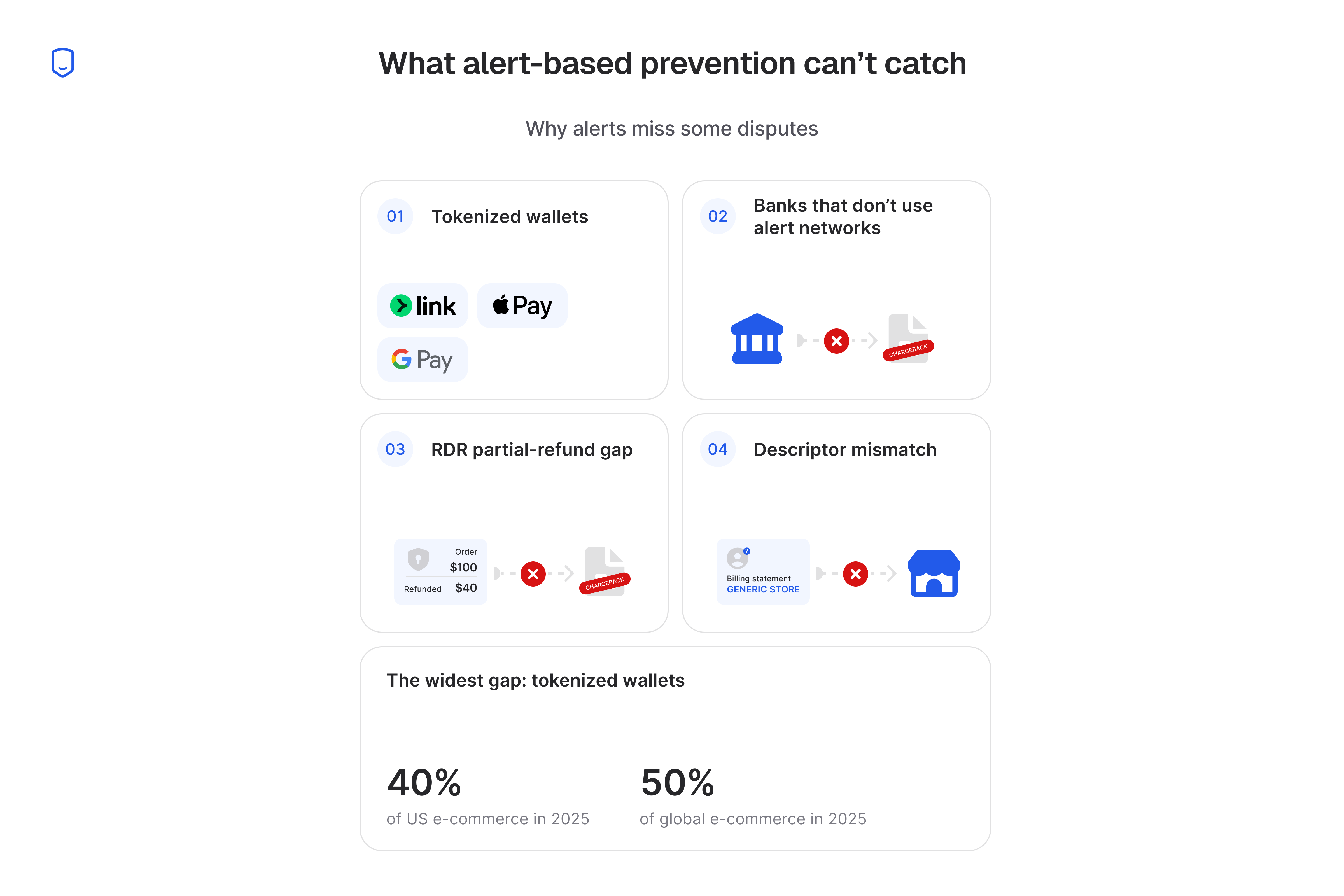
Alerts miss disputes that never reach a participating bank or network. A few transactions still become chargebacks even with prevention turned on. An honest cost decision accounts for the gaps.
Tokenized wallet payments are the widest gap. Stripe Link, Apple Pay, and Google Pay are harder to match back to the original alert. Their share of sales keeps rising too. Digital wallets ran 40% of US e-commerce in 2025, and 56% globally.
The gap widens as more sales move through them.
Beyond wallets, some banks skip alert networks and file disputes directly. RDR also can't cover a transaction that's already been partly refunded.
Tokenized wallets, bank filing issues, and the RDR partial-refund gap were the three limits Dropship.io's case study ran into. Its dispute rate still settled at 0.27% after full enrollment.
There's also a quieter failure that has nothing to do with coverage. When I worked in customer support, most alerts that missed a transaction failed for one reason. The merchant's billing descriptor was too generic, so the alert matched the wrong merchant and the chargeback slipped through.
The fix is upstream of any alert. A clear billing descriptor stops the "didn't recognize the charge" dispute before it starts. It also makes the alerts you pay for match the right transaction.
Our friendly fraud prevention guide works the same upstream angle.
How we sourced our data
These figures come from anonymized, aggregated data across merchants on the Chargeback.io platform, not an industry-wide survey. The population is our own merchants, and the unit is alerts received. Every share reflects how disputes land on our platform, not across the payments industry.
We count the total alerts in each category, like network, card brand, and reason code. That count becomes a share of the labeled records. We drop blank or unlabeled entries from the base first, so every figure reflects a recorded value for that dimension.
One limit is worth stating plainly. Alert coverage is thin outside Visa and Mastercard, so our card-brand shares understate the disputes on other networks. Your own exposure on those brands probably runs higher than our numbers show.
FAQ
What is a chargeback protection service?
A chargeback protection service reduces a merchant's chargebacks, usually by pairing dispute alerts with refund automation and fraud screening. Some providers also promise to reimburse losses on cleared transactions, though the terms vary widely.
Do companies actually hate getting chargebacks?
Yes, because a chargeback costs far more than the sale once you add up fees, lost product, and staff time. A rising rate also risks a monitoring program and the loss of your processor, which merchants fear most.
Can I use more than one alert network at the same time?
Yes, and most merchants do, since Ethoca and Verifi cover different card networks and running both widens your coverage. Enrolling in one alone leaves every dispute on the other network uncaught.
Does prevention stop friendly fraud or only real fraud?
Alerts catch both, because they trigger on any dispute a cardholder files, genuine fraud or friendly fraud alike. That's their main advantage over fraud-detection tools, which only screen suspect transactions at checkout.