What Is Ethoca Consumer Clarity?


Ethoca Consumer Clarity is a Mastercard product that shows cardholders clear details about a purchase, like the merchant's real name, logo, and receipt, inside their bank's app. The point is recognition. A cardholder who sees what they bought is less likely to dispute the charge as unfamiliar.
It's separate from Ethoca Alerts, which warn merchants after a dispute has already started.
I've disputed chargebacks and fixed billing descriptors on my own stores, and the first thing I check on any chargeback problem is the billing descriptor. That did more than any alert ever did, because a charge nobody recognizes is a chargeback waiting to happen.
Consumer Clarity handles that same problem from the bank's side.
Key takeaways
What is Ethoca Consumer Clarity?
Ethoca Consumer Clarity is a Mastercard product that shows cardholders recognizable transaction details in their bank's app, so they know a purchase before disputing it as unfamiliar.
The same detail reaches the issuer's call-center staff. Ethoca is Mastercard's company, so Consumer Clarity runs on the Mastercard network.
One limit is worth knowing. Consumer Clarity runs on Ethoca's network, which is Mastercard-first, so Visa charges fall outside it. Visa handles those through its own tool, Order Insight.
What information does Consumer Clarity share?
It shares the details a cardholder needs to place a charge: the merchant's real name, logo, and an itemized receipt of what they bought. These are the exact fields that go missing when a bank statement shows only a cryptic descriptor.
The descriptor is usually the problem. A charge that reads "SP* HLDNGS LLC" tells the cardholder nothing, so they flag it. The same charge shown as your store name, your logo, and a line-item receipt reads as the purchase they remember.
That detail reaches two places: the cardholder in their banking app, and the issuer's call-center agent who picks up when the cardholder calls to ask about the charge.
How does Consumer Clarity work?
The purchase detail travels from your transaction record to the cardholder's bank, which displays it wherever the cardholder or the bank's staff would question the charge. No step asks you to do anything once you're enrolled.
The path is short. Your transaction record holds the detail, and Ethoca passes it to the bank that issued the card. The bank shows it in the cardholder's app and surfaces it to the agents who field "I don't recognize this charge" calls.
A cardholder who sees the store's real name and a receipt reads the charge as legitimate, so the dispute that was about to start never does.
Does Consumer Clarity prevent chargebacks?
It prevents the specific chargebacks that start when a cardholder doesn't recognize a real charge, though Mastercard publishes no figure for how many. It does nothing for disputes that are genuinely fraudulent or filed in bad faith.
Most unrecognized-charge disputes are friendly fraud, where a real customer disputes a charge they actually made. Sometimes that's deliberate. More often the cardholder doesn't recognize the descriptor and assumes fraud.
Consumer Clarity targets the honest-confusion half. When the customer sees the store name and a receipt in their banking app, the charge they were about to report becomes one they remember making.
A cardholder disputing in bad faith will still go ahead, so treat Consumer Clarity as a fix for confusion, not a shield against every chargeback. To narrow the confusion cases before they ever reach the bank app, fix the billing descriptor so it names your store on the statement in the first place.
Other benefits for merchants
Beyond stopping confusion disputes, Consumer Clarity cuts the "what is this charge?" calls that reach your issuer's support line and never require any action from you. The same detail that shows in the app also reaches call-center agents, so an agent can place the charge on the spot instead of routing the cardholder toward a dispute.
Because the bank does the showing, enrollment is the whole job. You supply your billing descriptor once, and the display runs on every covered transaction after that.
Ethoca Consumer Clarity vs. Ethoca Alerts
Consumer Clarity shares purchase detail before a dispute to prevent confusion, while Ethoca Alerts notify the merchant after a cardholder has already started one. Same company, two jobs, opposite ends of the dispute timeline.
Clarity relies on recognition. It shows the cardholder what they bought, so once you're enrolled it needs no action from you.
Ethoca Alerts rely on notification. They tell you a dispute is happening. Your provider then matches the transaction and triggers your refund rule to resolve it in time.
That matching step has its own mechanics. The amount, date, and descriptor all have to line up before the alert can act. Our guide to how chargeback alerts work walks through where that breaks.
The demand on you differs too. Clarity asks nothing after enrollment, since the bank does the showing. An alert asks for a decision on the clock. Manual review windows on Ethoca Alerts run 24-72 hours, as the same guide above covers, and a refund only helps if it lands inside that window.
The two tools work together.
A merchant who runs only Ethoca Alerts still gains from Clarity, because Clarity can stop the dispute from being filed at all. Run both, and you catch confusion early while keeping a refund window for the disputes that slip through.
Ethoca Consumer Clarity vs. Visa Order Insight
Consumer Clarity shows detail to the cardholder in their bank app on Mastercard, while Visa's Order Insight shares that detail with the issuer's dispute system on Visa. They chase the same goal, cardholder confusion over a real charge, on two networks.
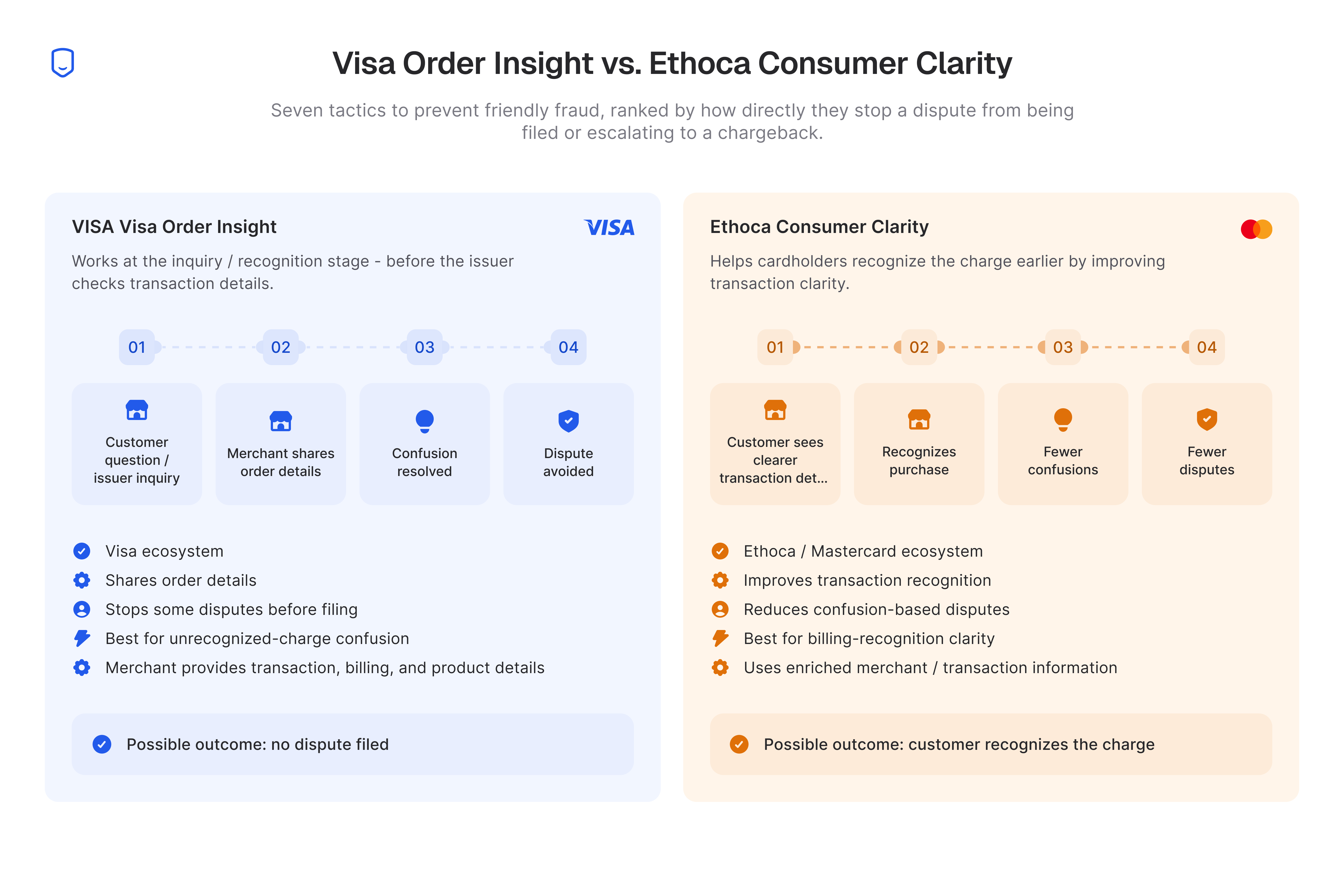
The networks are why one can't stand in for the other. Consumer Clarity works on Mastercard transactions, and Order Insight works on Visa's.
A merchant taking both card brands needs both tools.
If your sales skew heavily to one network, that's where the confusion disputes cluster. Start there, and add the other once the first is running.
These two look like the same product on two networks. The real difference is where the detail lands.
Consumer Clarity puts it straight in front of the cardholder in their bank app. Verifi built Order Insight for Visa, and it sends the detail to the issuer's side of the inquiry. Treat them as parallel tools for one shared goal, reaching different people.
FAQ
Is Ethoca owned by Mastercard?
Yes. Mastercard acquired Ethoca in 2019, and the company now operates as Ethoca by Mastercard.
Does Consumer Clarity cost anything for merchants?
There may be a cost, but Mastercard doesn't publish a public price. What you pay depends on the alert provider you enroll through, so ask them directly.
Do I need both Consumer Clarity and Ethoca Alerts?
Run both if you can, since they cover different stages. Ask your provider which ones your account already includes.
What is the difference between Verifi and Ethoca?
They belong to rival card networks. Ethoca is Mastercard's, and Verifi is Visa's, and each runs the dispute-prevention tools for its own network.