
















Braintree Chargebacks: Fees, Timelines, and Prevention
Braintree chargebacks carry fees and case-specific response deadlines, so matching evidence to the reason code and fixing descriptor and prevention gaps protects both revenue and account standing.
Braintree chargebacks are forced reversals a customer’s bank files against a transaction you already settled. Braintree charges $15 for one, plus another $5 when the customer disputes the charge as unauthorized. Neither fee comes back if you win.
When a merchant brings me a chargeback problem, the first thing I ask is what the customer saw on their statement. Fixing that one line of text on my own stores saved me more money than any dispute I ever won.
It matters twice as much here. According to Braintree’s own fee documentation, it takes the $15 the moment the case opens. Learn what a dispute costs and what evidence Braintree wants, and the accept-or-fight call takes two minutes.
What happens when you get a Braintree chargeback?
A Braintree chargeback is a reversal your customer’s bank files against a transaction you already settled. Depending on your banking partner, the disputed funds are either debited immediately or held while the case is decided. Braintree notifies you so you can accept or dispute the chargeback.
A refund request comes from the customer to you, and you decide it. A chargeback comes from the bank, and it moves the money before you get a say.
Merchants get confused about where the notice comes from, because PayPal owns Braintree. For PayPal cases, Braintree’s Control Panel needs a full PayPal integration, linked accounts, and PayPal disputes enabled. You can also use PayPal’s Resolution Center.
But a PayPal-funded checkout can raise its own dispute, in a separate system.
One kind of dispute may never reach you at all.
A pre-arbitration is a second-round dispute, filed after someone already decided the case once. On flat-rate US accounts, Braintree accepts these under $1,000 for you as of August 27, 2025. Anything above that still comes to you.
What does a Braintree chargeback cost?
According to Braintree’s fee schedule, it charges a flat $15 per chargeback and a separate $5 for unauthorized disputes. You pay both whether you win or lose.
The two are separate line items, and an unauthorized dispute triggers both at once, so that chargeback costs $20 before anyone reads your evidence.
Braintree also sells two add-ons that pay back the sale amount on disputes they cover. According to Braintree’s fee pages, Chargeback Protection starts at 0.4% per transaction and Effortless Chargeback Protection starts at 0.6%.
Read the fine print, though. Each covers only certain dispute types, neither waives the fees, and outside that coverage you pay the same per-case charges.
How long do you have to respond to a Braintree chargeback?
Braintree publishes no fixed deadline, so the window comes from the card network and arrives with the case. Read the date in your Control Panel, because every case carries its own.
Miss it and the dispute goes to the network with none of your evidence attached. That’s a loss.
Flat-rate US accounts get one exception. According to Braintree’s own dispute overview, the pre-arbitrations under $1,000 that it auto-accepts open no window at all.
Should you accept or dispute a Braintree chargeback?
Braintree’s own guidance frames it this way. Accept when the amount is too small to justify the evidence work or the transaction was fraudulent. Dispute when your evidence fits the case.
You pay the flat fee whichever way you go, so keep it out of the comparison. What you’re weighing is the sale amount against the time to pull records, check the address, and write the response.
Say a $22 subscription charge comes back as unauthorized. The $15 fee and the $5 unauthorized fee take $20 of that $22. An hour of digging up evidence costs more than you could get back.
The size of the order matters more than how strong your evidence is. Spend that same hour on a $900 order with signed delivery proof and a matching AVS response. You get far more back.
What counts as strong evidence for a Braintree dispute?
Braintree requires at least one document from a defined set for fraud and merchandise-not-received disputes. Its guidance asks for proof the customer has the goods, a signed delivery form or ID copy, and delivery to an AVS-matched address.
The right document wins the case. The bank names one specific reason when it files, so your packet has to answer that reason.
A file that would win a fraud dispute loses if the bank filed a different type.
The card networks assign those reasons. Our chargeback reason codes guide walks through what each code asks you to prove.
You can also look your code up in our reason-code lookup tool.
Unauthorized claims are where merchants get this wrong most often. That code asks one thing, whether the cardholder agreed to the charge. Send the signed authorization or the AVS match.
How does a Braintree chargeback affect your account?
Cross a card brand’s threshold and you pay monthly fines and face an account review. Braintree’s Disputes team watches accounts and flags you if a card brand does.
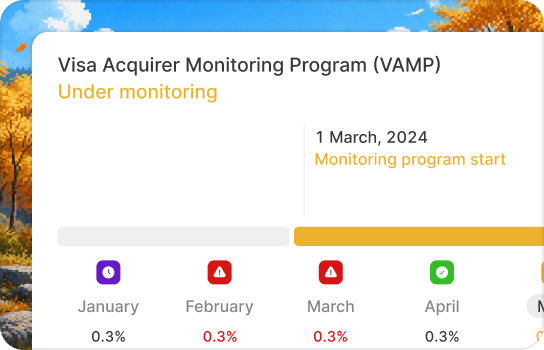
The calculation depends on the card brand. Mastercard ECP divides chargebacks received this month by sales processed last month. Visa VAMP divides that month’s fraud reports and disputes, after applicable exclusions, by that month’s settled Visa transactions. Pre-arbitrations and retrievals do not count as first chargebacks.
Our guide to your chargeback rate covers how to track it.
Each brand sets its own numbers. Mastercard’s Excessive Chargeback Program sets the two tiers you can land in. You’re an Excessive Chargeback Merchant at 100 to 299 chargebacks and a ratio of 1.50% to 2.99%. The High Excessive tier starts at 300 chargebacks and a 3.00% ratio.
From month 4 in HECM, an additional Issuer Recovery Assessment of $5 per chargeback above 300 can apply.
According to Mastercard’s Excessive Chargeback Program schedule, the longer you stay in either tier, the more it charges you each month. The fines escalate to $100,000 on ECM and up to $200,000 on HECM by month 19:
Getting out takes longer than getting in. Mastercard wants you under the thresholds for 3 months, while Visa needs one month of compliance. Visa runs its own program too, the Visa Acquirer Monitoring Program (VAMP).
Our breakdown of how Mastercard monitors chargebacks covers what the review asks you to document.
How to prevent Braintree chargebacks
Write the descriptor as the storefront name your customers know, then connect dispute alerts so you hear before a case opens. The 2-question Braintree dispute check asks both before a dispute exists:
- Fix the billing descriptor so customers recognize the charge.
- Add dispute alerts so you hear before the chargeback files.
A bad descriptor creates the complaints alerts then charge you to catch, so step one shrinks the volume step two has to handle.
1. Fix your billing descriptor first
A descriptor a customer can’t place turns a real charge into a fraud claim. Your customer reads one line on a statement weeks after buying, and if the name means nothing, they call the bank.
Three steps set it up:
- Open the Business page in your Braintree Control Panel to edit your account’s descriptors if you’re in the US, Europe, or Australia. In other regions, contact Braintree for help.
- Write the descriptor as the name customers know you by.
- Add a phone number or your site’s URL in the descriptor’s phone field.
That phone field is what makes a confused customer call you instead of their bank.
Then buy something from your own store and read the charge on your own statement.
Our guide to your billing descriptor covers the character limits and formats each processor allows.
In the support tickets I worked, a mismatched descriptor kept turning out to be the real problem behind merchants who thought their tools had failed.
2. Layer on dispute alerts before the chargeback stage
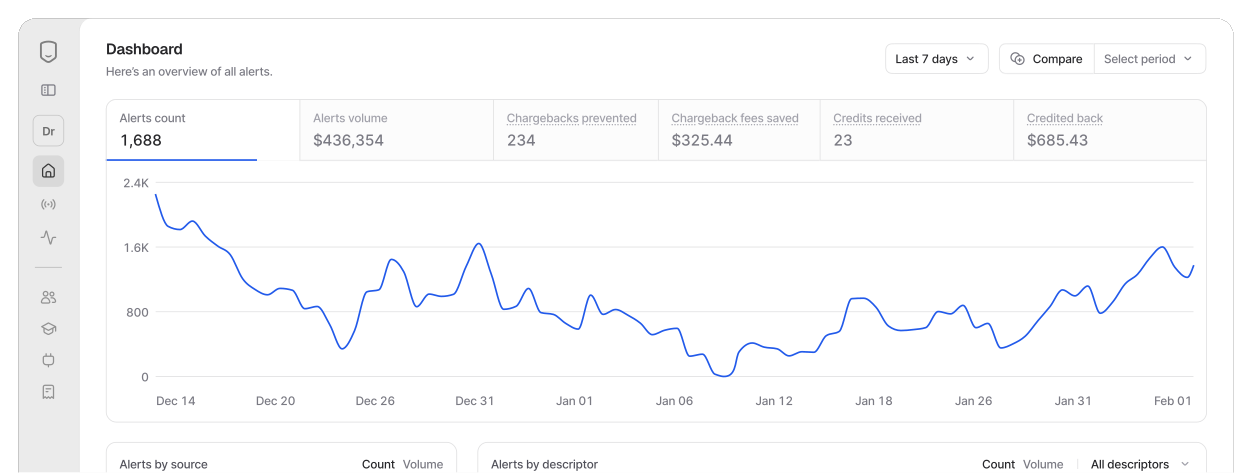
Alerts reach you while the dispute is still with the customer’s bank, before Braintree opens a case and the fee applies. Ethoca and Verifi send those notices for Mastercard and Visa. Refund inside the alert window and the complaint closes without a chargeback.
Timing is the whole point. Once the case shows up in your Control Panel you’re back to accepting or disputing. An alert reaches you early enough for a refund to end it.
We pull alerts from Ethoca, RDR, and CDRN, and can refund a flagged charge automatically before it becomes a chargeback.
See our Braintree integration to connect it to the account you run.
Does Braintree’s PayPal ownership change how disputes work?
A card charge through Braintree follows Braintree’s dispute rules and the fees above, while a PayPal-funded payment goes through PayPal’s buyer-protection process. One company owns both, but the two disputes travel separate paths.
A card charge answers to Visa or Mastercard, whoever owns the processor. A PayPal buyer-protection claim settles inside PayPal, between the company and its own account holders.
Sell through a Braintree card checkout and a PayPal button both, and disputes come from either one, each with its own rules and fees.
Track them as two numbers, because a combined figure tells you nothing useful.
FAQ
How do I win a Braintree dispute?
Send the document the cited reason code asks for, and leave out the rest. Braintree wants at least one qualifying document per dispute type, so the match decides the case rather than the volume.
Does Braintree refund the chargeback fee if you win?
No. Both fees bill when the case opens, and the outcome never reverses them.
Braintree chargeback vs. retrieval request
A chargeback disputes the payment and can remove or hold the funds, while a retrieval request asks for transaction information without moving money. Retrieval is optional. Braintree says Visa and Mastercard have deprecated this stage, and merchants do not need to respond to any Visa or Mastercard retrievals US issuers still send.
Can you use Braintree with a high chargeback ratio?
Braintree looks at your chargeback history when it underwrites you. A ratio above the card brand thresholds can get you declined, put on a rolling reserve, or charged a higher rate.