Chargeblast vs Chargeback.io: pricing and features

Chargeblast vs Chargeback.io (we) comes down to price, support, and what the dashboard hands you. Both vendors resell the same Ethoca and Verifi alerts. Neither one sees a dispute the other misses, so coverage is a tie by design.
Our alert pricing starts at $15, and you pay only for the alerts that stop a chargeback. Chargeblast's own site puts its rate at $19 either way.
On my own stores, the billing model decided whether alert tooling paid for itself. I wanted my invoice to count the alerts that saved me money.
The table below has the numbers, so you can pick between the two without a sales call.
Key takeaways
- Both vendors resell the same Ethoca and Verifi alerts, so coverage is identical.
- Compare $15 per alert with us against $19 at Chargeblast.
- Pay only for the alerts that prevent a dispute.
- Enroll in about 12 hours with us for Ethoca and CDRN, against roughly 24 at Chargeblast.
- Merchants rate us 4.9 out of 5 across reviews.
Comparing per-alert cost right now? See what pay-per-successful-alert coverage costs against your own dispute volume.
What does Chargeblast do, and is it good?
Chargeblast takes Ethoca and Verifi dispute alerts and refunds the transaction before it becomes a chargeback, and merchants rate it 4.5 out of 5 on Trustpilot. Trustpilot labels that score "Excellent."
We work the same way. Across the merchants we protect, we prevent up to 91% of chargebacks.
Here's the part most comparison pages skip. Ethoca and Verifi own the alert programs, and both of us resell the same feeds. Neither vendor can widen your coverage or reach a dispute the other one can't.
Mastercard disputes arrive through Ethoca alerts. Visa disputes arrive on a separate enrollment.
So a 4.5 average tells you Chargeblast works. It can't tell you which reseller to buy from, because the thing being resold is the same on both sides.
That pushes the whole decision onto execution. Six things differ, and you can check every one before you sign:
- Price per alert: what the reseller adds on top of the network fee
- Billing model: whether you pay for alerts that fire or alerts that work
- Features: what the platform does with an alert once it lands
- Integrations: whether the refund runs on your processor without you
- Support: who answers when an alert misses, and how fast
- Enrollment speed: how many days you spend unprotected
I've spent enough time on descriptor and matching problems to trust those six over any review score.
Summary: Both vendors resell the same alerts, so price, features, support, and speed decide it.
How does Chargeback.io compare to Chargeblast?
We charge from $15 per successful alert, against Chargeblast's $19 per alert whatever the outcome. According to Chargeblast's own pricing page and ours, those are each vendor's published floors. We also enroll you in about half the time.
The two line up like this:
| Feature | Chargeback.io | Chargeblast |
|---|---|---|
| Alert cost | From $15 | From $19 |
| Payment model | Pay for successful alerts | Pay per alert |
| Alert networks | Ethoca and Verifi | Ethoca and Verifi |
| Duplicate alert handling | Automated duplicate prevention | Manual credit requests |
| Refund automation | All connected processors | Varies by processor |
| Alert data shown | Full detail on every alert | Limited alert metadata |
| Enrollment time | From 12 hours | From 24 hours |
| Official Ethoca and Verifi partner | Yes | Not stated |
| Merchant rating | 4.9 out of 5, 88 reviews | 4.5 out of 5, Trustpilot |
Price the difference against your own numbers, using the rates from the table above.
Say you had ten alerts last month. Multiply that count by $19, then multiply the ones that worked by $15. Both figures are published floors, so use your own quoted rates. At those floors, the gap on ten alerts works out to $40.
Duplicates widen it, because Chargeblast credits them only when you request each one. We catch duplicates automatically, so one dispute arriving on two networks bills once.
The billing model matters most when your alert quality is uneven. An alert on a charge you already refunded still costs $19 under pay-per-alert. Under pay-for-success, it costs nothing.
Summary: We're cheaper per alert, faster to enroll, and only bill when an alert works.
Check your own bill against pay-per-successful-alert coverage.
Which platform does more with an alert?
We ship an MCP server, full alert-level data, and eleven processor integrations. That's where a same-network reseller can actually differ. Chargeblast runs a self-serve dashboard with limited alert metadata.
Three of our features have no published equivalent on their side:
- An MCP server: Connect Claude or another AI client to your own alert data, then ask in plain language which descriptors draw the most disputes.
- Business Health, our dispute-source view: See where your chargebacks come from so you can take action to prevent them.
- Full alert transparency: Every alert shows its network, its matched transaction, its status, and its fee.
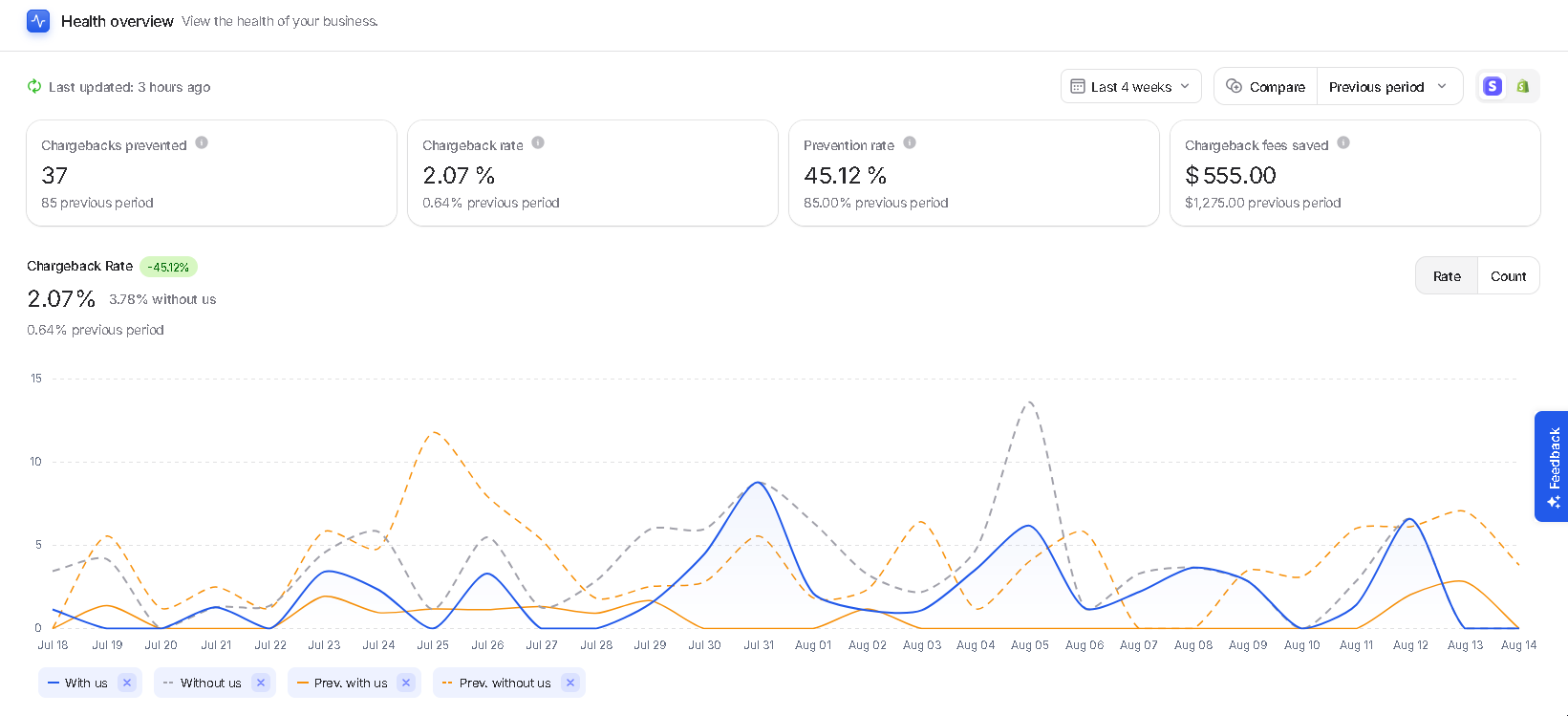
That third one earns its place. Merchants billed for more alerts than their processor dashboard shows will recognize why.
Summary: Our MCP server and alert-level transparency are what a same-network reseller competes on.
Which one connects to your processor?
We connect to eleven processors and subscription tools, and refunds fire automatically on every live one. Chargeblast automates refunds processor by processor.
Seven run live today, starting with Stripe, then Shopify Payments, Airwallex, Braintree, Authorize.net, NMI, and Next Commerce. Chargebee, Recurly, and Slack are in build. A manual-refund path covers processors we haven't reached yet.
That list is the practical test of any alert vendor. An alert names one transaction, and the vendor has to reach it to refund in time.
A vendor that can't reach your processor leaves you refunding by hand inside a 24-hour window. Miss the window and the alert turns into the chargeback it warned you about.
Set your auto-refund threshold above your average order value on day one. The threshold caps what refunds automatically, so a low setting quietly leaves almost every alert for you to handle.
Summary: Eleven live integrations mean the refund runs without you on the processor you already use.
How does support compare?
Merchants rate us 4.9 out of 5 on the Shopify App Store, and 94% of them give five stars. We answer over email, chat, and video, around the clock.
Those reviews are specific rather than generic. Merchants name the rep who helped them, and they keep naming response times in minutes. One had an integration problem fixed two minutes after asking.
Support decides three concrete things in an alerts business:
- Whether a missed alert gets escalated to Ethoca or Verifi
- Whether your BIN and CAID enrollment clears in hours or stalls for a week
- Whether someone catches a bad refund threshold before it costs you
I worked those tickets. Billing descriptors came up in over 600 support conversations in a single year, more than any other topic I handled.
Every one of them turned on a fast, specific answer. That was the difference between a prevented dispute and a chargeback.
Chargeblast's Trustpilot reviews are genuinely positive too, so this isn't one vendor having support and the other not. The gap shows up in the detail.
Our reviews keep naming speed, and nine in ten of them give five stars.

Summary: Our 4.9 rating across 88 reviews turns on support speed, which is what a missed alert costs.
How fast can you switch?
Enrollment with us runs from about 12 hours, against roughly 24 at Chargeblast. Switching means re-enrolling with the networks rather than rebuilding anything. Nothing in your checkout or processor setup changes.
Your old alerts keep firing until the new ones start. Run both for a few days, watch the same disputes arrive on each, then cancel the first contract.
One detail catches most migrations. Your previous provider has to release your descriptor before we can enroll it, so open that request on day one. Merchants who skip it think they've unenrolled and sit unprotected for a week.
Price either vendor against your own volume first. Our chargeback ROI calculator runs the math on your dispute count and processor fee.
Want a broader vendor list?
We compare more Chargeblast alternatives across prevention and recovery.
Summary: Switching is a network re-enrollment, and the old alerts run until the new ones start.
FAQ
Is switching from Chargeblast to Chargeback.io difficult?
No, enrollment takes about 12 hours and nothing in your checkout has to change. Ask your current provider to release your descriptor first, because that step gates the rest.
Does Chargeback.io cover the same networks?
Yes, both vendors resell Ethoca and Verifi alerts, so coverage is identical. We also hold official partner status with both networks.
Which is cheaper, Chargeback.io or Chargeblast?
According to Chargeblast's published rates and ours, we start at $15 per successful alert against their $19 per alert regardless of outcome. The gap widens on duplicates and on alerts for charges you'd already refunded.
Is Chargeblast worth it against Chargeback.io?
Chargeblast is a working alert vendor with real positive reviews, so it's a legitimate option. We win on cost, billing model, integrations, support speed, and enrollment time.